Home
Home PG College
 Patient Login
 Sancheti Clinic
 Contact Us
 Download Reports
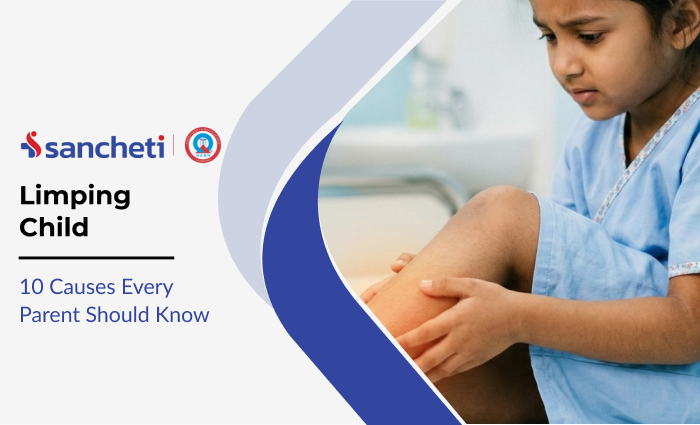

Limping Child: 10 Causes Every Parent Should Know
If your child has suddenly started limping or complaining of leg pain, it can be unsettling. A limping child is one of the most common reasons parents seek orthopaedic care, and the causes range from minor to serious.
While some cases resolve on their own, others require prompt medical attention. At Sancheti Hospital, Pune’s leading orthopaedic centre, our paediatric specialists evaluate children every day for this concern.
Why Is My Child Limping? Understanding Paediatric Limp
A limp in a child is never completely normal. It is usually a sign that something is causing pain, weakness, or structural imbalance in the legs, hips, knees, or feet. Identifying the cause depends on the child’s age, duration of symptoms, whether there is fever, and the location of pain. Here are the ten most important causes parents should be aware of.
10 Common Causes of Limping in Children
1. Toxic Synovitis (Transient Synovitis)
Toxic synovitis is the most frequent cause of sudden hip pain and limping in children between the ages of 3 and 10. It involves temporary inflammation of the hip joint lining, usually following a viral infection. Children typically refuse to bear full weight and hold the hip in a flexed, outward position. The good news: it usually resolves within 1–2 weeks with rest and anti-inflammatory medication. However, it must always be distinguished from septic arthritis, which requires urgent treatment.
2. Septic Arthritis (Joint Infection)
Unlike toxic synovitis, septic arthritis is a bacterial infection of the joint and is a medical emergency. The child presents with high fever, severe joint pain, and complete refusal to move the affected limb. It most commonly affects the hip or knee. Prompt surgical drainage and intravenous antibiotics are necessary to prevent permanent joint damage. If your child has a limp with high fever, visit an orthopaedic specialist immediately.
3. Perthes Disease (Legg-Calvé-Perthes Disease)
Perthes disease occurs when blood supply to the femoral head is temporarily disrupted, causing the bone to break down and reshape over time. It typically affects boys aged 4–10 and presents as a painless or mildly painful limp. Early diagnosis with X-ray or MRI is essential. Treatment ranges from physiotherapy to surgical intervention depending on severity.
4. Developmental Dysplasia of the Hip (DDH)
DDH is a condition where the hip socket does not fully cover the ball of the hip joint. If undetected in infancy, it can cause a visible limp as the child begins to walk. A waddling gait or asymmetric skin folds in a toddler are warning signs. At Sancheti Hospital, our paediatric orthopaedic team is experienced in both early detection and surgical correction of DDH.
5. Growing Pains
Growing pains are among the most common causes of leg pain in kids, typically affecting children between 3 and 12 years. The pain is usually felt in the thighs, calves, or behind the knees — most often at night — and does not cause a limp during the day. While generally benign, persistent or daytime pain should be evaluated to rule out more serious conditions.
6. Osgood-Schlatter Disease
This condition affects active, growing adolescents — particularly those involved in running or jumping sports. It causes pain and swelling just below the kneecap where the patellar tendon attaches. The child may limp during or after physical activity. Rest, stretching, and physiotherapy usually resolve symptoms over several months.
7. Slipped Capital Femoral Epiphysis (SCFE)
SCFE occurs when the growth plate at the top of the thigh bone slips out of position. It is more common in overweight adolescents and presents as hip or knee pain with an out-toeing gait. This is a surgical emergency — delayed treatment can lead to permanent deformity. If your teenager limps and complains of groin or knee pain, seek immediate orthopaedic evaluation.
8. Fractures and Bone Injuries
A sudden limp following a fall or physical activity often points to a fracture. Children’s bones are more flexible than adults’, making incomplete (greenstick) fractures common. Even when swelling or bruising is minimal, a child who refuses to bear weight after a fall should have an X-ray. Toddler’s fractures — spiral fractures of the tibia from minor twisting — are a typical presentation in children under 3.
9. Juvenile Idiopathic Arthritis (JIA)
JIA is the most common chronic inflammatory joint condition in children. It can present with morning stiffness, joint swelling, and a limp that improves as the day progresses. Unlike adult arthritis, JIA can affect children as young as 1–2 years. A multidisciplinary approach involving orthopaedics and rheumatology is essential for long-term management.
10. Bone Tumours (Rare but Important)
Although rare, both benign and malignant bone tumours can cause a limp, especially if accompanied by night pain, unexplained swelling, or weight loss. Osteosarcoma and Ewing’s sarcoma typically affect adolescents. Any limp that does not resolve or is associated with a palpable mass must be thoroughly investigated with imaging and specialist review.
When Should You Bring Your Child to a Doctor?
At Sancheti Hospital, we always recommend a prompt evaluation if your child:
- Limps for more than a few days without an obvious cause
- Refuses to walk or bear weight on one leg
- Has fever along with joint pain or swelling
- Experiences night pain that disturbs sleep
- Shows visible swelling, redness, or deformity in the limb
- Developed a limp shortly after a recent illness
How Is a Limping Child Evaluated at Sancheti Hospital?
Our paediatric orthopaedic team follows a systematic approach to diagnosis:
- A detailed clinical history covering age, onset, associated symptoms, and activity level
- Physical examination of the gait, hip, knee, and spine
- X-rays to assess bone structure and alignment
- Ultrasound to detect joint fluid, especially in the hip
- MRI when soft tissue or bone marrow evaluation is needed
- Blood tests to identify infection or inflammation markers
Early and accurate diagnosis makes a significant difference in outcomes. Many conditions — such as Perthes disease and SCFE — have excellent long-term results when treated in time.
Key Takeaways
- A limping child is never truly ‘normal’ — always investigate a persistent limp.
- Toxic synovitis is the most common cause of acute hip pain in young children; septic arthritis must always be ruled out.
- Serious conditions like SCFE, septic arthritis, and bone tumours require urgent orthopaedic attention.
- Children’s bone conditions are highly age-specific — the child’s age is one of the most important diagnostic clues.
- Growing pains are common and benign, but unexplained or persistent leg pain should be assessed by a specialist.
- At Sancheti Hospital, Pune, our experienced paediatric orthopaedic team provides comprehensive diagnosis and individualised treatment for all causes of limping in children.