Home
Home PG College
 Patient Login
 Sancheti Clinic
 Contact Us
 Download Reports

Tennis Elbow vs. Golfer’s Elbow: Key Differences and the Right Treatment for Each
Tennis elbow and golfer’s elbow are two of the most common causes of elbow pain in both athletes and working adults — and they are frequently confused with each other.
In short: both are overuse tendinopathies caused by repetitive forearm and wrist movements, but they affect opposite sides of the elbow, involve different muscle groups, and require treatment targeted to their specific anatomy. Getting the diagnosis right is the first step to getting the treatment right.
At Sancheti Hospital, Pune, our orthopaedic and sports medicine team sees both conditions regularly — not just in tennis players and golfers, but in painters, carpenters, IT professionals, and homemakers whose daily activities place repetitive load on the forearm tendons.
Understanding the Anatomy: Two Sides of the Same Elbow
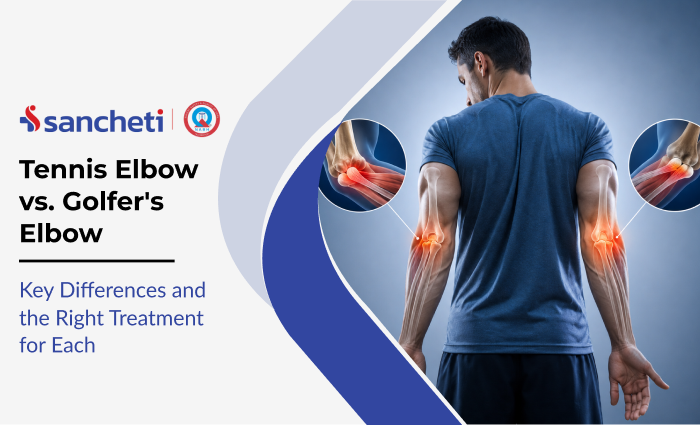
The elbow has a bony prominence on each side — the lateral epicondyle on the outer side and the medial epicondyle on the inner side. Both serve as attachment points for the forearm muscles that control wrist and finger movement.
Tennis elbow (lateral epicondylitis) involves degeneration of the tendons — particularly the extensor carpi radialis brevis (ECRB) — that attach to the lateral epicondyle. These are the muscles responsible for extending (cocking back) the wrist.
Golfer’s elbow (medial epicondylitis) involves degeneration of the flexor-pronator muscle group tendons that attach to the medial epicondyle. These muscles flex the wrist and pronate the forearm (turn the palm downward).
As with patellar tendinopathy, the term “epicondylitis” is somewhat misleading — both conditions are primarily degenerative tendinopathies rather than inflammatory conditions, particularly in chronic cases. This distinction matters because it directly influences what treatment actually works.
Tennis Elbow: Who Gets It and Why
Despite its name, fewer than 10% of tennis elbow cases occur in actual tennis players. The condition is far more common in adults aged 35–55 who perform repetitive wrist extension and gripping activities — typing, using a mouse, painting, plumbing, or any task involving sustained forearm loading.
In tennis players specifically, poor backhand technique — leading with the wrist rather than the shoulder, or using a grip that is too large or small — is the classic mechanism. The eccentric load on the ECRB tendon at ball impact, repeated across thousands of strokes, produces the cumulative microtrauma that drives tendon degeneration.
The hallmark of lateral epicondyle pain is:
- Pain and tenderness localised to the outer bony prominence of the elbow
- Pain that radiates down the back of the forearm toward the wrist
- Weakness of grip — particularly noticeable when lifting objects with the arm extended, pouring from a kettle, or shaking hands
- Pain reproduced by resisted wrist extension or by gripping with the elbow straight
- The coffee cup sign — pain when lifting a full cup with the elbow extended is one of the most commonly reported functional limitations
Golfer’s Elbow: Who Gets It and Why
Golfer’s elbow is less common than tennis elbow but often more disabling because the medial side of the elbow is anatomically more complex — the ulnar nerve runs in a groove just behind the medial epicondyle, and its involvement adds a neurological dimension that lateral epicondylitis does not typically have.
Again, the sport after which it is named accounts for a small minority of actual cases. Medial epicondyle pain is common in throwing athletes (cricketers, javelin throwers), climbers, weightlifters, and manual workers who perform repetitive wrist flexion, forearm pronation, or gripping under load.
The characteristic symptoms of golfer’s elbow include:
- Pain and tenderness directly over the medial epicondyle — the inner bony prominence of the elbow
- Pain that radiates down the inner forearm toward the wrist and sometimes into the ring and little fingers
- Weakness in grip and wrist flexion
- Pain reproduced by resisted wrist flexion or forearm pronation with the elbow extended
- Tingling or numbness in the ring and little fingers when the ulnar nerve is irritated — a feature not seen in tennis elbow and one that requires specific assessment
Single Most Important Diagnostic Distinction
The distinction between the two conditions comes down to one question: which side of the elbow hurts?
Outer elbow pain → Tennis elbow (lateral epicondylitis)
Inner elbow pain → Golfer’s elbow (medial epicondylitis)
Clinical examination confirms this with specific resisted movement tests. For tennis elbow, resisted wrist extension with the elbow straight reproduces lateral pain. For golfer’s elbow, resisted wrist flexion and forearm pronation reproduces medial pain.
Imaging is not always necessary for straightforward cases but is useful when the diagnosis is uncertain or symptoms are not improving as expected. Ultrasound shows tendon thickening and disorganised fibres at the affected epicondyle. MRI provides more detail and rules out associated pathology — particularly for medial elbow pain, where a partial UCL (ulnar collateral ligament) tear can mimic golfer’s elbow in throwing athletes, and where elbow dislocation history may have left residual ligament or cartilage damage contributing to symptoms.
Referred pain from the cervical spine and nerve entrapment syndromes — particularly radial nerve entrapment in tennis elbow and cubital tunnel syndrome in golfer’s elbow — must also be considered in cases that do not respond to local treatment. Persistent wrist pain accompanying elbow symptoms should prompt assessment of the entire kinetic chain from neck to hand.
Treatment: What Both Conditions Share
Both tennis elbow and golfer’s elbow are tendinopathies — and the same biological principles that govern treatment of patellar tendinopathy apply here. Rest alone does not stimulate tendon remodelling; the right kind of progressive load does.
Activity Modification
The first step is identifying and reducing the specific activities driving the tendon overload — not eliminating all activity. Complete rest allows symptoms to settle temporarily but does not restore tendon structure. Ergonomic modifications at work — adjusting keyboard height, mouse positioning, or tool grip design — are often as important as sports technique correction.
Eccentric and Isometric Loading
Isometric wrist exercises — sustained contractions without movement — are particularly effective in the acute, painful phase because they provide a tendon stimulus while minimising compression and shear forces at the enthesis (the tendon-bone junction).
Eccentric loading exercises — the Tylor bar exercise (slow wrist extension with a weighted bar for lateral epicondylitis) and its equivalent for medial epicondylitis — are the cornerstone of tendon remodelling rehabilitation. These are performed with a slow, controlled lowering phase that stimulates collagen reorganisation in the degenerative tendon tissue. A well-structured physiotherapy and rehabilitation program progresses through isometric loading, eccentric strengthening, and functional grip exercises in a sequence that matches the tendon’s healing biology.
Bracing
A counterforce brace worn just below the elbow reduces the tensile load transmitted to the epicondyle during gripping activities. For tennis elbow, the brace is worn on the outer forearm; for golfer’s elbow, on the inner forearm. Bracing provides meaningful symptomatic relief during activity and is a useful adjunct during the rehabilitation period — not a standalone treatment.
Corticosteroid Injections
Corticosteroid injections provide reliable short-term pain relief and are commonly used when pain is severe enough to prevent engagement with rehabilitation. However, the evidence is clear that their long-term outcomes are inferior to structured physiotherapy — they reduce pain at 6 weeks but often show higher recurrence rates at 6–12 months compared to rehabilitation-alone groups. They are used selectively at Sancheti Hospital, primarily as a pain management bridge to enable early rehabilitation rather than as a primary treatment strategy.
Treatment Differences: What Each Condition Needs Specifically
While the rehabilitation principles overlap, there are important condition-specific considerations.
For Tennis Elbow
Technique correction is essential for athletes — particularly the backhand in racket sports, where leading with the wrist rather than the elbow is the most common driver. Equipment review — racket grip size, string tension, and racket weight — is part of the assessment for any athlete with persistent lateral epicondyle tendinopathy.
Wrist extensor strengthening progresses from isometric holds through eccentric Tyler bar exercises to functional loaded gripping patterns. The ECRB tendon responds well to this protocol, and most patients with tennis elbow achieve significant improvement within 6–12 weeks of consistent loading rehabilitation.
For chronic, treatment-resistant cases, platelet-rich plasma (PRP) injection into the degenerative tendon tissue has a stronger evidence base in lateral epicondylitis than in most other tendinopathies and is a reasonable consideration when 3–6 months of rehabilitation have not produced adequate improvement. The full scope of lateral epicondylitis management including grading and imaging criteria is covered in our health library for those seeking more clinical detail.
For Golfer’s Elbow
The additional complexity in medial epicondylitis management is the ulnar nerve. When tingling, numbness, or weakness in the ring and little fingers accompanies medial elbow pain, cubital tunnel syndrome (ulnar nerve compression at the elbow) must be formally assessed and managed alongside the tendinopathy — because nerve symptoms will not resolve with tendon rehabilitation alone.
Wrist flexor and pronator strengthening follows the same progressive loading principles as tennis elbow rehabilitation, but the exercise selection is adapted to the medial muscle group. Throwing athletes require sport-specific loading of the medial elbow in the late-cocking and acceleration phases of the throw before returning to full competition.
When Surgery Is Considered
Surgery for both conditions is a last resort, reserved for patients who have genuinely completed 6–12 months of structured conservative management without adequate relief. The surgical principle is the same for both: debridement of the degenerative tendon tissue at the affected epicondyle, with or without reattachment of the tendon origin.
This can be performed as an open procedure or, increasingly, arthroscopically through small incisions with direct visualisation of the tendon pathology. Our sports medicine specialists at Sancheti Hospital reserve surgical discussion for patients with confirmed structural tendon degeneration on imaging who have exhausted conservative options — not as an early intervention.
Recovery after surgical debridement typically follows a 3–6 month rehabilitation course before full return to sport or heavy manual work.
Key Takeaways
- Tennis elbow affects the outer elbow (lateral epicondyle) and involves the wrist extensor tendons; golfer’s elbow affects the inner elbow (medial epicondyle) and involves the wrist flexor and pronator tendons.
- Both are tendinopathies — degenerative overuse conditions — not inflammatory injuries, which is why anti-inflammatory treatment alone rarely resolves them.
- The most effective treatment for both is progressive tendon loading rehabilitation — isometric exercises first, followed by eccentric strengthening, then functional and sport-specific loading.
- Golfer’s elbow has an additional layer of complexity when the ulnar nerve is involved — tingling and numbness in the ring and little fingers must prompt nerve assessment alongside tendon treatment.
- Corticosteroid injections provide short-term relief but inferior long-term outcomes compared to rehabilitation; they are best used as a pain bridge to enable early physiotherapy engagement.
- Surgery is effective for refractory cases but should follow at least 6–12 months of consistently applied conservative management.
- At Sancheti Hospital, Pune, our orthopaedic and sports medicine specialists assess both conditions with imaging, nerve evaluation where indicated, and sport or work-specific technique analysis to build treatment plans that address the root cause.
Frequently Asked Questions (FAQs)
Q1. Can I get a tennis elbow if I have never played tennis?
Absolutely — and the majority of people with tennis elbow have never played the sport. Any activity involving repetitive wrist extension or gripping under load can cause it: typing, carpentry, painting, plumbing, or even prolonged mobile phone use. The name reflects where the injury was first described in sport, not who gets it.
Q2. How long does a tennis elbow or golfer’s elbow take to recover fully?
Mild to moderate cases typically respond well within 6–12 weeks of structured rehabilitation. Chronic cases — where symptoms have been present for more than 3–6 months before treatment begins — can take 3–6 months to fully resolve. One of the most consistent predictors of longer recovery is delayed presentation, which is why early assessment and structured treatment produces better outcomes than self-managing with rest and pain relief.
Q3. Should I stop all activity while treating these conditions?
No. Complete rest is not necessary and is not the most effective strategy. The goal is to reduce the specific activities that provoke symptoms to below the pain threshold while maintaining general fitness and beginning a progressive tendon loading program. Athletes can often continue modified training; manual workers can often continue with ergonomic adjustments.
Q4. Is there a difference between how these conditions are treated in athletes versus non-athletes?
The rehabilitation principles are the same, but athletes require an additional layer of sport-specific loading — returning the tendon through the specific movement patterns and velocities of their sport before full return to competition. Technique correction is also more central in athletes, since faulty mechanics are often the primary driver rather than simple overuse.
Q5. Can both conditions occur in the same elbow at the same time?
It is uncommon but possible — particularly in athletes or manual workers who place high demands on both the flexor and extensor sides of the forearm simultaneously. A climber, for example, may develop both lateral and medial elbow pain from sustained grip loading. Each condition is assessed and rehabilitated on its own merits, with the treatment program addressing both tendon groups in sequence based on symptom severity.