Home
Home PG College
 Patient Login
 Sancheti Clinic
 Contact Us
 Download Reports
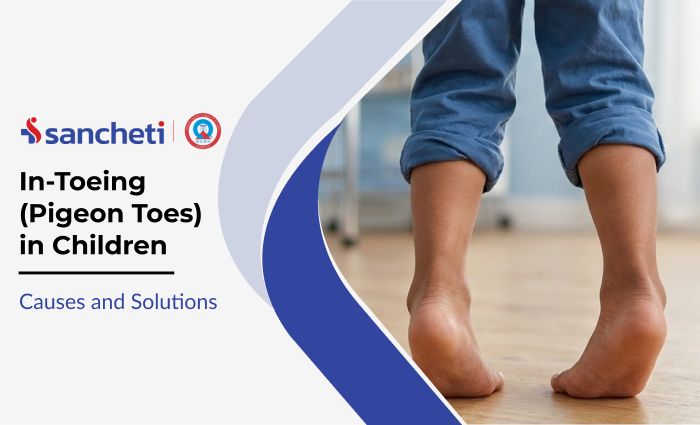

In-Toeing (Pigeon Toes) in Children: Causes and Solutions
If your child walks with their feet turned inward, they may have a condition commonly called “pigeon toes” or in-toeing. The good news? In most children, this is a normal part of development that resolves on its own without any treatment. However, some cases do require medical attention — and knowing the difference matters.
What Is In-Toeing in Children?
In-toeing simply means that when a child walks or runs, their feet point inward rather than straight ahead. You may notice it when your toddler first starts walking, or it may become more obvious as they grow. While it can look concerning to parents, pigeon-toed walking is actually one of the most common reasons families visit a pediatric orthopedic specialist.
At Sancheti Hospital, Pune, our pediatric orthopedic team regularly sees children with this condition — and the vast majority of them go on to walk and run perfectly normally.
What Causes Inward Turning Feet?
In-toeing is not a single condition. It’s a result of different structural variations in the leg, and the cause typically depends on the child’s age.
1. Metatarsus Adductus (Infants)
This is the most common cause in newborns and young infants. The front part of the foot curves inward, often because of the baby’s position in the womb. In mild cases, the foot is flexible and corrects itself within the first year of life.
2. Tibial Torsion (Toddlers — Ages 1 to 3)
Tibial torsion refers to an inward twist of the tibia (shin bone). It’s the leading cause of pigeon-toed walking in toddlers. As children begin to walk and their legs bear weight, this rotation typically straightens out naturally by age 4 to 5.
3. Femoral Anteversion (Children Ages 3 to 8)
In older children, in-toeing is often caused by femoral anteversion — an inward twist of the femur (thigh bone). Children with this condition often prefer to sit in a “W” position on the floor. You may notice their knees and feet both point inward when they walk. This is the most common reason an older child appears pigeon-toed, and it usually self-corrects by early adolescence.
Is In-Toeing a Serious Problem?
For most children, in-toeing is not painful and does not interfere with normal development. Children with this condition can run, play sports, and keep up with their peers without difficulty. Studies consistently show that the large majority of in-toeing cases resolve naturally by the time a child reaches their early teens.
That said, there are situations where you should consult a specialist:
- The condition is getting worse, not better, over time
- Your child frequently trips or falls due to their gait
- Your child complains of pain in their legs or feet
- In-toeing is present only on one side
- The child is older than 10 and the problem persists
How Is In-Toeing Diagnosed?
At Sancheti Hospital, our orthopedic specialists begin with a thorough physical examination. The doctor will observe how your child walks, assess the range of motion in their hips, knees, and ankles, and evaluate the alignment of the foot.
In some cases, an X-ray or other imaging may be ordered to rule out underlying bone or joint conditions. A detailed family history is also taken, as in-toeing can sometimes run in families.
Treatment Options for Pigeon-Toed Children
Treatment depends entirely on the cause, severity, and the child’s age. Here’s what current medical evidence supports:
Watchful Waiting
For most children, the recommended approach is careful monitoring over time. The vast majority of cases resolve without any intervention. Routine follow-up visits allow the doctor to track progress and step in only if needed.
Physiotherapy and Stretching Exercises
In some cases, a physiotherapist may guide parents through gentle stretching exercises to improve flexibility and encourage better alignment. This is particularly helpful when there is associated muscle tightness.
Footwear and Orthotics
Specially designed shoes or orthotic insoles are sometimes recommended to support foot position during walking. While they don’t correct the underlying bone rotation, they can help with comfort and gait in certain situations.
Casting or Bracing (for Metatarsus Adductus)
Infants with a more rigid curved foot may benefit from serial casting or bracing during their early months. This is most effective when started early, typically before six months of age.
Surgery (Rare Cases Only)
Surgical correction is considered only in severe, persistent cases that cause significant functional problems and have not improved by late childhood. The procedure involves a carefully planned bone realignment and is performed by experienced pediatric orthopedic surgeons. At Sancheti Hospital, such procedures are undertaken with advanced planning and post-operative rehabilitation support.
What Parents Can Do at Home
While medical supervision is important, there are a few things parents can do to support their child’s development:
- Encourage active play — running, cycling, and swimming all support healthy musculoskeletal development
- Avoid the W-sitting position, especially in children with femoral anteversion, and encourage cross-legged sitting instead
- Choose well-fitted footwear that offers proper support
- Avoid “corrective” shoes or wedges without medical advice, as these have not been proven effective and can sometimes cause discomfort
When to Visit Sancheti Hospital
If you are concerned about your child’s walking pattern, an early consultation with a pediatric orthopedic specialist can provide clarity and peace of mind. At Sancheti Hospital in Pune, our experienced team uses a comprehensive, evidence-based approach to evaluate child walking problems — ensuring that every child receives the right care at the right time.
We understand that seeing your child walk differently can be worrying. Our goal is to guide your family with accurate information, timely care, and compassionate support at every step.
Key Takeaways
- In-toeing (pigeon toes) is a common condition where children walk with their feet turned inward — and it is usually not a cause for alarm.
- The three main causes are metatarsus adductus (infants), tibial torsion (toddlers), and femoral anteversion (older children).
- Most cases resolve naturally with growth and do not require medical treatment.
- Surgery is rarely needed and is reserved only for severe, persistent cases.
- Parents should seek medical advice if the condition is worsening, painful, one-sided, or persists beyond age 10.
- Avoiding W-sitting and keeping children physically active supports healthy leg development.
- Sancheti Hospital, Pune offers expert pediatric orthopedic care for children experiencing gait and walking concerns.