Home
Home PG College
 Patient Login
 Sancheti Clinic
 Contact Us
 Download Reports
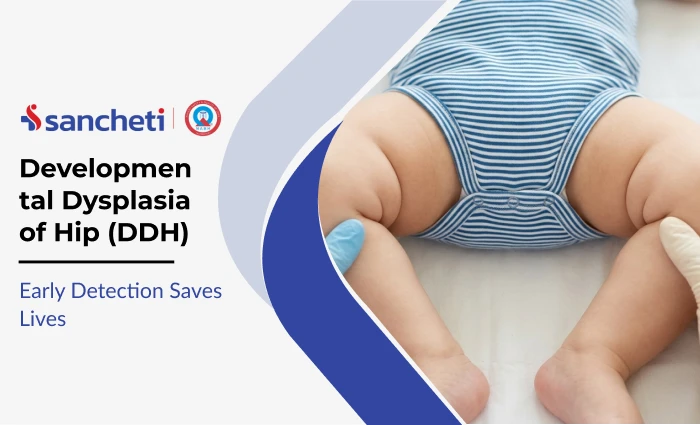

Developmental Dysplasia of Hip (DDH): Early Detection Saves Lives
Developmental Dysplasia of the Hip (DDH) is a condition where a baby’s hip joint doesn’t form properly, causing the ball of the joint to sit loosely — or completely outside — the hip socket. The good news?
When caught early, DDH is highly treatable with non-surgical methods, and most children go on to live completely normal, active lives. Early detection truly makes all the difference.
What Is Developmental Dysplasia of the Hip?
DDH is an umbrella term for a spectrum of hip problems present at or around birth. In a healthy hip, the femoral head (the ball) fits snugly into the acetabulum (the socket). In children with developmental hip dysplasia, this fit is either shallow, loose, or completely displaced.
It’s important to understand that DDH isn’t always obvious at birth. Some cases develop gradually during the first months of life, which is why ongoing screening matters just as much as the initial newborn examination.
How Common Is DDH in Babies?
Hip dysplasia in babies affects approximately 1 to 3 in every 1,000 births worldwide. In India, the condition often goes undiagnosed longer than it should, partly due to limited awareness and inconsistent screening practices — particularly in smaller towns and semi-urban areas. At Sancheti Hospital in Pune, our pediatric orthopedic team regularly sees children referred from across Maharashtra, many of whom are diagnosed later than ideal.
Who Is at Risk? Key Risk Factors Parents Should Know
Some babies are more likely to develop DDH than others. Risk factors include:
- Female sex — Girls are 4 to 5 times more likely to be affected than boys
- Breech position during pregnancy (baby positioned feet-first)
- Family history of hip dysplasia or joint laxity
- First-born children, as the uterus is tighter and restricts fetal movement
- Oligohydramnios (low amniotic fluid), which limits normal hip movement in the womb
- Swaddling practices that keep the hips extended and adducted (legs together and straight)
If your baby has one or more of these risk factors, early DDH screening is strongly recommended.
Recognising the Signs: What Parents and Doctors Look For
“Newborn Hip Click” and What It Means
One of the earliest signs picked up during a physical examination is an audible or felt click in the hip, which is why the term newborn hip click is commonly used. Doctors use two specific manoeuvres — the Ortolani test (to detect a dislocated hip that can be reduced) and the Barlow test (to detect a hip that can be dislocated) — to check for instability in newborns.
However, not every click is a cause for alarm. Soft clicks from tendons are common and benign. A clunk — a more pronounced, mechanical sensation — is what warrants further investigation.
Signs to Watch for at Home
As your baby grows, watch for:
- Unequal leg lengths
- Asymmetric skin folds on the thighs or buttocks
- Limited range of motion in one hip (difficulty spreading legs during nappy changes)
- A noticeable limp once your child begins to walk
- Walking on tiptoe on one side
If you notice any of these signs, consult a pediatric orthopedic specialist promptly.
DDH Screening: Why It Shouldn’t Be Skipped
DDH screening involves a combination of clinical examination and, when indicated, imaging. Here’s how it typically works:
- Universal clinical screening is recommended for all newborns using the Ortolani and Barlow tests at birth and during routine well-baby visits in the first few months.
- Ultrasound screening is the gold standard for infants under 4 to 6 months of age, as the hip is still largely cartilaginous and doesn’t show well on X-ray. Ultrasound can accurately measure the depth and shape of the hip socket.
- X-ray becomes useful after 4 to 6 months, when the femoral head begins to ossify (harden into bone).
- At Sancheti Hospital, our pediatric orthopedic team follows evidence-based protocols for infant hip problems, ensuring that at-risk babies receive timely ultrasound assessments and that no case slips through the cracks.
Treatment Options: The Earlier, the Simpler
The treatment of DDH depends on the baby’s age at diagnosis and the severity of the condition.
Birth to 6 Months: Pavlik Harness
The Pavlik harness is the first-line treatment for young infants. This soft brace holds the hips in a flexed, abducted position — the ideal position for the socket to deepen and stabilise around the femoral head. When used correctly, it has a success rate of over 90% in mild to moderate cases.
6 to 18 Months: Closed or Open Reduction
If the Pavlik harness fails or the diagnosis is delayed, the baby may need a procedure called closed reduction (manipulating the hip into position under anaesthesia) followed by a spica cast to hold the hip in place. In more severe or complex cases, open reduction surgery may be required.
After 18 Months: Surgical Correction
Later diagnosis significantly increases the complexity of treatment. Children diagnosed after walking age often need osteotomy (reshaping the bones) in addition to reduction. Recovery is longer, and outcomes, while generally good, are less predictable than with early treatment.
This is why the message at Sancheti Hospital is always the same: don’t wait, don’t watch and wonder — get it checked.
DDH Care at Sancheti Hospital, Pune
Sancheti Hospital has been a trusted name in orthopedic care in Pune for decades. Our dedicated pediatric orthopedics unit is equipped with:
- Advanced musculoskeletal ultrasound for infant hip screening
- Experienced pediatric orthopedic surgeons with subspecialty training in DDH
- A multidisciplinary team including physiotherapists, cast technicians, and child-friendly nursing care
- A comprehensive follow-up programme to monitor hip development through growth
Whether you are a parent concerned about your newborn’s hip or a pediatrician seeking a reliable referral centre for pediatric hip care in Pune, Sancheti Hospital offers the expertise and infrastructure to ensure the best outcomes for your child.
Key Takeaways
- DDH is a common but often missed condition where the hip joint doesn’t develop normally in infants and young children.
- Early screening — both clinical and ultrasound — is the single most important step in ensuring a good outcome.
- Risk factors include female sex, breech birth, family history, and certain swaddling practices.
- A newborn hip click during clinical examination is a key early warning sign that needs further evaluation.
- Treatment is simplest and most effective when started before 6 months of age; delay significantly increases treatment complexity.
- Sancheti Hospital, Pune offers specialised DDH screening, diagnosis, and treatment for infants and children across Maharashtra.