Home
Home PG College
 Patient Login
 Sancheti Clinic
 Contact Us
 Download Reports
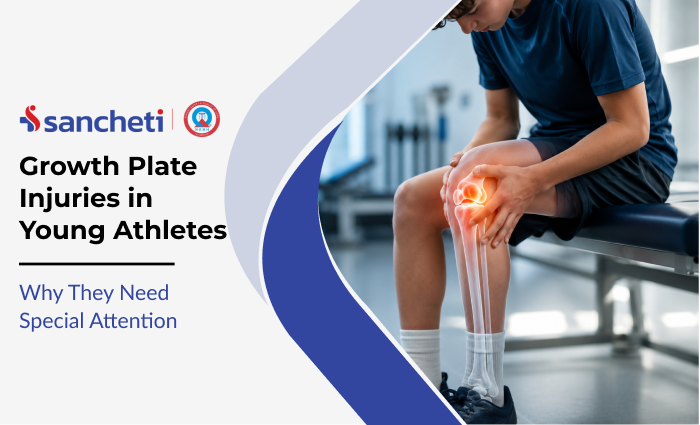

Growth Plate Injuries in Young Athletes: Why They Need Special Attention
Growth plate injuries are one of the most common — and most misunderstood — orthopedic concerns in children and teenagers who play sports. In short: children’s bones are still developing, and the soft cartilage zones where this growth happens (called growth plates or physes) are significantly weaker than the surrounding bone and ligaments.
This makes young athletes particularly vulnerable to injuries that adults would not experience at the same point of impact or stress. At Sancheti Hospital, Pune, we see a significant number of these cases — and early, accurate management makes all the difference in how well a child recovers.
What Are Growth Plates and Why Do They Matter?
Growth plates are areas of developing cartilage tissue located near the ends of the long bones in children and adolescents. They are responsible for determining the future length and shape of the mature bone. Once a child reaches full skeletal maturity — typically between ages 14–16 in girls and 16–18 in boys — these plates close and harden into solid bone.
Until that happens, they remain the weakest link in a growing skeleton. In fact, a force that would simply sprain a ligament in an adult can fracture a growth plate in a child. This is why pediatric sports injuries cannot simply be treated the same way as adult sports injuries.
Who Is at Risk?
Any child or teenager who is physically active is at some level of risk, but the following groups tend to be more vulnerable:
- Children between ages 8 and 16 who are in competitive sports
- Athletes who train intensively without adequate rest
- Those experiencing a rapid growth spurt
- Children who play contact sports, gymnastics, football, basketball, or cricket
- Athletes who specialise in a single sport year-round without seasonal breaks
At our pediatric orthopedic department, we regularly evaluate young athletes from across Pune and Maharashtra who come in with pain that parents initially dismissed as “growing pains.”
Common Types of Growth Plate Injuries
1. Acute Growth Plate Fractures
These occur due to a sudden traumatic event — a fall, collision, or twist. The Salter-Harris classification is the standard system used to grade these fractures from Type I (mildest) to Type V (most severe, involving compression of the growth plate). The higher the grade, the greater the risk of disrupting normal bone growth.
2. Osgood-Schlatter Disease
This is an overuse condition where repetitive stress at the tibial tuberosity — the bony bump just below the knee — causes pain and swelling. It is common in active children during growth spurts, particularly those involved in running and jumping sports. While it typically resolves with rest and physiotherapy, cases that go untreated can become significantly painful. Osgood-Schlatter disease is one of the most frequent reasons adolescent athletes visit our clinic.
3. Sever’s Disease (Calcaneal Apophysitis)
Despite the alarming name, this is not an actual disease but an overuse growth plate injury at the heel bone. It occurs when the Achilles tendon repeatedly pulls on the still-developing bone where it attaches, causing pain at the back of the heel. It is particularly common in 8–15 year olds involved in football, running, and gymnastics. Heel pain during a growth spurt in an active child should never be ignored.
4. Slipped Capital Femoral Epiphysis (SCFE)
In this condition, the ball of the hip joint (femoral head) slips off the growth plate due to weakness in the physeal zone. It tends to affect overweight adolescents and active teenagers during periods of rapid growth. SCFE is a true orthopedic emergency — delay in treatment can lead to permanent hip damage and early arthritis. Slipped capital femoral epiphysis requires surgical pinning to stabilise the joint and prevent further slipping.
5. Little Leaguer’s Elbow and Shoulder
Young cricket bowlers, baseball pitchers, and overhead athletes frequently develop growth plate stress injuries around the elbow and shoulder due to repetitive throwing motions. These manifest as pain on the inner side of the elbow or the shoulder’s proximal humerus growth plate.
Warning Signs Parents and Coaches Should Not Miss
One of the biggest challenges with growth plate injuries in children is that they can mimic simple muscle soreness or a sprain. Here is what to watch for:
- Persistent pain at or near a joint in a child who is physically active
- Swelling, tenderness, or visible deformity after a fall or collision
- Pain that worsens with activity and does not settle with rest after 1–2 days
- A child who starts limping or refuses to put weight on a limb
- Reduced range of motion in a joint following sport
Never assume joint pain in an active child is “just growing pains.” A proper orthopedic assessment, often including X-rays or an MRI, is essential to rule out growth plate involvement.
How Are Growth Plate Injuries Diagnosed?
At Sancheti Hospital, evaluation begins with a detailed clinical examination. However, since physeal fractures often do not show up clearly on standard X-rays, an MRI is frequently required for accurate diagnosis — especially for stress injuries and early SCFE. CT scans may be used for more complex fractures to plan treatment.
The Salter-Harris grading guides treatment decisions once the fracture type is confirmed.
Treatment Options
Non-Surgical Management
The majority of growth plate injuries — particularly Type I and Type II fractures and overuse conditions like Sever’s disease and Osgood-Schlatter — respond well to conservative treatment:
- Rest and activity modification
- Immobilisation with cast, splint, or brace
- Ice and anti-inflammatory medications
- Physiotherapy to restore strength and flexibility
- Gradual, supervised return to sport
Surgical Treatment
Higher-grade fractures (Type III, IV, V) or displaced fractures typically require surgical fixation to realign and stabilise the bone. The goal is always to restore anatomical alignment while avoiding further damage to the growth plate. Our pediatric orthopaedic surgery team uses specialised implants and techniques designed specifically for growing bone.
In cases like SCFE, urgent surgery is performed to prevent the femoral head from slipping further.
Can Growth Plate Injuries Cause Long-Term Problems?
Yes, if left untreated or poorly managed. Complications can include:
- Growth arrest — partial or complete stoppage of normal bone growth
- Leg length discrepancy — one limb growing shorter than the other
- Angular deformity — abnormal bending of the limb
- Early-onset arthritis in the affected joint
- Chronic pain and reduced athletic capacity
This is why a specialist evaluation is non-negotiable when a growth plate injury is suspected. The younger the child and the higher the Salter-Harris grade, the closer the follow-up monitoring needs to be.
Prevention: Protecting Young Athletes
While not every injury is preventable, the risk of growth plate damage can be significantly reduced with the right approach:
- Allow adequate rest between training sessions — the physes need recovery time
- Avoid early sports specialisation; encourage multi-sport participation in younger children
- Ensure proper warm-up and cool-down routines before and after play
- Use sport-appropriate equipment and footwear that fits well
- Listen to the child — pain is not something they should “push through”
- Work with coaches who understand the physical limits of growing bodies
Our sports medicine team works closely with young athletes, their parents, and coaches to develop training programmes that balance performance with long-term skeletal health.
When to See a Doctor
If your child is complaining of joint pain that:
- Comes on after sport and does not settle within 48 hours
- Is associated with swelling or bruising after a fall
- Makes them reluctant to participate in activities they normally enjoy
- Is accompanied by a noticeable limp
…it is time for a proper medical evaluation. At Sancheti Hospital, our orthopedic specialists have extensive experience diagnosing and treating growth plate injuries in children and adolescents. Early intervention consistently leads to better outcomes, fewer complications, and a faster, safer return to the sport they love.
Key Takeaways
- Growth plates (physes) are cartilage zones near the ends of bones in children — they are weaker than bone and ligaments, making young athletes uniquely vulnerable.
- Common conditions include Osgood-Schlatter disease, Sever’s disease, SCFE, and acute Salter-Harris fractures.
- Symptoms like persistent joint pain, swelling after a fall, or a limp in an active child always warrant medical evaluation — do not assume it is growing pains.
- Most growth plate injuries respond well to conservative treatment; higher-grade fractures may require surgery.
- Untreated or poorly managed physeal injuries can lead to growth arrest, limb length differences, or early arthritis.
- Prevention involves rest, varied training, and listening when a child says something hurts.
Frequently Asked Questions (FAQs)
Q1. Can a child return to full sports after a growth plate injury?
In the vast majority of cases, yes — with proper treatment and rehabilitation, most children return to their previous level of activity without lasting restrictions. The timeline depends on the injury’s severity, the bone involved, and how much growing the child has left to do. Your orthopedic specialist will guide the return-to-sport progression carefully.
Q2. Are growth plate injuries visible on a regular X-ray?
Not always. Stress-related growth plate injuries and some fractures may appear normal on X-ray, particularly in the early stages. An MRI is often needed to confirm the diagnosis, which is why it is important to see a specialist even if the X-ray comes back looking “fine.”
Q3. My child’s coach says it’s just muscle soreness — should I still get it checked?
Yes. Coaches are valuable, but joint pain near the growth plate in an active child needs a medical opinion. What feels like muscle soreness could be early physeal stress that worsens significantly without modification of activity.
Q4. Does overweight in children increase the risk of growth plate injuries?
Yes, excess body weight places additional stress on the growth plates — particularly in the hip, knee, and ankle — during physical activity. Slipped capital femoral epiphysis (SCFE), for example, is significantly more common in overweight adolescents. Maintaining a healthy weight supports long-term bone and joint health in growing children.
Q5. At what age do growth plates fully close and this risk go away?
Growth plates generally close by age 14–16 in girls and 16–18 in boys, though this varies by individual and by which bone is involved. Once closed, the growth plate is no longer a vulnerability — but the skeleton is also no longer growing, so these injuries are truly a childhood and adolescent concern.