Home
Home PG College
 Patient Login
 Sancheti Clinic
 Contact Us
 Download Reports
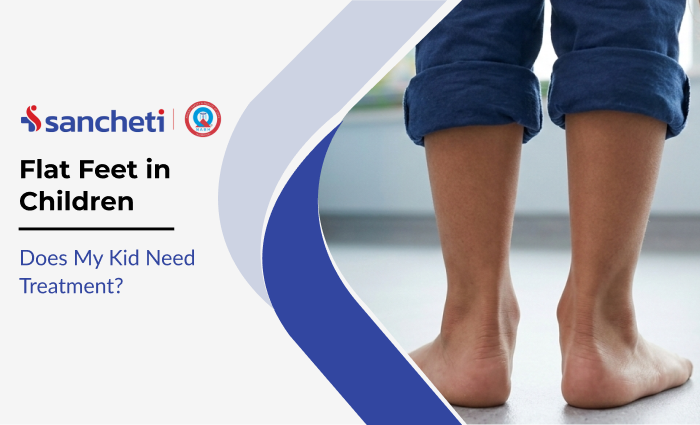

Flat Feet in Children: Does My Kid Need Treatment?
If your child has flat feet, the good news is that most cases require no treatment at all. Flat feet are extremely common in young children and often resolve naturally as they grow. However, in some cases — particularly when a child experiences pain, difficulty walking, or has a rigid flat foot — evaluation and treatment by a pediatric orthopedic specialist becomes important.
What Are Flat Feet in Children?
Flat feet, medically known as pes planus, occur when the arch of the foot makes full or near-full contact with the ground rather than curving upward. If you look at a child’s footprint, there’s little to no visible arch.
Here’s something that surprises many parents: almost all babies and toddlers appear to have flat feet. That’s completely normal. The arch typically develops between ages 3 and 6 as the foot’s muscles, tendons, and ligaments mature. By age 10, most children have a well-formed arch.
Flexible vs. Rigid Flat Feet: What’s the Difference?
Not all flat feet are the same, and understanding the distinction helps determine whether your child needs attention.
Flexible Flat Feet
This is by far the most common type in children. The arch disappears when your child stands but reappears when they sit or stand on their toes. Flexible flat feet are generally painless and considered a normal variation — not a deformity. Most children with flexible flat feet live full, active lives without any intervention.
Rigid Flat Feet
In rigid flat feet, the arch remains absent regardless of position — whether sitting, standing, or on tiptoe. This type is less common but more clinically significant. It can be associated with underlying bone abnormalities, such as tarsal coalition (where certain foot bones are fused together), and may cause pain, limited motion, or an abnormal gait. Rigid flat feet always warrant a thorough medical evaluation.
When Should You Be Concerned About Your Child’s Flat Feet?
Most parents notice flat feet visually and worry, but appearance alone is rarely a reason to seek treatment. Here are the signs that do warrant a visit to a pediatric orthopedic doctor:
- Foot or ankle pain, especially after physical activity
- Frequent tripping or clumsiness that seems beyond typical childhood awkwardness
- Difficulty keeping up with peers during play or sports
- Visible inward rolling of the ankles (overpronation)
- Shoe wear that is uneven or unusually rapid
- Leg or knee pain that may be connected to foot alignment
- Flat feet that persist beyond age 8–10 without any arch development
If your child complains of tired or achy feet regularly or avoids physical activities they once enjoyed, it’s worth having their feet assessed.
How Are Pediatric Flat Feet Diagnosed?
At Sancheti Hospital, our pediatric orthopedic team uses a combination of clinical examination and, when necessary, imaging to assess your child’s feet comprehensively.
Evaluation Process Includes:
Physical Examination — The doctor observes how your child stands, walks, and runs, and checks whether the arch appears when the child rises on tiptoe (the key test for flexible vs. rigid flat feet).
Gait Analysis — Evaluating how your child moves helps identify any compensatory patterns that could affect the knees, hips, or lower back over time.
X-rays or MRI — Reserved for cases where rigid flat feet or underlying bone abnormalities are suspected. Imaging helps rule out tarsal coalition or other structural issues.
Does My Child Actually Need Treatment?
This is the most important question parents ask — and the answer depends entirely on the type of flat foot and the presence of symptoms.
When treatment is NOT needed:
The majority of children with flexible, painless flat feet need no treatment. Special shoes, arch supports, or orthotics have not been shown to speed up arch development or prevent future problems in asymptomatic children. Observation and reassurance are often all that is required.
When treatment is recommended:
Treatment is considered when flat feet cause pain, functional limitation, or are of the rigid variety.
Non-surgical approaches include:
- Custom orthotics or insoles to support the arch and reduce discomfort during activity
- Physiotherapy to strengthen the foot and ankle muscles, improve flexibility, and correct gait
- Activity modification during flare-ups of pain
- Appropriate footwear guidance — well-fitting shoes with good support matter, though they don’t correct the condition
When surgery might be considered:
Surgical treatment for flat feet in children is rare and only considered for rigid flat feet unresponsive to conservative management, or for structural bone problems like tarsal coalition. At Sancheti Hospital, our orthopedic specialists always explore all non-surgical options before recommending any procedure.
Can Flat Feet Cause Long-Term Problems?
For the vast majority of children, flexible flat feet cause no lasting issues. However, if left unaddressed in symptomatic cases, flat feet can contribute to:
- Shin splints and stress-related injuries
- Knee pain due to altered alignment
- Hip and lower back discomfort
- Reduced participation in sports or physical activity
Early assessment ensures that children who do need support receive it at the right time — before compensatory patterns become ingrained.
Tips for Parents: Supporting Healthy Foot Development
Even if your child’s flat feet don’t need formal treatment, a few simple habits can support overall foot health:
- Encourage barefoot play on natural surfaces like grass or sand — this naturally strengthens foot muscles
- Choose well-fitting shoes that offer adequate support without being overly rigid
- Avoid hand-me-down footwear, as shoes mold to the original wearer’s gait
- Keep an eye on your child’s activity levels and comfort — any new complaints of foot or leg pain should be taken seriously
- Schedule a check-up if you’re uncertain — peace of mind is always worthwhile
Why Choose Sancheti Hospital for Your Child’s Foot Health?
At Sancheti Hospital, Pune, our pediatric orthopedic team has decades of experience managing a wide range of childhood musculoskeletal conditions, including flat feet, gait abnormalities, and complex foot deformities. We take a conservative, evidence-based approach — treating only when necessary and always keeping your child’s long-term wellbeing at the center of every decision.
Whether you’re looking for a simple reassurance or a detailed evaluation, our specialists provide personalized care in a child-friendly environment.
Key Takeaways
- Flat feet are extremely common in young children and usually resolve on their own as the arch develops with age.
- There are two main types: flexible flat feet (common, usually harmless) and rigid flat feet (less common, may need treatment).
- Most children with flat feet — especially when painless — need no treatment. Watchful waiting is appropriate.
- Treatment is recommended when a child experiences pain, difficulty walking, or has rigid flat feet.
- Non-surgical options like physiotherapy, orthotics, and footwear guidance are effective for most symptomatic cases.
- Surgery is rare and only considered for structural abnormalities unresponsive to conservative care.
- If you’re unsure about your child’s foot development, consult a pediatric orthopedic specialist early — timely evaluation makes a real difference.