Home
Home PG College
 Patient Login
 Sancheti Clinic
 Contact Us
 Download Reports
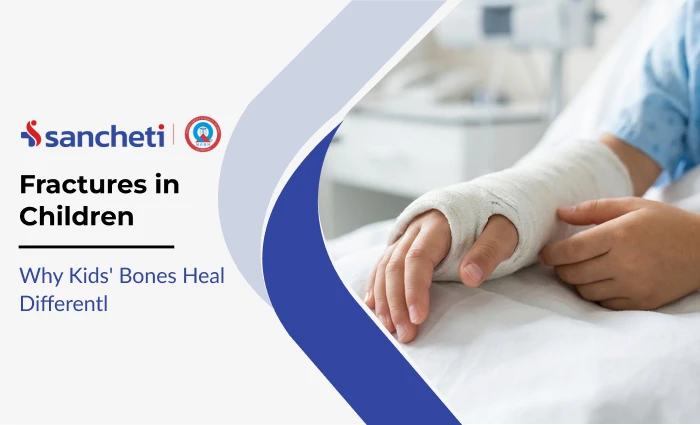

Fractures in Children: Why Kids’ Bones Heal Differently
Children’s bones are not simply smaller versions of adult bones — they are biologically different, more flexible, and heal faster. Pediatric fractures, including unique injury types like greenstick fractures and growth plate injuries, require specialized care.
At Sancheti Hospital, Pune, our pediatric orthopedic team understands these differences and tailors treatment to each child’s growing skeleton.
How Children’s Bones Differ from Adults
A child’s skeleton is in a constant state of growth and remodeling. The most significant difference is the presence of growth plates — also called physes — which are areas of developing cartilage located near the ends of long bones. These plates are responsible for longitudinal bone growth, but they are also structurally weaker than the surrounding bone, making them more vulnerable to injury.
Children’s bones also have a thicker, more active periosteum (the membrane surrounding bone), which means they can produce new bone more rapidly. This is why a child who breaks a bone often heals in half the time an adult would — sometimes within just 3 to 6 weeks, depending on the child’s age and the severity of the fracture.
Common Types of Fractures in Children
Not all fractures are alike, and children experience several injury patterns that are rarely seen in adults.
Greenstick Fracture
One of the most common pediatric fracture types is the greenstick fracture. Because children’s bones are more porous and flexible, a strong force may cause the bone to bend and crack on one side without breaking all the way through — much like a green, freshly cut stick of wood. These fractures are most common in the forearm and are usually treated with splinting or casting.
Growth Plate Injuries (Physeal Fractures)
A growth plate injury is a serious concern in pediatric orthopedics. Because the growth plate is the weakest point in a child’s bone — even weaker than surrounding ligaments — injuries that might cause a sprain in an adult can fracture the growth plate in a child. If not treated correctly, damage to the growth plate can disrupt normal bone development and lead to limb length discrepancy or angular deformity.
The Salter-Harris classification system helps doctors grade growth plate injuries from Type I (least severe) to Type V (most severe, a crushing injury to the plate). Higher grades require more intensive management and closer long-term follow-up.
Torus (Buckle) Fractures
Another fracture pattern unique to young patients is the torus or buckle fracture, where the bone compresses and buckles on one side rather than snapping. These are typically low-energy injuries — common after a fall on an outstretched hand — and generally heal well with immobilization alone.
Why Pediatric Fractures Heal Faster
The accelerated healing in children comes down to biology. Younger bone has a richer blood supply, greater cellular activity, and a more responsive periosteum. Additionally, children’s bones have a remarkable capacity for remodeling — meaning minor malalignment after a fracture can often correct itself as the child grows, something that simply does not happen in adult bone.
However, faster healing does not mean fractures in children can be ignored or undertreated. Growth plate injuries in particular must be carefully evaluated and monitored for months after the initial injury to ensure the bone is developing normally.
Warning Signs: When to Seek Immediate Care
Parents should seek prompt medical attention if their child experiences any of the following after a fall or impact:
- Persistent pain, swelling, or bruising around a limb or joint
- Inability or reluctance to use an arm or leg
- Visible deformity or an unusual angle of a limb
- Tenderness directly over a bone
- Swelling around a joint, especially the wrist, elbow, ankle, or knee
Children sometimes continue to use an injured limb due to adrenaline or fear of medical care. Swelling and point tenderness should always be taken seriously, even without a clear complaint of severe pain.
Fracture Treatment for Children: What to Expect
Treatment for a child bone fracture depends on the type, location, and severity of the injury, as well as the child’s age and stage of skeletal development. Most pediatric fractures are managed non-surgically through immobilization with a cast or splint. At Sancheti Hospital, Pune, we prioritize the least invasive approach that ensures proper healing.
Non-Surgical Management
The majority of pediatric fractures — including greenstick and buckle fractures — respond well to casting or splinting. Closed reduction (manually realigning the bone without surgery, under sedation) may be needed for more displaced fractures before immobilization.
When Surgery Is Necessary
Certain fractures — including severely displaced breaks, open fractures, and higher-grade growth plate injuries — require surgical fixation. Pediatric orthopedic surgeons use specialized implants designed to avoid further damage to the growth plate. The goal is always stable fixation with the smallest possible intervention.
Rehabilitation and Recovery
After immobilization is removed, children typically regain strength and range of motion quickly. Guided physiotherapy may be recommended for complex fractures. Regular follow-up X-rays are essential, especially after growth plate injuries, to confirm that bone development is proceeding normally.
Pediatric Fracture Care at Sancheti Hospital, Pune
At Sancheti Hospital, Pune, our orthopedic specialists have decades of experience managing all types of pediatric fractures — from simple greenstick injuries to complex growth plate fractures. We use advanced imaging, child-friendly care protocols, and evidence-based treatment plans to ensure every child heals safely and completely.
Our dedicated team works closely with families to explain the injury, the healing process, and what to watch for during recovery. If your child has suffered a bone injury, early and accurate diagnosis makes a meaningful difference in long-term outcomes.
Key Takeaways
- Children’s bones are biologically different from adults — more flexible, faster-healing, and equipped with active growth plates that require special attention.
- Greenstick fractures and growth plate injuries are patterns specific to children and demand expert pediatric orthopedic evaluation.
- Growth plate injuries must be carefully managed and monitored, as improper treatment can affect a child’s long-term bone development.
- Symptoms such as swelling over a bone, reluctance to use a limb, or tenderness after a fall always warrant medical assessment.
- Most fractures in children heal without surgery through casting or splinting, though complex cases may require surgical fixation.
- Sancheti Hospital, Pune, offers specialized fracture treatment for children with a child-centered approach and experienced orthopedic care.