Home
Home PG College
 Patient Login
 Sancheti Clinic
 Contact Us
 Download Reports

Types of Kyphosis: A Complete Guide
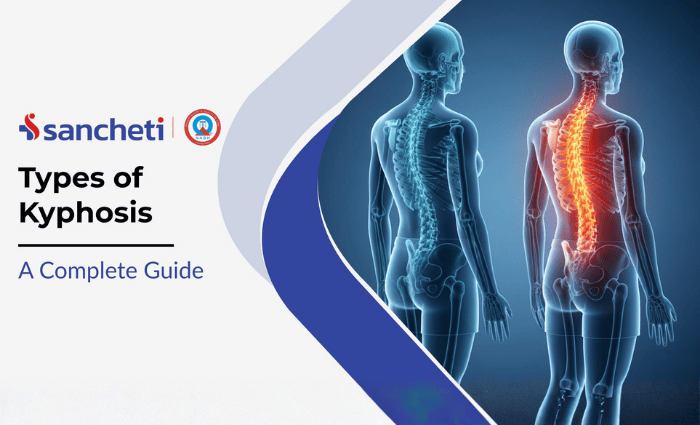
The human spine has natural curves that help absorb shock and maintain balance. But when the upper back curves excessively forward, it leads to kyphosis – commonly recognized as a rounded or hunched posture. While mild cases often go unnoticed, more severe forms can affect appearance, mobility, and comfort.
Kyphosis isn’t a single condition – it has multiple types, each with unique causes, symptoms, and treatment needs. Understanding the types of kyphosis helps identify whether the issue is postural, structural, or disease-related. In this guide, we’ll explain the major forms of kyphosis, their symptoms, and how specialists determine which type of deformity is kyphosis in every case.
What Is Kyphosis?
Kyphosis refers to an excessive forward rounding of the thoracic spine (mid-to-upper back). The curve may be flexible and correctable, or rigid and structural, depending on its cause. Mild curvature is common, especially in older adults, but pronounced curvature can cause back pain, stiffness, or breathing issues if left untreated.
Kyphosis is classified based on the underlying reason for the curvature. Let’s explore the main categories.
1. Postural Kyphosis
The most common and generally mild form, postural kyphosis, develops due to poor posture and weak spinal muscles, particularly in adolescents or individuals with sedentary lifestyles.
Features:
- The curve is flexible and can often be corrected by consciously straightening the back.
- Commonly affects the mid-thoracic spine.
Risk Factors:
- Slouching or prolonged screen time
- Weak back and core muscles
- Sedentary lifestyle
Treatment:
- Physiotherapy and posture correction
- Strengthening and stretching exercises
- Ergonomic adjustments at work or home
This type responds well to non-surgical management and rarely requires medical intervention.
2. Scheuermann’s Kyphosis
A structural form that develops during adolescence due to abnormal spinal bone growth. The vertebrae become wedge-shaped instead of rectangular, causing a rigid forward curve that cannot be corrected by posture alone.
Key Characteristics:
- Usually appears in the mid-to-upper back (thoracic spine).
- May be hereditary and more common in teenage boys.
- Progresses during growth spurts.
Symptoms:
- Noticeable rounding of the back
- Back pain and fatigue after activity
- Reduced flexibility and tight hamstrings
Treatment:
- Physiotherapy for strengthening and flexibility
- Bracing during adolescence to prevent progression
- Surgery for severe or worsening deformity
Scheuermann’s kyphosis is one of the most common structural spinal deformities seen in young individuals.
3. Congenital Kyphosis
This rare type is present at birth and results from the malformation of spinal bones during fetal development. It tends to worsen as the child grows.
Features:
- Usually affects the upper or middle back.
- Often associated with other congenital spinal or organ abnormalities.
Symptoms:
- Visible curvature early in life
- Restricted movement
- Possible neurological symptoms in severe cases
Treatment:
- Close monitoring during growth
- Early surgical correction to prevent severe deformity or spinal cord compression
Prompt medical evaluation is essential, as untreated congenital kyphosis can lead to permanent spinal damage.
4. Nutritional or Metabolic Kyphosis
This form develops due to poor bone health from nutritional deficiencies or metabolic disorders, such as rickets in children or osteoporosis in older adults.
Features:
- Bones become weak and fragile, unable to support normal alignment.
- Most common in children lacking vitamin D and calcium or elderly individuals with bone density loss.
Symptoms:
- Gradual onset of back pain or height loss
- Forward rounding of the upper back
- Increased fracture risk
Treatment:
- Correcting dietary deficiencies (vitamin D and calcium supplements)
- Weight-bearing exercises to strengthen bones
- Medical management for osteoporosis
This type of kyphosis emphasizes the connection between nutrition, bone health, and spinal stability.
5. Post-Traumatic Kyphosis
Develops after spinal injury, fracture, or accident that damages the vertebrae.
Features:
- The curvature often appears suddenly after an injury or trauma.
- Severity depends on the extent of bone damage or the degree of healing alignment.
Treatment:
- Physiotherapy and bracing for mild cases
- Surgery (spinal fusion or kyphoplasty) for severe deformities or instability
Prompt medical attention following a spinal injury is key to preventing long-term deformity.
6. Degenerative Kyphosis
Common among older adults, degenerative kyphosis develops from age-related wear and tear on the spine, often exacerbated by conditions such as arthritis, disc degeneration, or osteoporosis.
Features:
- Gradual forward stooping posture
- Accompanied by back stiffness, pain, or reduced height
Treatment:
- Physical therapy to strengthen extensor muscles
- Pain management and posture support
- Medical treatment for underlying bone or joint disease
Degenerative kyphosis progresses slowly and is usually managed conservatively through physiotherapy and lifestyle modification.
7. Neuromuscular Kyphosis
Seen in individuals with neuromuscular disorders such as cerebral palsy, muscular dystrophy, or spina bifida. Muscle weakness or imbalance causes spinal instability, leading to progressive curvature.
Features:
- Common in children or young adults with neurological conditions
- Often accompanied by scoliosis (sideways spinal curve)
Treatment:
- Physiotherapy to strengthen muscles
- Supportive bracing
- Surgery for severe deformities affecting breathing or balance
This type requires ongoing multidisciplinary care and long-term follow-up.
8. Gibbus Deformity (Angular Kyphosis)
A sharp, angular spinal curve caused by vertebral collapse or infection, such as spinal tuberculosis (Pott’s disease).
Features:
- Localized, abrupt curvature rather than a smooth rounding
- May lead to severe pain or neurological issues if untreated
Treatment:
- Anti-tuberculosis therapy if infection-related
- Bracing or surgery to stabilize the spine
This is a more aggressive, less common form of kyphosis requiring specialized medical intervention.
Which Type of Deformity Is Kyphosis?
Kyphosis is classified as a forward-bending spinal deformity, primarily affecting the thoracic region. It differs from lordosis (inward curvature) and scoliosis (sideways curvature).
The types of kyphosis – postural, structural, or congenital – determine its severity, management, and long-term outlook. Identifying which type of deformity is kyphosis in a patient requires clinical examination, X-rays, and sometimes an MRI to assess bone shape, flexibility, and neurological involvement.
Treatment Overview for Different Types of Kyphosis
Most forms of kyphosis can be improved with physiotherapy, postural correction, and muscle strengthening. Surgical options are reserved for cases that are severe or progressive.
Non-Surgical Treatment:
- Postural training and back-strengthening exercises
- Pain management through heat therapy or mild medications
- Nutritional support and bone health optimization
- Bracing for adolescents during growth
Surgical Treatment:
- Spinal fusion or corrective surgery for structural deformities
- Kyphoplasty or vertebroplasty for fractures
- Deformity correction in congenital or severe Scheuermann’s cases
Sancheti Hospital: Comprehensive Spine Care for Kyphosis
At Sancheti Hospital, we recognize that kyphosis can affect individuals of all ages – from teenagers experiencing postural changes to older adults experiencing bone loss. Our spine specialists provide complete diagnosis, physiotherapy-based rehabilitation, and surgical options when required.
We tailor treatment to each patient’s needs – whether it’s postural correction, managing pain from degenerative changes, or addressing structural deformities.
If you’re unsure about your posture or struggling with back discomfort, visit Sancheti Hospital for expert evaluation and personalized spine care. A balanced spine leads to a better, pain-free life.