Home
Home PG College
 Patient Login
 Sancheti Clinic
 Contact Us
 Download Reports
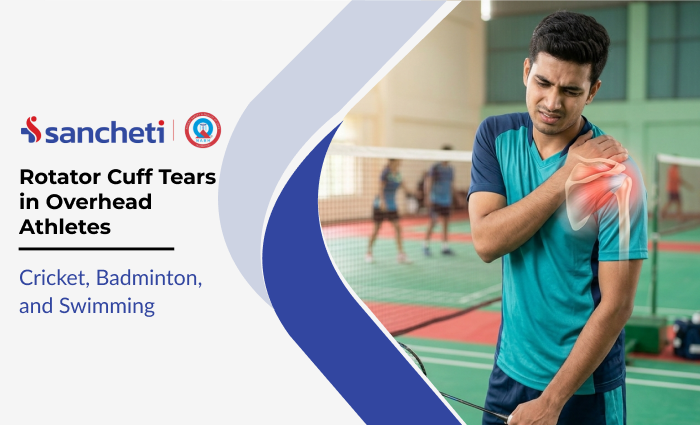

Rotator Cuff Tears in Overhead Athletes: Cricket, Badminton, and Swimming
Rotator cuff tears are among the most debilitating shoulder injuries an overhead athlete can face — and they are far more common than most people realise. In short: years of repetitive overhead motion gradually wear down the tendons of the rotator cuff until they partially or fully tear, often ending seasons and sometimes careers if not caught and treated early. Whether you’re a fast bowler, a badminton shuttler, or a competitive swimmer, this injury deserves your full attention.
At Sancheti Hospital, Pune, our shoulder and sports medicine specialists treat overhead athletes across all levels — from state-level cricketers to national swimmers. This blog explains exactly why these athletes are at such high risk, what the warning signs are, and what your treatment options look like.
What Is the Rotator Cuff and Why Is It So Vulnerable?
The rotator cuff is a group of four muscles and their tendons that wrap around the shoulder joint — the supraspinatus, infraspinatus, teres minor, and subscapularis. Together, they hold the head of the humerus (upper arm bone) firmly within the shallow socket of the shoulder blade, enabling the wide range of motion the shoulder is known for.
This very mobility is also the shoulder’s vulnerability. Unlike the hip joint, which is deeply socketed and inherently stable, the shoulder trades stability for range of motion. The rotator cuff tendons bear enormous load during overhead activities, and over time — or in a single forceful event — that load exceeds what the tissue can handle.
Rotator cuff injuries range from mild tendinitis and partial thickness tears to full-thickness ruptures that disconnect the tendon entirely from the bone.
Why Overhead Athletes Are at Higher Risk
Not all athletes stress the shoulder equally. Cricket, badminton, and swimming are uniquely demanding on the rotator cuff because of the volume, velocity, and mechanics of their overhead movements.
Cricket: Fast Bowlers and Throwers
A fast bowler’s shoulder undergoes extreme internal rotation forces during the delivery stride — forces comparable to those seen in baseball pitchers. The supraspinatus and infraspinatus tendons are placed under maximum eccentric load as the arm decelerates after ball release. Over a long season with inadequate recovery, this leads to cumulative tendon damage.
Fielders who throw repeatedly from the boundary are also at risk. The combination of a long lever arm, high velocity, and poor throwing mechanics creates the ideal conditions for both partial and full-thickness rotator cuff tears.
Badminton: The Overhead Smash
The badminton smash generates one of the fastest racket speeds in any sport. At the point of contact, the shoulder is in full abduction and external rotation — the exact position that compresses the rotator cuff tendons against the acromion (the bony arch above the shoulder). Repeated smashing over years leads to progressive tendon irritation, shoulder impingement syndrome, and eventually tearing if the underlying impingement goes unaddressed.
Swimming: Volume Over Velocity
Swimmers don’t generate the explosive forces seen in cricket or badminton, but what they lack in intensity they make up for in volume. Elite swimmers complete thousands of overhead strokes per training session. The repetitive internal rotation demand of freestyle and butterfly puts sustained stress on the supraspinatus tendon and the biceps tendon anchor — a condition commonly referred to as swimmer’s shoulder that, when neglected, progresses to structural tendon damage.
Types of Rotator Cuff Tears
Understanding the type and severity of a tear directly determines the treatment pathway.
Partial thickness tears involve damage to only a portion of the tendon. The tendon is frayed or split but remains attached to the bone. These are more common in younger athletes and can often be managed conservatively if caught early.
Full thickness tears mean the tendon has torn completely through, either partially across its width or as a complete rupture detaching from the bone. Full tears cause significant loss of strength and shoulder function and are less likely to resolve without surgical intervention.
Tears are also classified by which tendon is involved. The supraspinatus is the most commonly torn tendon in overhead athletes. In more severe cases — particularly after a traumatic event — multiple tendons may be involved simultaneously.
Warning Signs: When to Stop and Get Assessed
Overhead athletes are notorious for playing through pain. This is a dangerous habit with rotator cuff injuries because a partial tear that continues to be loaded will almost always progress to a complete rupture.
Watch for these symptoms:
- Shoulder pain that worsens with overhead activity or at night while lying on the affected side
- Weakness when lifting the arm, especially above shoulder height
- Difficulty reaching behind the back or across the body
- A dull ache that persists even at rest
- A sense of the shoulder feeling “tired” or unstable during sport
- Pain that radiates from the top of the shoulder down the outer arm
Night pain in particular is a hallmark of significant rotator cuff pathology and should never be dismissed as simple muscle soreness.
Diagnosis: What to Expect at Sancheti Hospital
A thorough clinical assessment involves specific provocative tests — the Empty Can test for supraspinatus, the Lift-off test for subscapularis, and the External Rotation Resistance test for infraspinatus — to isolate which tendon is affected and how severely.
MRI is the gold standard for imaging rotator cuff tears. It clearly shows the size, location, and depth of the tear, as well as the condition of the surrounding tendons, bursa, and labrum. In some cases, an ultrasound may be used for dynamic assessment of the tendon during movement.
It is also important to assess for associated injuries. Overhead athletes with rotator cuff pathology frequently have concurrent SLAP tears — damage to the labrum at the top of the shoulder socket — which significantly influences the treatment plan and recovery timeline.
Treatment Options: Conservative vs. Surgical
When Physiotherapy and Conservative Care Come First
Not every rotator cuff tear requires surgery. Partial tears, early-stage tendinopathy, and tears in older or less active athletes often respond well to a structured non-surgical program that includes:
- Activity modification and relative rest from overhead sport
- Anti-inflammatory medications and, in some cases, a corticosteroid injection
- Targeted physiotherapy focusing on rotator cuff strengthening, scapular stability, and posture correction
- Biomechanical assessment and correction of faulty throwing, smashing, or stroking mechanics
For many athletes — particularly those with partial tears or degenerative changes — a 3–6 month rehabilitation program produces meaningful pain relief and functional recovery. The key is committing fully to the program rather than dipping in and out between training sessions.
When Surgery Is the Right Call
Surgery becomes necessary when:
- A full-thickness tear causes significant weakness and functional loss
- A partial tear fails to improve after 3–6 months of diligent conservative treatment
- The athlete is young, highly active, and demands full shoulder function for their sport
- There is a concurrent SLAP tear, biceps tendon rupture, or significant impingement that needs addressing
Shoulder arthroscopy for rotator cuff repair at Sancheti Hospital is performed through small keyhole incisions using miniaturised cameras and instruments. The torn tendon is reattached to the bone using suture anchors — a technique that restores the original footprint of the tendon with minimal disruption to surrounding tissue.
Recovery and Return to Sport
Recovery timelines vary depending on the size of the tear, the number of tendons involved, and the athlete’s sport and position.
- Weeks 1–4: Arm in a sling, gentle pendulum exercises, pain management
- Weeks 4–8: Progressive passive range-of-motion work, sling weaned off
- Months 2–4: Active strengthening of the rotator cuff and scapular stabilisers
- Months 4–6: Sport-specific conditioning — throwing progressions for cricketers, stroke mechanics for swimmers
- Months 6–9: Graduated return to competitive play
It is worth noting that returning to overhead sport after a full-thickness repair takes longer than many athletes expect. Rushing this timeline is one of the most common causes of re-tear. Our sports medicine specialists work closely with athletes throughout each phase to ensure the shoulder is genuinely ready — not just pain-free — before full return to competition.
Key Takeaways
- The rotator cuff is under extreme and repetitive stress in cricket, badminton, and swimming due to the nature of overhead movement in each sport.
- Partial tears can often be managed conservatively; full-thickness tears in active athletes generally require surgery for full functional recovery.
- Night pain, persistent weakness, and a shoulder that feels fatigued during sport are early warning signs that should not be ignored.
- Shoulder arthroscopy for rotator cuff repair is a minimally invasive, highly effective procedure with strong outcomes when combined with proper rehabilitation.
- Returning to competitive overhead sport after surgery typically takes 6–9 months — patience and structured rehabilitation are as important as the operation itself.
- At Sancheti Hospital, Pune, our shoulder specialists understand the biomechanical demands of each sport and tailor treatment plans accordingly.
Frequently Asked Questions (FAQs)
Q1. Can a rotator cuff tear heal on its own without any treatment?
Partial tears in the outer portion of the tendon may stabilise with rest and rehabilitation, but they rarely heal completely on their own. Full-thickness tears have essentially no capacity for self-healing because the torn ends retract and lose contact with each other. Without treatment — surgical or otherwise — a full tear tends to progress in size over time.
Q2. How do I know if my shoulder pain is a rotator cuff tear or just muscle soreness?
Muscle soreness typically resolves within 48–72 hours with rest. Rotator cuff pain tends to be more persistent, worsens specifically with overhead activity, is often felt at night, and is accompanied by weakness when lifting the arm. If shoulder pain has lasted more than two weeks without improvement, it warrants a proper orthopaedic evaluation rather than continued self-management.
Q3. Is there an age limit for rotator cuff repair surgery?
There is no strict age limit. The decision is based on the patient’s overall health, the size and chronicity of the tear, tissue quality, and functional demands. Older patients with large, long-standing tears may have more retracted tendons and poorer tissue quality, which makes surgical repair more complex — but it is still performed successfully in appropriately selected patients.
Q4. Can rotator cuff tears be prevented in overhead athletes?
While not entirely preventable, the risk can be significantly reduced through proper warm-up routines, rotator cuff strengthening exercises, scapular stability training, and regular biomechanical review of throwing or stroking technique. Managing training loads — avoiding sudden spikes in bowling overs, smash repetitions, or swimming yardage — is equally important in keeping cumulative tendon stress within safe limits.
Q5. What happens if a rotator cuff tear is left untreated for a long time?
A neglected full-thickness tear tends to enlarge over time as the remaining tendon tissue continues to fray under load. Eventually, the muscle attached to the torn tendon undergoes fatty infiltration — a degenerative process where muscle tissue is replaced by fat — making surgical repair progressively less effective. This is why early diagnosis and timely treatment consistently produce better outcomes than delayed intervention.