Home
Home PG College
 Patient Login
 Sancheti Clinic
 Contact Us
 Download Reports
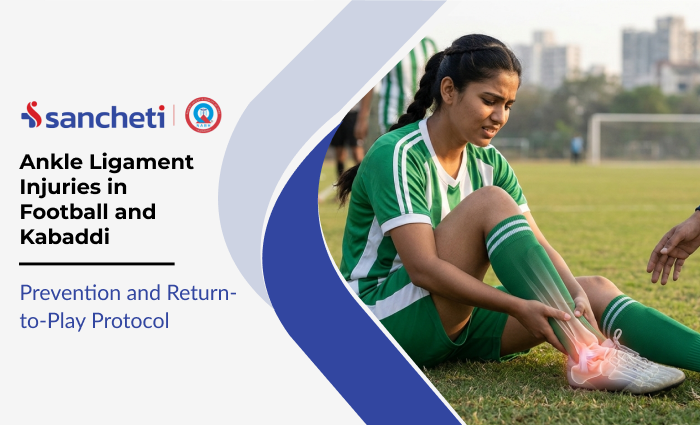

Ankle Ligament Injuries in Football and Kabaddi: Prevention and Return-to-Play Protocol
Ankle ligament injuries are the single most common sports injury in both football and kabaddi — and yet they remain one of the most undertreated. An ankle sprain might sound minor, but inadequately rehabilitated ligament damage is one of the leading causes of chronic ankle instability, repeat injury, and premature exit from competitive sport.
At Sancheti Hospital, Pune, our sports medicine and foot and ankle specialists work with athletes across contact and field sports daily.
Why Football and Kabaddi Athletes Are Especially Vulnerable
The ankle is the most mobile weight-bearing joint in the body, and that mobility comes at a cost in high-contact, multi-directional sports.
In football, the mechanisms are well documented — sudden changes of direction, slide tackles, landing from headers, stepping on another player’s foot, and playing on uneven ground. The lateral ankle ligaments, particularly the anterior talofibular ligament (ATFL), are placed under maximum stress when the foot rolls inward during these movements.
In kabaddi, the demands are arguably even more extreme. Raiders make explosive lunges, pivots, and direction changes on a compact court surface, while defenders execute sudden tackle-and-hold manoeuvres that load the ankle in unpredictable positions. The physical contact involved — grappling, pulling, and falling — adds a traumatic dimension that football doesn’t always share. Kabaddi’s rising profile at the national and professional level means more athletes are training at higher intensities, and ankle injuries are rising in parallel.
Anatomy of the Ankle Ligaments: What Actually Gets Injured
The ankle has ligaments on both sides, but the vast majority of sports-related injuries involve the lateral ligament complex on the outer side of the joint. This complex consists of three ligaments:
- Anterior talofibular ligament (ATFL) — the most commonly injured, torn in nearly all lateral ankle sprains
- Calcaneofibular ligament (CFL) — injured in more severe sprains alongside the ATFL
- Posterior talofibular ligament (PTFL) — rarely torn, only in severe dislocations
The medial (deltoid) ligament on the inner side is much stronger and less frequently injured, though high-energy contact injuries in kabaddi can affect it.
Understanding which ligament is torn — and how severely — is what guides every subsequent decision about treatment, rehabilitation, and return to play.
Grading Ankle Ligament Injuries
Ankle sprains are graded into three levels, each with distinct implications for management:
Grade 1 — Mild stretching of the ligament with no structural tearing. Localised tenderness, minimal swelling, no instability. The athlete can usually bear weight. Recovery typically takes 1–2 weeks.
Grade 2 — Partial tear of the ligament. Moderate swelling, bruising, pain with weight-bearing, and some degree of joint laxity on examination. Recovery takes 3–6 weeks with proper rehabilitation.
Grade 3 — Complete rupture of one or more ligaments. Significant swelling, bruising, inability to bear weight, and clear mechanical instability. Recovery takes 6–12 weeks or longer, and some cases require surgical consideration.
The problem in sport — particularly in kabaddi where matches continue through pain — is that Grade 2 and 3 injuries are frequently undertreated as Grade 1. This is how ankle instability becomes a chronic, recurring problem that ultimately shortens athletic careers.
Diagnosing the Injury Correctly
Clinical examination remains the cornerstone of diagnosis. The anterior drawer test assesses ATFL integrity, while the talar tilt test evaluates the CFL. Both are performed by an orthopaedic specialist with the ankle in a specific position to stress each ligament independently.
X-rays are taken primarily to rule out associated ankle fractures, which can mimic sprain symptoms — a distinction that matters enormously for management. The Ottawa Ankle Rules are a validated clinical tool that helps determine when imaging is necessary.
MRI is reserved for cases where the injury doesn’t respond to treatment as expected, where chronic instability is present, or where associated injuries are suspected. This is particularly important because significant ankle sprains in athletes — especially those involving the ATFL and CFL together — can be associated with osteochondral lesions of the talus, where the cartilage lining of the ankle joint is damaged. These lesions are easily missed on X-ray but clearly visible on MRI, and if left unaddressed they become a source of chronic pain and joint degeneration. Osteochondral lesions of the ankle are far more common in athletes than the general population precisely because of this mechanism.
Acute Management: First 72 Hours Matter
What an athlete does — or doesn’t do — in the first three days after an ankle ligament injury has a direct bearing on recovery speed and ligament healing quality.
The POLICE protocol (Protection, Optimal Loading, Ice, Compression, Elevation) has largely replaced the older RICE approach in sports medicine practice:
- Protection — avoid activities that reproduce pain or stress the healing ligament
- Optimal Loading — early, pain-free movement is encouraged to stimulate ligament healing; complete immobilisation is counterproductive
- Ice — applied for 15–20 minutes every 2 hours in the first 48 hours to limit swelling
- Compression — a firm bandage reduces swelling and provides proprioceptive feedback
- Elevation — keeping the ankle above heart level reduces fluid accumulation
Crutches may be needed for Grade 2 and 3 injuries in the first few days, but prolonged non-weight-bearing beyond what is necessary slows recovery and weakens the surrounding musculature.
Rehabilitation: Phase That Decides Everything
This is where the gap between “recovered” and “fully rehabilitated” is either closed or left open — and where most re-injuries originate.
A structured ankle rehabilitation program moves through four phases:
Phase 1 — Acute (Days 1–7): Pain and swelling control, gentle range-of-motion exercises, isometric strengthening, protected weight-bearing as tolerated.
Phase 2 — Subacute (Weeks 2–4): Progressive strengthening of the peroneal muscles (the ankle’s primary dynamic stabilisers), proprioception training on stable surfaces, full weight-bearing, and restoration of normal gait.
Phase 3 — Neuromuscular (Weeks 4–8): Balance training on unstable surfaces, single-leg exercises, agility ladder work, and sport-specific movement patterns introduced at reduced intensity.
Phase 4 — Sport-Specific (Weeks 6–12+): Full-speed direction changes, contact drills, position-specific movements. For kabaddi raiders, this means lunging and pivoting patterns; for football players, cutting, crossing, and jumping sequences.
A well-structured physiotherapy and rehabilitation program that progresses through these phases systematically — rather than jumping straight from “no pain” to “back on the field” — is what separates athletes who recover fully from those who go on to suffer repeat injuries season after season.
When Surgery Is Considered
The vast majority of ankle ligament injuries, including most Grade 3 tears, heal successfully with conservative management. Surgery is considered in a limited set of circumstances:
- Persistent mechanical instability despite 3–6 months of structured rehabilitation
- Associated osteochondral lesion or loose body inside the joint requiring arthroscopic treatment
- Elite athletes with complete multi-ligament ruptures and high return-to-sport demands
- Failed previous conservative management with ongoing functional instability
The Brostrom-Gould procedure is the gold standard surgical repair for chronic lateral ankle instability — it tightens the stretched or torn ATFL and reinforces it with the adjacent retinaculum. This is performed as part of our foot and ankle surgery program at Sancheti Hospital, with rehabilitation following the same phased approach as conservative management, adjusted for surgical healing timelines.
Return-to-Play Protocol: Criteria That Actually Matter
“When can I play again?” is the most common question we hear. The honest answer is: when your ankle meets objective criteria — not when the pain has settled.
A structured return-to-play protocol for ankle ligament injuries requires the athlete to demonstrate:
- Full pain-free range of motion equal to the uninjured side
- Strength of the peroneal and calf muscles at least 90% of the uninjured side
- Single-leg balance equal to the uninjured side on both stable and unstable surfaces
- Completion of sport-specific drills — cutting, jumping, contact — without pain, swelling, or instability
- Psychological readiness and confidence to play at full intensity
Returning before these benchmarks are met — particularly the strength and neuromuscular control criteria — dramatically increases the risk of re-sprain. At Sancheti Hospital’s sports medicine division, return-to-play decisions are made collaboratively between the orthopaedic specialist, physiotherapist, and where available, the team’s coach or trainer — because what gets an athlete back safely is a shared responsibility.
Prevention: Reducing the Risk Before the Injury Happens
Ankle ligament injuries are not entirely preventable, but the evidence for reducing their frequency is strong:
- Proprioception and balance training as part of pre-season conditioning — even 10–15 minutes of balance board work per session measurably reduces sprain incidence
- Ankle taping or bracing during match play for athletes with a previous sprain history
- Adequate warm-up before training and matches, including dynamic ankle mobility drills
- Footwear appropriate to the surface — studs suited to firm ground in football, court shoes with lateral support in kabaddi
- Strengthening the peroneal muscles — the most underappreciated prevention tool; strong peroneals react fast enough to prevent the ankle from rolling under load
Key Takeaways
- Ankle ligament injuries are the most common injury in both football and kabaddi, and the ATFL is the most frequently torn ligament.
- Correct grading of the sprain — Grade 1, 2, or 3 — determines the entire treatment and rehabilitation pathway.
- Associated injuries like osteochondral lesions are more common than athletes realise and should be ruled out with MRI when recovery stalls.
- The POLICE protocol in the first 72 hours, followed by a phased rehabilitation program, is the foundation of full recovery.
- Return to play should be based on objective strength, balance, and functional criteria — not just pain resolution.
- Surgery is rarely needed but is highly effective for chronic instability that fails conservative management.
- At Sancheti Hospital, Pune, our foot, ankle, and sports medicine specialists guide athletes through every stage — from acute injury management to safe, confident return to competition.
Frequently Asked Questions (FAQs)
Q1. Is it normal for an ankle sprain to still hurt after 6 weeks?
Persistent pain beyond 6 weeks after a moderate to severe sprain warrants reassessment. It can indicate incomplete rehabilitation, a missed associated injury such as an osteochondral lesion or peroneal tendon damage, or developing chronic instability. An MRI at this stage is often informative and helps redirect the management plan.
Q2. How is chronic ankle instability different from a regular sprain?
A regular sprain is an acute injury that heals with appropriate treatment. Chronic ankle instability is a pattern of repeated sprains and persistent giving-way that develops when earlier injuries are inadequately rehabilitated. The ligaments heal in a lengthened, lax position, reducing the ankle’s ability to resist inversion forces during sport.
Q3. Should I be taping my ankle for every match even after full recovery?
Preventive taping or bracing is strongly recommended for athletes with a history of ankle sprains for at least the first 6–12 months after return to play. After that, the decision depends on whether any residual instability remains. Taping does not replace strength and proprioception training — it works best as an adjunct to, not a substitute for, proper conditioning.
Q4. Can a kabaddi player return to play with Grade 3 ankle sprain without surgery?
Yes, in most cases. The majority of Grade 3 lateral ankle ligament tears heal functionally with structured rehabilitation over 8–12 weeks, even in high-demand athletes. Surgery is considered only when rehabilitation has been completed diligently and the ankle remains mechanically unstable — not as a first response to a complete tear.
Q5. What is the difference between an ankle sprain and an ankle fracture — and how can I tell?
Both cause pain, swelling, and difficulty weight-bearing immediately after injury. Fractures tend to produce bony tenderness directly over the malleolus (the bony bumps on either side of the ankle), whereas ligament sprains produce tenderness over the soft tissue just in front of or below those bony landmarks. However, clinical distinction is unreliable — X-rays are needed whenever there is significant swelling, inability to bear weight, or direct bony tenderness. Never self-diagnose a significant ankle injury.