Home
Home PG College
 Patient Login
 Sancheti Clinic
 Contact Us
 Download Reports
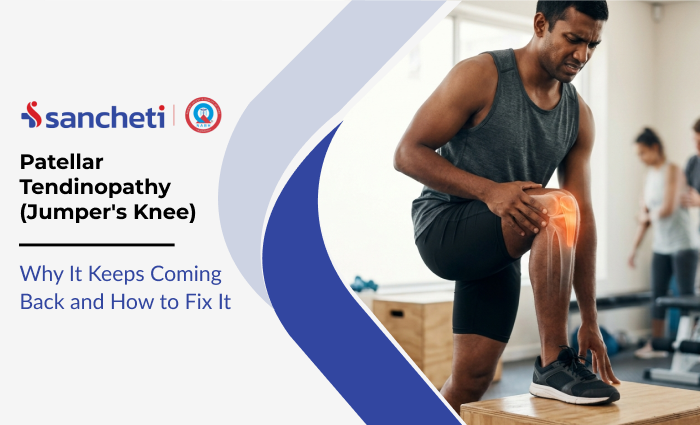

Patellar Tendinopathy (Jumper’s Knee): Why It Keeps Coming Back and How to Fix It
Patellar tendinopathy — commonly called jumper’s knee — is one of the most frustrating overuse injuries in sport. It keeps coming back not because athletes are unlucky, but because it is almost always undertreated the first time. In short: the patellar tendon degenerates under repetitive load faster than it can repair itself, and the conventional approach of rest alone does nothing to address the root cause. Understanding why it recurs is the first step to actually fixing it for good.
At Sancheti Hospital, Pune, our sports medicine and orthopaedic team regularly sees athletes — from basketball and volleyball players to sprinters and kabaddi raiders — caught in the same cycle of partial recovery and re-flare. This blog explains the biology behind the injury, why standard rest-based management fails, and what a rehabilitation-led approach that actually works looks like.
What Is the Patellar Tendon and What Does It Do?
The patellar tendon connects the patella (kneecap) to the tibia (shin bone) and forms the final link in the quadriceps mechanism — the muscular chain responsible for straightening the knee. Every time you jump, sprint, squat, or land, this tendon absorbs and transmits enormous force. In elite jumping athletes, the patellar tendon can experience loads of up to seven times body weight during a single landing.
It is this extraordinary mechanical demand that makes the tendon vulnerable. Unlike acute injuries caused by a single event, patellar tendinopathy is a cumulative condition — the result of repeated microtrauma that outpaces the tendon’s ability to remodel and heal.
Why Is It Called Jumper’s Knee?
The term jumper’s knee reflects the sports where it is most prevalent — volleyball, basketball, athletics (jumping events), and any discipline involving repeated explosive knee loading. In the Indian sporting context, kabaddi, kho-kho, and court-based sports see a disproportionately high number of cases, particularly in athletes who train heavily during competitive seasons without adequate periodisation.
The injury is not exclusive to jumping sports, however. Sprinters, cyclists, and even weightlifters can develop patellar tendon pain because the common factor is not jumping per se — it is the volume and intensity of quadriceps loading over time.
Biology of Tendinopathy: Why Rest Alone Does Not Work
This is the most important thing to understand about patellar tendinopathy — and the most commonly misunderstood.
A healthy tendon is a highly organised structure of parallel collagen fibres. In tendinopathy, repeated overload disrupts this organisation. The tendon responds by attempting to heal, but the new tissue is disorganised, less stiff, and more pain-sensitive than the original. This disorganised tissue is called tendinotic tissue, and it does not respond to rest the way an inflamed structure would.
This is why patellar tendinopathy is not strictly an inflammatory condition — the older term “tendinitis” is actually a misnomer for chronic cases. Anti-inflammatory medications and rest manage symptoms temporarily, but they do not restore tendon structure. The moment the athlete returns to loading, the disorganised tissue fails again under stress — and the cycle repeats.
The tendon does not need less load. It needs the right kind of load, applied progressively, to stimulate proper collagen remodelling. This is the principle that underpins modern tendinopathy rehabilitation, and it is why athletes who follow a structured physiotherapy and rehabilitation program fare significantly better than those who simply rest and return.
Recognising the Symptoms
Jumper’s knee symptoms follow a recognisable pattern that distinguishes them from other causes of anterior knee pain:
- A sharp or burning pain at the inferior pole of the patella — the bony tip at the bottom of the kneecap — which is the tendon’s attachment point
- Pain that is typically worst at the start of activity, eases after a warm-up, and returns after training
- Stiffness and pain the morning after a heavy training session
- Tenderness on direct palpation of the patellar tendon, particularly at its upper attachment
- In more advanced cases, pain persists throughout activity and begins to interfere with daily tasks like climbing stairs or sitting for long periods
The symptom pattern — pain that warms up and temporarily eases — is one of the hallmarks of tendinopathy and helps distinguish it from conditions like knee fractures or bursitis, which tend to cause more constant, activity-independent pain.
Diagnosis: Grading the Severity
Clinical diagnosis is based on the location and behaviour of pain. The Victorian Institute of Sport Assessment — Patella (VISA-P) score is a validated questionnaire used to quantify symptom severity and track progress over time. It asks about pain during specific activities and its impact on sport participation, giving a score out of 100 — where 100 represents a fully symptom-free tendon.
Imaging confirms the diagnosis and assesses structural severity:
- Ultrasound is the most practical tool — it shows tendon thickening, disorganised fibres, and neovascularisation (new blood vessel ingrowth, a marker of chronic tendinopathy) in real time
- MRI provides a more detailed picture of tendon structure and rules out associated pathology, including partial tears or involvement of the fat pad beneath the tendon
Grading tendinopathy severity guides how aggressively rehabilitation should progress and whether any adjunct interventions are warranted.
Why Does It Keep Coming Back? Real Reasons
Athletes who experience repeated flare-ups of patellar tendinopathy almost always share one or more of the following patterns:
Returning to sport too early: Pain resolution is not the same as tendon recovery. A tendon can become pain-free within days to weeks of rest, but its structural integrity and load tolerance may not be restored for several months. Athletes who return to full training at this point are loading a tendon that is biochemically and structurally still compromised.
Inadequate quadriceps and hip strength: Weakness in the quadriceps, hip abductors, and gluteal muscles increases the mechanical burden on the patellar tendon during every jump and landing. The tendon compensates for what the surrounding musculature cannot — and eventually exceeds its load capacity.
Training load spikes: A sudden increase in training volume or intensity — pre-season camp, tournament preparation, adding heavy plyometric sessions — is the most common trigger for both initial onset and recurrence. The tendon adapts slowly; the training schedule often does not account for this.
Incomplete rehabilitation: Many athletes stop their exercise program as soon as pain settles, before completing the strength and load progression stages. This leaves the tendon structurally vulnerable to the next training cycle.
Treatment Approach That Actually Works
Stage 1 — Load Management and Isometric Exercise
The first goal is to reduce pain while maintaining some tendon stimulus. Complete rest is avoided. Isometric quadriceps exercises — where the muscle contracts without movement, such as a static wall sit — have been shown to provide significant pain relief in reactive tendinopathy and help maintain tendon stiffness during the early management phase.
Stage 2 — Heavy Slow Resistance Training
This is the cornerstone of patellar tendinopathy rehabilitation and the stage most commonly skipped. Heavy slow resistance exercises — such as slow squats, leg press, and Bulgarian split squats performed at a 3-second down, 3-second up tempo — apply the sustained mechanical stimulus the tendon needs to remodel its collagen architecture.
The load must be genuinely heavy (typically 70–85% of maximum), and the tempo must be slow. These two factors together are what drive tendon adaptation. Light, fast exercises do not produce the same stimulus. This phase typically lasts 8–12 weeks and is where the majority of structural tendon recovery occurs.
Stage 3 — Energy Storage and Release Exercises
Once the tendon has adequate load tolerance from heavy slow resistance work, the program reintroduces plyometric and elastic loading — the kind of loading that occurs during jumping and sprinting. This is done progressively, beginning with low-amplitude exercises like skipping and progressing to sport-specific jumping sequences.
Jumping back into plyometrics without completing Stage 2 is one of the most reliable ways to trigger a recurrence.
Stage 4 — Sport-Specific Return
The final phase reintegrates full training demands — position-specific movements, competitive intensity, contact where relevant. Return to sport is guided by VISA-P scores, strength testing, and the athlete’s ability to complete sport-specific drills without pain provocation.
Our sports medicine specialists at Sancheti Hospital supervise this entire progression, adjusting load parameters based on how the tendon responds at each stage rather than following a fixed calendar timeline.
Adjunct Treatments: What Helps and What Doesn’t
Several interventions are used alongside the rehabilitation program to manage symptoms and support tendon recovery:
Platelet-Rich Plasma (PRP) injections — involve injecting a concentration of the patient’s own growth factors into the tendon. Evidence supports their use in chronic, treatment-resistant cases as an adjunct to loading rehabilitation, not a standalone cure.
Extracorporeal shockwave therapy (ESWT) — uses high-energy acoustic waves to stimulate tendon remodelling and reduce neovascularisation. It is most effective in chronic tendinopathy and is typically delivered over 3–6 sessions.
Corticosteroid injections — provide short-term pain relief but are now known to weaken tendon tissue with repeated use. They are used very selectively and never as a primary treatment strategy for tendinopathy.
Surgery — reserved for a small minority of cases where 6–12 months of structured conservative management has genuinely failed. Arthroscopic debridement of the degenerative tendon tissue through our arthroscopic and sports surgery program is the most common surgical approach, with good outcomes in carefully selected patients.
Long-Term Risk of Ignoring It
Athletes who continue to train through persistent patellar tendon pain without proper management face two significant risks. The first is a patellar tendon rupture — a complete or near-complete tear that requires surgical repair and carries a lengthy recovery of 6–12 months. The second is progressive tendon degeneration that, over years, contributes to altered knee mechanics and early onset knee osteoarthritis — particularly in athletes who have been loading a structurally compromised tendon across multiple seasons.
Neither outcome is inevitable. Both are largely preventable with timely, correctly structured management.
Key Takeaways
- Patellar tendinopathy is a degenerative condition, not an inflammatory one — rest alone does not fix it because it does not restore tendon structure.
- It keeps recurring because athletes return too early, skip strength work, or spike training loads before the tendon has fully adapted.
- The treatment that works is progressive tendon loading — starting with isometrics, moving through heavy slow resistance training, and finishing with sport-specific plyometrics in a structured sequence.
- Adjunct therapies like PRP and shockwave can support recovery in chronic cases but only alongside a proper loading program.
- Surgery is a last resort for a small minority of cases that have genuinely failed 6–12 months of structured conservative management.
- At Sancheti Hospital, Pune, our sports medicine and orthopaedic specialists assess tendon health objectively and build athlete-specific rehabilitation programs that address the root cause — not just the symptoms.
Frequently Asked Questions (FAQs)
Q1. How long does patellar tendinopathy take to fully recover?
It depends on how long the condition has been present and how consistently rehabilitation is followed. Reactive tendinopathy caught early can resolve within 6–12 weeks. Chronic, long-standing tendinopathy with significant structural disorganisation typically requires 3–6 months of structured loading rehabilitation. Skipping stages or returning to sport prematurely extends this timeline significantly.
Q2. Should I stop playing sports completely while treating the jumper’s knee?
Not necessarily. Complete rest is rarely the right answer. Most athletes can continue modified training — maintaining fitness through low-tendon-load activities like swimming or cycling — while progressively rehabilitating the tendon through a loading program. The key is avoiding activities that provoke pain above a mild level during the acute phase.
Q3. Is patellar tendinopathy the same as patellar tendon rupture?
No. Tendinopathy is a degenerative condition involving disorganised collagen and pain, but the tendon remains structurally intact. A patellar tendon rupture is a complete or near-complete tear of the tendon, causing sudden severe pain, inability to extend the knee, and a visible gap below the kneecap. Rupture is a surgical emergency. However, a chronically degenerated tendon is at higher risk of rupture if it continues to be loaded without treatment — which is one reason tendinopathy should not be ignored.
Q4. Can stretching and foam rolling fix patellar tendinopathy?
Stretching and foam rolling have a role in managing muscle tightness around the knee and reducing load on the tendon indirectly, but they do not stimulate tendon remodelling on their own. They are useful adjuncts within a broader rehabilitation program but should not be mistaken for a treatment strategy in themselves.
Q5. Does wearing a patellar tendon strap actually help?
A patellar tendon strap applies pressure just below the kneecap and can provide meaningful short-term pain relief during activity by altering the force distribution along the tendon. It is a useful symptomatic tool — particularly useful during the early stages of return to sport — but it does not treat the underlying tendon degeneration. Think of it as pain management support, not a cure.