Home
Home PG College
 Patient Login
 Sancheti Clinic
 Contact Us
 Download Reports

Living with Trigeminal Neuralgia: Causes and Pain Management Options
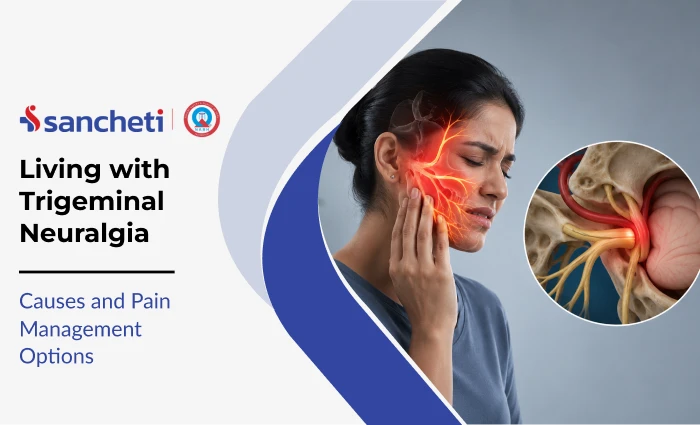
Trigeminal neuralgia is a chronic neuropathic pain disorder characterised by sudden, severe, electric shock-like pain in the face, typically lasting a fraction of a second to two minutes per attack, triggered by ordinary activities such as eating, speaking, or brushing teeth.
At Sancheti Hospital, Pune, our Neurology Department manages patients across the full spectrum of facial nerve pain, from newly diagnosed cases responding to medication, to treatment-refractory cases requiring surgical evaluation.
What Is Trigeminal Neuralgia?
The trigeminal nerve is the primary sensory nerve of the face. It exits the brain at the level of the pons (lower brainstem) and divides into three branches, each supplying distinct areas of the face.
Trigeminal neuralgia occurs when the nerve’s normal insulating layer, the myelin sheath, is damaged at the trigeminal root entry zone. This focal demyelination causes abnormal electrical firing: the nerve discharges intensely in response to stimuli that should produce no pain at all, such as a light touch on the cheek or a gentle breeze.
Who It Affects
A systematic review found a pooled global incidence of 25.3 cases per 100,000 person-years.
Key epidemiological patterns:
- Women are affected approximately 1.5 times more often than men
- The 51-59 age group has the highest prevalence; incidence rises sharply with age
- The right side of the face is affected slightly more often than the left
- The V2 and V3 branches are most commonly involved; V1 alone is least common
- Approximately 2-8% of patients with trigeminal neuralgia have underlying multiple sclerosis
Trigeminal neuralgia is not fatal, but its impact on daily function is severe. The chronic, unpredictable nature of attacks, occurring without warning during everyday activities, produces significant anxiety, depression, social withdrawal, and compromised sleep quality in many patients. Early and effective management is therefore important not only for pain control but for psychological wellbeing.
Types of Trigeminal Neuralgia
The International Classification of Headache Disorders (ICHD-3) defines three types of trigeminal neuralgia. The distinction matters clinically because each type has different underlying pathology, responds differently to treatment, and carries a different surgical prognosis.
| Type | Underlying Mechanism | Proportion of Cases | Key Clinical Feature |
|---|---|---|---|
| Classical TN | Neurovascular compression at the trigeminal root entry zone; causes focal demyelination and nerve hyperexcitability | 75% | MRI shows vascular contact with morphological change of the nerve root |
| Idiopathic TN | No identifiable cause on clinical examination or imaging; presumed microscopic or metabolic nerve injury | 10% | Diagnosis of exclusion; clinically indistinguishable from classical TN |
| Secondary TN | Caused by an underlying disease that damages the trigeminal nerve at the brainstem | 15% | Responds less predictably to pharmacological and surgical treatment |
Symptoms of Trigeminal Neuralgia
The pain pattern of trigeminal neuralgia is among the most diagnostically distinctive in medicine. The International Headache Society requires at least three attacks meeting specific criteria before diagnosis is confirmed.
| Feature | Description |
|---|---|
| Pain quality | Electric shock-like, stabbing, lancinating, or burning, not dull or aching |
| Duration per attack | A fraction of a second to two minutes per paroxysm |
| Laterality | Strictly unilateral; bilateral TN is rare and usually suggests secondary cause |
| Distribution | Confined to the territory of one or more trigeminal branches (V1, V2, V3) |
| Trigger zone | A specific area of the face, often around the mouth or nose, that reliably triggers attacks when touched |
| Triggering activities | Eating, drinking, speaking, smiling, tooth brushing, light touch on the face, cold wind, or washing the face |
| Pain-free intervals | Complete absence of pain between attacks in the purely paroxysmal form; a minority have background dull ache in addition |
| Refractory period | After a paroxysm, a brief period in which repeated stimulation does not trigger further attacks |
The severity of each attack, combined with the unpredictability of triggers, is what makes trigeminal neuralgia so disabling. Patients may stop eating solid food, avoid speaking above a whisper, refuse to go outdoors, and abandon dental care; not out of anxiety, but as rational avoidance of known triggers.
Diagnosis for Trigeminal Neuralgia
Trigeminal neuralgia is primarily a clinical diagnosis, it is based on the history and the characteristic pattern of pain. However, imaging is mandatory to classify the type and guide treatment.
Clinical Assessment
A specialist will assess: the quality, duration, distribution, and triggers of pain; whether attacks are purely paroxysmal or include a background ache; the presence of a trigger zone; any prior medical or dental treatments; and whether there are additional neurological findings (sensory loss, motor weakness in the jaw, or other cranial nerve involvement). The presence of neurological signs beyond pain should raise suspicion for secondary TN.
MRI with Dedicated Trigeminal Protocol
High-resolution MRI using three-dimensional sequences is the investigation of choice. It serves three purposes: identifying neurovascular compression at the root entry zone; classifying the type of TN; and ruling out secondary causes. The purpose of demonstrating neurovascular contact on MRI is to guide surgical decision-making, not to validate the clinical diagnosis.
Differential Diagnosis
Several conditions mimic trigeminal neuralgia, and correct differentiation is clinically important because treatment differs substantially:
| Condition | Key Differentiating Feature |
|---|---|
| Dental pain (pulpitis, abscess) | Persistent, often throbbing; not triggered by light touch; localised to a specific tooth |
| Post-herpetic neuralgia | Follows a shingles outbreak in the same distribution; constant burning rather than paroxysmal |
| Cluster headache | Severe unilateral periorbital pain with autonomic features (tearing, nasal discharge); longer attacks |
| Temporomandibular joint (TMJ) disorder | Jaw pain with clicking; worsened by chewing; associated with limited jaw opening |
| Glossopharyngeal neuralgia | Similar paroxysmal character but triggered by swallowing; pain in the throat and ear rather than face |
| MS-related facial pain | May be continuous rather than purely paroxysmal; often bilateral; associated with other MS symptoms |
Treatment Options
Trigeminal neuralgia treatment doesn’t provide cure for the condition. The aim is to achieve satisfactory pain control, ideally freedom from attacks, with the least burdensome treatment at each stage. Management follows a stepwise hierarchy from medication through to surgery.
Step 1: First-Line Medication
Carbamazepine is the only medication with Class I (Level A) evidence for trigeminal neuralgia. A study confirmed significant efficacy in reducing pain intensity and frequency. It acts by stabilising voltage-gated sodium channels, reducing the abnormal neuronal firing that produces attacks. A single 100 mg tablet can provide complete relief within two hours in responsive patients. The starting dose is typically 100-200 mg twice daily, titrated upward as needed.
Side effects limit long-term use in some patients: drowsiness, dizziness, balance problems, and low sodium (hyponatraemia) are common.
Step 2: Second-Line Medications
- Oxcarbazepine: A structurally related alternative to carbamazepine with a more favourable tolerability profile; often preferred when carbamazepine causes significant side effects.
- Lamotrigine: Second-line option; evidence is less robust than carbamazepine but useful as add-on therapy when first-line agents provide incomplete control
- Baclofen: A GABA-B agonist used as an add-on to carbamazepine; may potentiate pain relief
- Gabapentin and pregabalin: Commonly used for neuropathic pain broadly; evidence in TN is less established than for carbamazepine, but used in practice when first-line drugs are not tolerated
When two medication trials at adequate doses fail to control attacks, specialist referral for surgical evaluation is appropriate.
Step 3: Surgical Options
Surgery is indicated when medications fail to control attacks adequately, produce intolerable side effects, or when the patient and clinician agree that a more definitive approach is appropriate. Three broad categories of surgical intervention are available, each with different mechanisms, risk profiles, and durability of pain relief.
The Neurology Department at Sancheti Hospital, Pune, evaluates each patient’s age, fitness, TN type, imaging findings, and prior treatment history before recommending any surgical option. There is no single best surgical approach for all patients with trigeminal neuralgia.
Living with Trigeminal Neuralgia
Trigeminal neuralgia is a chronic condition. For most patients, it persists over years to decades, with periods of remission punctuated by relapse. Managing it well requires more than medication: it demands consistent self-management, monitoring for trigger patterns, and active attention to mental health.
Trigger Identification and Management
Most patients develop a reliable understanding of their triggers over time. Systematic trigger mapping helps. Common individual triggers include cold wind, cold or hot foods and drinks, certain textures of food, specific facial movements, dental procedures, and emotional stress. Keeping a pain diary to correlate attacks with activities, foods, weather, and stress levels allows informed modification of daily routines.
Medication Adherence and Monitoring
Carbamazepine and similar agents require consistent dosing to maintain therapeutic blood levels. Missing doses or abrupt discontinuation can cause breakthrough attacks or withdrawal effects. Patients on long-term carbamazepine require periodic monitoring: full blood count (risk of aplastic anaemia), liver function tests, and serum sodium levels.
Mental Health and Psychological Support
The psychological burden of trigeminal neuralgia is clinically significant and often underaddressed. Studies consistently find elevated rates of anxiety and depression in TN patients, not as a secondary feature, but as a direct consequence of unpredictable, severe pain and the lifestyle restrictions it imposes.
Physiotherapy and Rehabilitation
A physiotherapist experienced in facial pain can address secondary musculoskeletal problems that develop in TN patients, jaw tension, cervical muscle tightness, and postural changes from habitual facial guarding.
Planning Around Remissions
Spontaneous remissions occur in some patients, particularly early in the condition. Medication should not be abruptly discontinued during remission without discussion with the treating neurologist; controlled gradual dose reduction under supervision is appropriate if remission appears sustained.
Prevention of Trigeminal Neuralgia
There is no established way to prevent trigeminal neuralgia from developing. The condition is structural and neurological in origin. What can be managed is the prevention of attacks in established TN and the optimisation of long-term outcomes.
- Consistent medication adherence: The most effective way to prevent breakthrough attacks in controlled TN is uninterrupted, correctly dosed pharmacological management.
- Early treatment of secondary causes: In MS-related TN, optimising disease-modifying therapy for MS itself may reduce TN attack frequency by reducing active central demyelination
- Protect high-risk patients: Patients with known multiple sclerosis benefit from proactive neurological screening for TN onset, as early diagnosis enables earlier treatment initiation
- Avoid known personal triggers: Once identified through observation, consistently avoiding or modifying exposure to reliable triggers reduces attack frequency.
- Do not delay surgical evaluation: Patients who are medically fit and have failed two medication trials should seek surgical assessment without undue delay
- Address dental health proactively: Regular dental care with prior communication about TN status significantly reduces procedure-related attack risk
Key Takeaways
- Trigeminal neuralgia is characterised by electric shock-like facial pain lasting seconds to two minutes per attack, triggered by ordinary activities including eating, speaking, and light facial touch.
- Women affected approximately 1.5 times more often than men.
- Three types are recognised: classical TN, idiopathic TN, and secondary TN.
- Carbamazepine is the only first-line medication with Class I (Level A) evidence.
- Surgery is appropriate when two adequate medication trials fail.
- The psychological burden of trigeminal neuralgia is clinically significant. Anxiety, depression, and social withdrawal are common consequences of undertreated TN and should be addressed as part of comprehensive management.
- Patients who have failed medications and are surgically fit should not delay specialist surgical evaluation.
- At Sancheti Hospital, Pune, our Neurology Department assesses each patient’s TN type, imaging findings, medication history, and surgical fitness to build a treatment plan appropriate for their specific situation and stage of disease.
Frequently Asked Questions (FAQs)
Q1. Is trigeminal neuralgia the same as a toothache or jaw pain?
No, and this distinction is clinically important. Trigeminal neuralgia produces brief, electric shock-like paroxysms in the territory of the trigeminal nerve, lasting seconds per attack, triggered by light touch or movement, and completely pain-free between attacks. Dental pain (from pulpitis, abscess, or gum disease) is typically persistent, often throbbing, localised to a specific tooth, and associated with cold sensitivity or tenderness on percussion. Many TN patients undergo unnecessary dental extractions before the correct diagnosis is made, because the pain is in the jaw or cheek.
Q2. Can trigeminal neuralgia go away on its own?
Spontaneous remissions occur in some patients, particularly in the earlier stages of the condition. These can last weeks to months without any change in treatment. However, trigeminal neuralgia is a chronic condition; remissions do not indicate permanent resolution, and attacks typically return, often with increasing frequency and severity over the years without treatment.
Q3. Why does carbamazepine stop working over time?
This is a recognised phenomenon called tachyphylaxis, a gradual reduction in the drug’s effectiveness at the same or higher doses over time. It is thought to reflect progressive changes in the underlying nerve and changes in sodium channel expression at the compression site. The loss of medication efficacy is one of the most consistent indicators that a patient may be a good surgical candidate.
Q4. What is the difference between microvascular decompression and the percutaneous procedures?
Microvascular decompression (MVD) is a craniotomy, an open operation requiring general anaesthesia, that repositions the blood vessel away from the trigeminal nerve without damaging the nerve itself. It addresses the root cause in classical TN and preserves full facial sensation. It carries the best long-term outcome: 70% pain-free at 10 years. Percutaneous procedures (radiofrequency rhizotomy, balloon compression, glycerol injection) are needle-based, performed under light sedation or anaesthesia through a cheek puncture into the skull base. They work by deliberately damaging a portion of the nerve to interrupt pain signals, which means they reliably produce some degree of facial numbness.
Q5. How does trigeminal neuralgia affect mental health, and is treatment available?
The impact of trigeminal neuralgia on mental health is substantial and clinically well-documented. Patients develop anxiety about when the next attack will occur, social isolation to avoid triggers, depression from chronic pain and loss of function, and sleep disruption from nocturnal attacks or fear of them. These are not personality traits or exaggerated responses, they are proportional reactions to one of the most painful conditions in medicine. Pain psychology services, support groups, and in some cases low-dose antidepressants are part of comprehensive management. Untreated depression and anxiety worsen pain perception and reduce medication effectiveness.