Home
Home PG College
 Patient Login
 Sancheti Clinic
 Contact Us
 Download Reports
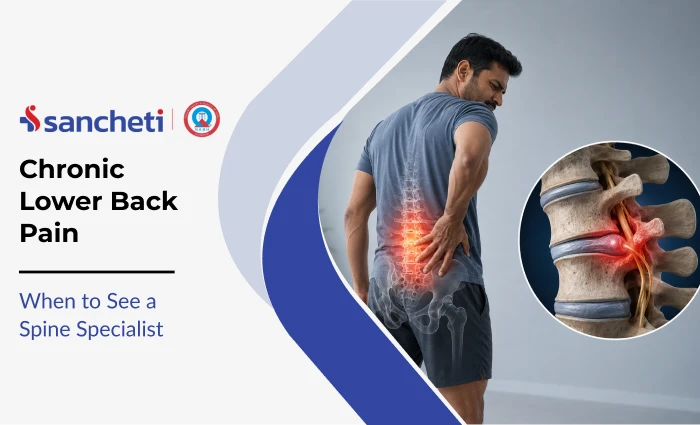

Chronic Lower Back Pain: When to See a Spine Specialist
Chronic lower back pain is pain in the lower back that persists for 12 weeks or longer, making it the leading cause of disability worldwide.
Most cases are mechanical and respond well to structured conservative care, but a smaller number signal something that a primary care visit or physiotherapy alone will not resolve. Knowing the difference is what determines whether you need more exercise and patience or a spine specialist.
At Sancheti Hospital, Pune, our Spine Department sees patients across this entire spectrum, from chronic mechanical back pain needing a better-structured rehabilitation plan to cases with red flag features needing urgent surgical evaluation.
What Is Chronic Lower Back Pain?
Low back pain is classified by duration: acute (under 4 weeks), subacute (4 to 12 weeks), and chronic (12 weeks or longer). This distinction matters clinically because the natural history differs sharply; most acute episodes resolve substantially within a month, while chronic pain follows a different, more complex course shaped by biological, psychological, and social factors together, not by ongoing tissue damage alone.
Globally, low back pain is the single leading cause of years lived with disability worldwide, ahead of every other health condition tracked by the Global Burden of Disease study.
Importantly, the severity of chronic lower back pain is not simply proportional to how much tissue damage is visible on a scan. Disc degeneration and facet joint changes are present in the majority of older adults regardless of whether they have any pain at all, meaning an MRI finding alone rarely tells the whole story, and very often does not explain why a specific patient is in pain.
Who It Affects
Low back pain prevalence rises through adulthood, with the highest number of cases occurring between ages 50 and 55, and is more common in women than men. Globally, 38.8% of disability from low back pain is attributable to three modifiable factors combined: occupational physical demands, smoking, and high BMI (Lancet Rheumatology, GBD 2021).
Key epidemiological patterns:
- Between 4% and 25% of people with an acute episode of low back pain go on to develop chronic pain.
- Among countries with the largest case numbers, India ranks among the highest globally for total low back pain cases, alongside China and the United States
- Occupations involving repetitive lifting, bending, awkward postures, and whole-body vibration carry consistently elevated risk across studies
- Of patients presenting to primary care with low back pain, the overwhelming majority have non-specific mechanical pain, with no single identifiable structural cause
- Serious underlying pathology, such as fracture, cancer, infection, or cauda equina syndrome, accounts for under 1% of primary care presentations
Causes of Chronic Lower Back Pain
Clinicians group the causes of chronic lower back pain into three broad categories based on how the pain presents and how seriously it needs to be investigated. Understanding which category a given case falls into is the single most useful diagnostic step, and is exactly what determines whether specialist referral is urgent, advisable, or unnecessary.
| Category | Proportion of Cases | Typical Causes |
|---|---|---|
| Non-specific mechanical pain | 90-95% | Degenerative disc disease, facet joint osteoarthritis, myofascial pain, sacroiliac joint dysfunction, deconditioning; no single structural cause clearly explains the pain |
| Radicular syndrome | 5-10% | Disc herniation compressing a nerve root, lumbar spinal stenosis; pain radiates into the leg following a nerve distribution |
| Specific serious spinal pathology | Under 1% | Vertebral fracture, malignancy, spinal infection, axial spondyloarthritis, cauda equina syndrome; uncommon, but the reason red-flag screening exists |
Symptoms of Chronic Lower Back Pain
The pattern of symptoms helps distinguish mechanical pain from radicular pain from a genuine emergency. Most chronic lower back pain is dull, aching, and worsened by certain positions or activities. Specific symptom patterns point toward a different, more specific cause.
| Pattern | Typical Features |
|---|---|
| Mechanical (non-specific) | Dull or aching pain, worsened by movement or prolonged positions, improved with rest or position change, no leg symptoms |
| Radicular (nerve root) | Pain radiating below the knee following a specific nerve path, often with numbness, tingling, or weakness in the leg or foot |
| Inflammatory | Worse in the morning with stiffness lasting over 30 minutes, improves with activity, often in younger adults |
| Pain at rest or at night | Pain that does not ease with rest or position change, or specifically wakes the patient at night; a recognised red flag for serious pathology in nearly all clinical guidelines |
When to See a Spine Specialist
This is the central practical question, and the answer depends on which of three situations applies: an emergency, a case that warrants specialist referral without delay, or chronic pain that has reasonably exhausted primary and conservative care.
See emergency care immediately if:
- You have any red flag symptoms, particularly bladder, bowel, or saddle numbness symptoms, which indicate a time-critical surgical emergency
Seek specialist referral without delay if:
- You have significant trauma, known osteoporosis, or long-term steroid use with new back pain; fracture risk needs prompt evaluation
- You have a history of cancer, unexplained weight loss, or fever with back pain, which needs evaluation to rule out infection or malignancy
- You have progressive leg weakness or a new neurological deficit, even without the emergency features above
- You are immunosuppressed or have a history of intravenous drug use, raising infection risk
See a spine specialist (non-urgent but appropriate) if:
- Pain has lasted beyond 12 weeks despite structured physiotherapy and exercise-based conservative treatment
- You have leg pain radiating below the knee that has not improved after 6 weeks of appropriate conservative management
- Pain significantly limits your ability to work, sleep, or carry out daily activities despite ongoing treatment
- You have recurrent disabling episodes of back pain, even if individual episodes eventually settle
- You are being considered for an interventional procedure or surgery, and need a specialist’s opinion on candidacy
What A Spine Specialist Evaluation Involves
A specialist assessment goes beyond a general physical exam. It typically includes a focused neurological examination (reflexes, strength, sensation), specific tests to reproduce nerve-related symptoms, and a clinical decision about whether imaging is indicated at all. When imaging is appropriate, MRI is the investigation of choice for soft tissue, disc, and nerve root detail; X-ray remains useful for assessing bony alignment, fractures, and instability. Nerve conduction studies and EMG may be added when radicular symptoms need to be confirmed or localised precisely before any interventional or surgical decision.
Treatment for Back Pain
Treatment for chronic lower back pain follows a clear hierarchy in nearly every major clinical guideline: active, non-drug treatment first; medication as an adjunct, not a primary solution; and surgery reserved for specific indications rather than isolated back pain.
Step 1: Active, Non-Pharmacological Treatment (First-Line)
Major guidelines recommend exercise-based therapy, multidisciplinary rehabilitation, cognitive behavioural therapy, and spinal manipulation as the initial treatment for chronic low back pain. There is no clear evidence that one specific exercise approach outperforms another; what matters most is the appropriate progression of volume and intensity, delivered consistently, by a physiotherapist experienced in spinal rehabilitation.
- Progressive general exercise training, including aquatic exercise for older adults
- Specific trunk muscle activation and motor control exercise for patients with movement control impairments
- Cognitive behavioural therapy, particularly when psychological factors are contributing to pain persistence
- Patient education and reassurance; actively correcting the misconception that chronic back pain reflects ongoing structural damage
Step 2: Medication (Adjunct, Not Primary)
NSAIDs are generally preferred over acetaminophen, which has not been shown to outperform placebo for low back pain. Muscle relaxants may help for short periods. Opioids carry substantial risk in chronic non-cancer pain and are not recommended as routine treatment; the well-documented association between chronic low back pain and long-term opioid use is a pattern most current guidelines actively try to avoid, not encourage.
Step 3: Interventional Procedures
Epidural steroid injections may help radicular pain from a disc herniation in the short to medium term. Facet joint injections and radiofrequency ablation are considered for confirmed facet-mediated pain; a prospective study found 60% of patients achieved at least 90% pain reduction after radiofrequency ablation, lasting up to 12 months in many cases. These procedures are bridges to better function, not permanent solutions, and work best combined with ongoing rehabilitation.
Step 4: Surgery; Specific Indications Only
Spinal fusion surgery is not indicated for isolated low back pain in the absence of serious spinal pathology or structural instability.
- Microdiscectomy: indicated for radicular pain from disc herniation not responding to 6-12 weeks of conservative treatment
- Decompression (laminotomy/laminectomy): indicated for spinal stenosis causing significant functional limitation despite conservative care
- Spinal fusion: appropriately indicated for confirmed instability, spondylolisthesis, or as part of decompression surgery where removing enough bone to relieve nerve compression would otherwise destabilise the spine; not for isolated mechanical back pain
The Spine Department at Sancheti Hospital, Pune, evaluates each patient against this hierarchy individually, ensuring that interventional and surgical options are offered only where the evidence genuinely supports them, not as a default for unresolved pain.
Recovery
Recovery from chronic lower back pain is rarely a straight line. Unlike acute back pain, which usually improves substantially within weeks, chronic pain tends to fluctuate, with periods of improvement followed by flares, even with good treatment. Setting expectations around this pattern, rather than expecting a complete and permanent resolution, is itself part of effective management.
Conservative Treatment Timeline
| Timeframe | Expected Progress |
|---|---|
| Weeks 1-6 | Active exercise programme established; pain education; avoid prolonged rest or inactivity |
| Weeks 6-12 | Reassessment of progress; consider imaging or specialist referral if no meaningful improvement |
| Months 3-6 | Most patients achieve significant functional improvement with consistent exercise therapy |
| Months 6-12+ | Chronic, fluctuating course for a subset of patients; focus shifts to long-term self-management |
Post-Surgical Recovery (Where Surgery Is Indicated)
| Procedure | Hospital Stay | Return to Light Activity | Full Recovery |
|---|---|---|---|
| Microdiscectomy | 1-2 days | 2-4 weeks | 3 months |
| Decompression | 1-3 days | 4-6 weeks | 3-4 months |
| Spinal fusion | 3-5 days | 6-8 weeks | 6-12 months |
Structured post-operative exercise therapy meaningfully improves outcomes after lumbar spine surgery, including discectomy, decompression, and fusion. Surgery addresses the structural problem; rehabilitation determines how well function actually returns.
Prevention
Given that occupational factors, smoking, and high BMI together account for nearly 39% of disability from low back pain globally, prevention is not a marginal add-on; it is one of the most evidence-backed interventions available.
- Stay physically active: regular exercise, including aerobic activity and core strengthening, is one of the most consistently supported preventive measures across all major guidelines
- Maintain a healthy body weight: elevated BMI is directly responsible for an estimated 11.5% of global disability from low back pain
- Stop smoking: smoking accounts for disability as well for lower back pain globally, and is independently associated with disc degeneration
- Avoid prolonged bed rest during flares: remaining active, within reasonable limits, consistently produces better outcomes than rest during a back pain episode
- Use safe lifting techniques: bend at the knees, keep loads close to the body, and avoid twisting while lifting, particularly in occupations with repetitive heavy lifting
- Address awkward postures and vibration exposure at work: where occupational modification is possible, reducing exposure to these established risk factors lowers long-term risk
- Don’t over-rely on imaging for reassurance: understanding that age-related spinal changes are near-universal and not automatically painful helps prevent unnecessary anxiety and over-treatment
Key Takeaways
- Chronic lower back pain is pain lasting 12 weeks or longer, and is the leading cause of disability worldwide.
- About 90-95% of cases are non-specific mechanical pain with no single identifiable cause; 5-10% are radicular (nerve-related); under 1% reflects serious pathology such as fracture, cancer, infection, or cauda equina syndrome.
- Red flag symptoms: bladder or bowel dysfunction, saddle numbness, significant trauma, fever, unexplained weight loss, or progressive weakness require urgent or emergency evaluation.
- Non-urgent but appropriate reasons to see a spine specialist include pain persisting beyond 12 weeks despite structured conservative treatment, leg pain not improving after 6 weeks, or recurrent disabling episodes.
- Treatment follows a clear hierarchy: active exercise and multidisciplinary rehabilitation first, medication as an adjunct, and surgery reserved for specific indications. Spinal fusion is not recommended for isolated mechanical back pain without confirmed instability or serious pathology.
- Occupational factors, smoking, and high BMI together account for nearly 39% of global disability from low back pain, making prevention through activity, weight management, and smoking cessation a high-value strategy.
- At Sancheti Hospital, Pune, our Spine Department evaluates each patient against the appropriate treatment hierarchy, ensuring imaging, interventional procedures, and surgery are offered when the evidence supports them, not as a default response to unresolved pain.
Frequently Asked Questions (FAQs)
Q1. Do I need an MRI for chronic lower back pain?
Not automatically, and this often surprises patients. Most current clinical guidelines recommend against routine imaging for low back pain in the absence of red flag symptoms, because imaging findings such as disc degeneration and facet joint changes are present in the large majority of pain-free adults over a certain age, meaning the scan frequently shows changes that do not explain the pain and can create unnecessary worry. Imaging becomes appropriate after roughly 6 weeks of properly structured conservative treatment with no meaningful improvement, when red flag symptoms are present, or when you are being assessed as a candidate for an interventional procedure or surgery.
Q2. My scan shows disc degeneration; does that mean I need surgery?
Almost certainly not on its own. Disc and facet joint degeneration is found on imaging in more than 90% of older adults, the great majority of whom have no back pain at all. A degenerative finding on a scan is, by itself, a poor predictor of whether it is the actual source of your specific pain, and an even poorer basis for deciding on surgery. Surgery is considered when there is a clear correlation between the imaging finding, your specific symptoms (particularly radicular leg pain or neurological deficit), and a documented failure of appropriate conservative treatment; not because a scan report contains the word “degeneration” or “bulge.”
Q3. I’ve had back pain for years and just live with it, should I still see a specialist now?
Yes, particularly if your pain has changed in character, if you have never had a structured assessment, or if you have simply adapted around increasing limitations rather than actively addressing them. Long-standing chronic pain that has never been formally evaluated against red flag criteria, never had a proper trial of structured exercise therapy, or has gradually worsened, still benefits from specialist assessment.
Q4. How long should I try physiotherapy before considering it a failure and seeing a spine specialist?
A reasonable, evidence-informed benchmark is 6 to 12 weeks of properly structured, consistently performed exercise therapy, not occasional or passive treatment. The keyword is structured: a programme with appropriate progression in volume and intensity, ideally guided by a physiotherapist experienced in spinal conditions, not a generic handout of stretches done sporadically. If there has been no meaningful improvement in pain or function after a genuine 6-12 week trial of this kind of programme, that is a reasonable and appropriate point to seek a spine specialist’s opinion.
Q5. Is surgery usually the answer for chronic lower back pain that hasn’t improved?
No, and this is an important point of clinical honesty. Surgery has clear, well-supported indications: confirmed disc herniation causing radicular pain not responding to conservative treatment, spinal stenosis causing significant functional limitation, or confirmed structural instability. For isolated mechanical low back pain without these specific findings, surgery is explicitly not recommended by major clinical guidelines, because the evidence does not show it outperforms structured conservative care for this presentation.