Home
Home PG College
 Patient Login
 Sancheti Clinic
 Contact Us
 Download Reports
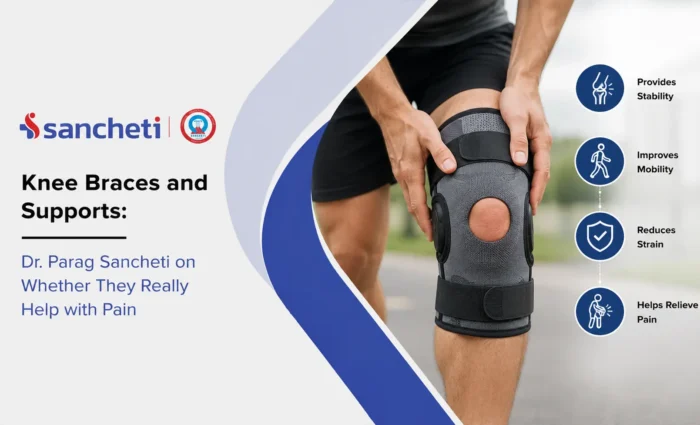

Knee Braces and Supports: Dr. Parag Sancheti on Whether They Really Help with Pain
Do knee braces help? The honest answer is: it depends on the brace and the diagnosis. Most patients who are disappointed by a brace bought the wrong type for their condition. Most who benefit from one use it alongside physiotherapy, not instead of it.
Dr. Parag Sancheti, Chairman and Managing Director of Sancheti Hospital with over 34 years of knee surgery experience, approaches braces and supports as a clinical decision. This article explains which brace works for which condition, and where the limits lie.
What Is a Knee Brace?
A knee brace is an external support device worn around the knee to achieve a specific mechanical or functional effect. A simple compression sleeve and a hinged unloader brace are both technically knee braces, but they work through completely different mechanisms and are appropriate for completely different conditions. Treating them as interchangeable is where most patient disappointment with bracing originates.
The right brace has to follow the right diagnosis. Medial compartment osteoarthritis, patellofemoral pain, an ACL injury, and post-surgical immobilisation each call for a different brace design. A brace chosen by price, convenience, or a friend’s recommendation rather than a clinical indication will frequently provide no benefit, and occasionally makes things worse by creating a false sense of security that reduces physiotherapy engagement. The brace is an adjunct to a treatment plan, not the plan itself.
Five Types of Knee Braces
Each brace category works through a distinct mechanism. Selecting the right one requires knowing which problem is being addressed.
| Type | How It Works | Primary Indication |
|---|---|---|
| Compression sleeve | Warmth, compression, and proprioceptive feedback; no structural load correction | Mild generalised knee pain, early OA flares, general activity support |
| Unloader (valgus or varus) | Three-point leverage shifts load away from the damaged compartment | Medial or lateral compartment OA with malalignment |
| Functional or hinged brace | Restricts excessive movement in specific directions | ACL, MCL, or PCL ligament injuries; post-surgical protection |
| Patellofemoral brace | Targeted straps improve kneecap tracking during movement | Patellofemoral pain syndrome; patellar maltracking |
| Rehabilitative or immobiliser | Rigid or semi-rigid construction restricts movement completely | Post-surgical immobilisation; acute fractures |
Do Knee Braces Actually Help with Pain?
The evidence is more nuanced than marketing suggests. Blanket statements in either direction, that bracing always helps or never helps, are not supported.
The strongest evidence is for the valgus unloader brace in medial compartment osteoarthritis. A randomised controlled trial found significantly greater pain reduction in patients using the unloader brace combined with usual care, compared to usual care alone, across every measured outcome at six weeks. Compression sleeves show consistent but modest benefit for early OA, primarily through proprioceptive and thermal effects. Functional braces after ligament injury have well-established evidence for reducing reinjury risk during return to sport.
The single most important practical finding from brace research is the adherence problem. Only a minority of patients prescribed an unloader brace use it consistently. The clinical benefit is dose-dependent, meaning a brace worn occasionally provides far less relief than one worn as prescribed. The gap between what bracing can do in a well-conducted trial and what it delivers in practice is almost entirely explained by this.
Unloader Brace: Right Tool for Compartmental Arthritis
The unloader brace is the most clinically specific knee brace in routine practice and the most frequently misapplied. It has one primary indication: knee osteoarthritis that is predominantly in one compartment, either medial or lateral, in a patient whose leg alignment contributes to that overloading. It is not a general-purpose arthritis brace.
The mechanism is mechanical leverage. During the stance phase of walking, the brace applies a three-point corrective force that shifts the knee slightly away from the damaged compartment. A valgus unloader brace pushes the knee outward to reduce medial compartment load. A varus unloader brace pushes it inward to offload the lateral side. Valgus unloader braces can reduce the external knee adduction moment by up to 7%, which translates into meaningful pain reduction for patients who wear them consistently.
The best candidates have genuinely single-compartment disease, moderate rather than end-stage arthritis, and the willingness to wear the brace during all weight-bearing activities. Patients with advanced multi-compartment OA, significant excess weight, or poor adherence are unlikely to achieve the improvements that well-selected patients demonstrate.
Compression Sleeve: Modest Benefits, Frequently Overstated
The compression sleeve is the most widely purchased and most widely misunderstood knee support. It is not a structural device. It does not offload a damaged compartment or stabilise a ligament. For patients expecting it to do those things, disappointment is inevitable.
What it does provide are three genuine effects. Compression reduces swelling and improves the perception of joint stability. Warmth increases local circulation and eases the stiffness that many knee pain patients experience, particularly in cooler weather or first thing in the morning. Proprioceptive feedback from the sleeve against the skin improves awareness of knee position during movement, which slightly moderates the loading patterns that aggravate painful joints.
For mild-to-moderate generalised knee pain, early OA flares, or as a confidence aid during activity, a well-fitted sleeve is a reasonable choice with consistent if modest evidence of benefit. It should not be used in place of a correctly indicated unloader brace where compartmental OA with malalignment is the diagnosis.
What No Knee Brace Is Capable of
This is the most important part of the conversation to have before any brace is prescribed. No knee brace, however well designed, changes the underlying disease. Braces manage symptoms. They do not slow arthritis progression, regenerate cartilage, repair ligaments, or address the muscle weakness that contributes to joint overloading.
A patient who uses an unloader brace consistently will have meaningfully less pain and better function than one who does not, in the specific condition for which the brace is indicated. The medial compartment cartilage is still wearing at roughly the same rate it would without the brace. The brace buys time and improves quality of life; it does not reverse the disease.
This is why bracing must be part of a broader plan: physiotherapy to build the muscular protection the joint needs, weight management to reduce the load the joint carries, and appropriate medical management of the underlying condition. A brace substituted for these components consistently underdelivers.
Using a Knee Brace Correctly
Getting the diagnosis-appropriate brace is only the first step. How it is used matters as much as which type is chosen. Three errors consistently undermine otherwise appropriate brace prescriptions.
- Wearing it constantly: braces are intended for weight-bearing activity, not rest, sleep, or sedentary periods. Constant use creates soft tissue dependency and progressively reduces the muscular contribution that the joint needs to function independently
- Poor fit: an unloader brace that migrates during walking, or a sleeve that is too loose to provide meaningful compression, delivers little of the benefit it is designed for. Fitting should be assessed by a clinician or orthotist, not self-determined from a size chart
- Using it instead of physiotherapy: the brace reduces the symptom; physiotherapy addresses the muscular insufficiency contributing to the overloading. Patients who combine both consistently outperform those using either alone. The brace creates a window of reduced pain during which physiotherapy can be more effective, not a reason to skip it
When Bracing Is No Longer Enough
Bracing belongs in the conservative management phase. That phase has a defined boundary of effectiveness, and recognising when it has been reached avoids months of inadequate treatment while underlying disease advances.
An unloader brace that was helpful six months ago and is now providing insufficient relief is a clinical signal. The arthritis has likely progressed beyond the single compartment the brace was designed to address, or advanced to a stage where structural intervention is now the appropriate conversation. Similarly, a functional brace after an ACL tear manages instability but does not repair the ligament. It is a temporary measure, not a definitive treatment.
When a brace that was previously working is no longer adequate, or when symptoms are limiting progressively more activities despite consistent brace use and physiotherapy, a reassessment at Sancheti Hospital’s Joint & Knee Replacement Department moves the conversation from symptom management to addressing the structural problem directly.
Key Takeaways
- Knee braces help when the right type is matched to the right diagnosis. An unloader brace for compartmental OA, a functional brace for ligament instability, and a patellofemoral brace for patellar tracking problems each have consistent clinical evidence in appropriate patients.
- The five brace types work through different mechanisms and are not interchangeable. Choosing based on pain location rather than diagnosis is the most common reason patients are disappointed by bracing.
- The unloader brace has the strongest evidence for knee pain in single-compartment OA. The limiting factor is adherence: only around 25% of patients use it consistently enough to achieve the clinical benefits the evidence demonstrates.
- No brace slows arthritis progression or repairs damaged tissue. Bracing manages symptoms and supports function; it is most effective as part of a plan that includes physiotherapy and weight management.
- Wearing a brace during rest and sleep creates dependency and weakens supporting musculature over time. Braces are appropriate during weight-bearing activity, not as a round-the-clock substitute for normal joint mechanics.
- For the right knee support for pain based on a specific diagnosis rather than a product recommendation, book a consultation at Sancheti Hospital, Pune.
Frequently Asked Questions (FAQs)
Q1. How do I know which type of knee brace I need?
The starting point is always the diagnosis, not the symptom. If the pain is on the inner side of the knee with varus alignment and X-ray confirming medial compartment narrowing, a valgus unloader brace is indicated. If the pain is at the front of the knee around the kneecap, aggravated by stairs and prolonged sitting, a patellofemoral brace is the appropriate choice. If the knee is unstable after a ligament injury, a functional hinged brace is relevant. If the pain is diffuse and mild, a compression sleeve is a reasonable starting point. Buying a brace off-the-shelf without a clinical assessment is the most common reason the wrong type is chosen. The most efficient route to the right brace is a short consultation with a knee specialist or physiotherapist who can confirm the diagnosis and match it to the appropriate support.
Q2. My knee feels better in the brace but the pain returns immediately when I take it off. Why?
This is normal and does not mean the brace is failing. A brace reduces pain during use by modifying joint loading or improving proprioception; it does not change the underlying condition causing the pain. When the brace comes off, the loading pattern returns to what it was before, so the pain returns too. This pattern is the clearest possible signal that the brace needs to be part of a broader management plan. Physiotherapy that builds the muscular support the joint needs, and weight management that reduces the total load, are what progressively reduce the pain between sessions of brace use. Patients who use the brace consistently while working through a physiotherapy programme typically find that, over months, the level of pain when not wearing the brace gradually decreases as the underlying contributing factors are addressed.
Q3. Is there a best knee brace for arthritis?
The answer depends on the arthritis pattern. For medial compartment OA, where the inner side of the knee is predominantly affected, a valgus unloader brace is the most clinically specific option and has the best evidence base. For early generalised OA where symptoms are diffuse, a compression sleeve provides modest but real relief through compression and proprioception. For patellofemoral arthritis behind the kneecap, a patellar tracking brace is the appropriate choice. There is no single best knee brace for arthritis because arthritis itself is not a single pattern. A brace selected without knowing which compartment or surface is primarily affected will frequently provide no meaningful benefit. The additional 20 minutes spent getting a diagnosis-led recommendation from a specialist is more valuable than any brace that can be bought without it.
Q4. Can wearing a knee brace too much make my knee weaker?
Yes, over time and particularly if the brace is worn during rest and low-demand activities rather than just during weight-bearing movement. The muscles around the knee develop their stabilising capacity through use under load. When an external device consistently substitutes for that muscular contribution, the muscles lose the stimulus they need to maintain their strength, a process called disuse adaptation. This is why brace use should be strategic: during demanding activities that provoke pain or instability, but not as a constant support that removes the normal loading stimulus the muscles need. Patients who wear a brace all day every day and stop physiotherapy because the brace feels sufficient often find their overall knee function declining over months rather than improving. The brace should be reducing symptoms enough to allow physiotherapy to progress, not replacing the physiotherapy itself.
Q5. When should I stop using a brace and see a specialist instead?
Several signals indicate that bracing has reached the limit of what it can achieve and that a specialist assessment is needed. The brace that was providing adequate relief six months ago is now insufficient: this suggests disease progression beyond the stage the brace was designed to manage. Pain is spreading to previously unaffected areas of the knee despite consistent brace use and physiotherapy. Function is declining progressively rather than stabilising. The brace is now needed for daily activities that previously required no support at all. Any of these patterns means the underlying condition has advanced and the management plan needs to be reassessed. Continuing with the same brace and the same conservative approach when these signals are present delays treatment that could be more effective and risks allowing more damage to accumulate before the appropriate intervention is started.