Home
Home PG College
 Patient Login
 Sancheti Clinic
 Contact Us
 Download Reports
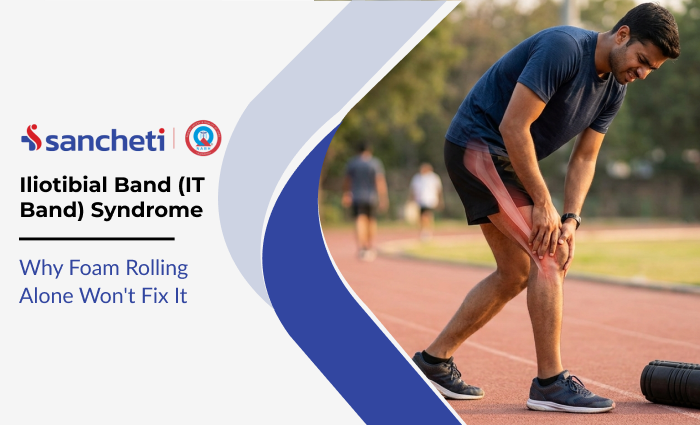

Iliotibial Band (IT Band) Syndrome: Why Foam Rolling Alone Won’t Fix It
IT band syndrome is one of the most common overuse injuries in runners and cyclists — and one of the most stubbornly mismanaged. Athletes spend weeks religiously foam rolling the outer thigh, stretching the IT band, and reducing mileage, only to find the pain returns the moment they push past a certain distance again. In short: iliotibial band syndrome is not a tightness problem that foam rolling can fix — it is a load and biomechanics problem that requires a fundamentally different approach to resolve for good.
At Sancheti Hospital, Pune, our sports medicine and orthopaedic team regularly sees runners who have been managing lateral knee pain with foam rolling and rest for months without lasting improvement.
What Is the Iliotibial Band?
The iliotibial band is a thick band of fascia — dense connective tissue — that runs along the outer side of the thigh from the iliac crest of the pelvis down to the tibia just below the knee. It has no contractile tissue of its own; it is not a muscle. It is tensioned by two muscles at its upper end — the tensor fasciae latae (TFL) and the gluteus maximus — which pull on it from slightly different directions.
The IT band’s primary role is to assist in stabilising the knee and hip during the stance phase of running and cycling. It is not designed to be stretched like a muscle, and it does not respond to stretching the way muscle tissue does. This is one of the most important biological facts that conventional IT band management ignores — and it explains why foam rolling and stretching, while they may provide temporary symptomatic relief, do not address the underlying problem.
What Actually Causes IT Band Syndrome?
The older explanation — that the IT band repeatedly rubs or “snaps” over the lateral femoral epicondyle (the bony prominence on the outer knee) as the knee bends and straightens — has been largely revised in recent sports medicine research.
The current understanding is that IT band syndrome is caused by compression of the highly innervated fat pad and connective tissue beneath the IT band at the lateral knee, not friction over bone. As the knee passes through approximately 30 degrees of flexion — which happens at foot strike during running — the IT band compresses this tissue against the lateral femoral epicondyle. Repeated compression across thousands of running steps inflames and sensitises this tissue, producing the characteristic sharp, burning pain on the outer side of the knee.
This compression is worsened by:
- Weakness of the hip abductors and gluteal muscles — when the glutes fail to control hip drop during single-leg stance, the femur adducts (drops inward) and the IT band tightens further over the lateral knee
- Running volume spikes — sudden increases in weekly mileage are the most consistent trigger for onset
- Downhill running — increases the time the knee spends near the impingement zone
- Crossover running gait — where the foot lands across the midline of the body, increasing lateral knee compression forces
- Excessive foot pronation — which causes internal tibial rotation and increases IT band tension at the knee
Recognising IT Band Syndrome: Symptoms and Presentation
IT band syndrome symptoms are distinctive enough that athletes can often self-identify the condition — though clinical confirmation is important to rule out other causes of lateral knee pain:
- A sharp, burning, or aching pain on the outer side of the knee, specifically over or just above the lateral femoral epicondyle
- Pain that typically begins after a consistent distance — the same kilometre mark in every run — and forces the athlete to slow down or stop
- The pain eases quickly with rest but returns reliably with the next run at the same distance threshold
- Tenderness on palpation of the lateral knee, often most pronounced at 30 degrees of knee flexion
- In some athletes, pain is also felt at the outer hip where the IT band originates — this often coexists with trochanteric bursitis and indicates that the entire lateral chain from hip to knee is under abnormal load
It is important to distinguish IT band syndrome from other causes of lateral knee pain — a lateral meniscus tear, biceps femoris tendinopathy, and patellofemoral pain syndrome can all produce outer knee discomfort and should be assessed clinically before committing to an IT band-focused treatment plan.
Why Foam Rolling Doesn’t Fix It
Foam rolling the IT band became popular because it produces an immediate sensation of release and temporary pain relief. But understanding the biology of the IT band explains why this relief is short-lived and does not address the underlying problem.
The IT band is fascia — it is structurally incapable of lengthening meaningfully in response to foam rolling or stretching. The forces required to actually elongate dense fascial tissue far exceed anything a foam roller can generate. The relief athletes feel is real, but it comes from temporary changes in pain sensitivity and blood flow, not structural change in the IT band itself.
More fundamentally, foam rolling does nothing to address the two root causes of IT band syndrome: inadequate hip and gluteal strength, and the biomechanical loading patterns that drive compression at the lateral knee. An athlete who foam rolls daily and returns to the same running gait and training load will reproduce the same injury because nothing that matters has changed.
What Actually Works: A Rehabilitation-Led Approach
Stage 1 — Load Management and Symptom Control
The first priority is reducing compression at the lateral knee sufficiently to allow pain-free movement. This does not mean complete rest — it means identifying and staying below the load threshold that provokes symptoms. For most athletes, this involves:
- Reducing run distance to below the kilometre mark where pain begins
- Replacing some running with lower-compression activities — cycling (with saddle height adjusted) or swimming — to maintain fitness
- Avoiding downhill running entirely in the acute phase
- Anti-inflammatory medications or a short course of corticosteroid injection in severely symptomatic cases to settle acute tissue irritation
Stage 2 — Hip Abductor and Gluteal Strengthening
This is the most critical and most commonly skipped component of IT band rehabilitation. Weakness in the gluteus medius and gluteus maximus is present in the overwhelming majority of athletes with IT band syndrome, and it is the primary biomechanical driver of the condition.
A well-structured physiotherapy and rehabilitation program targets these muscles specifically and progressively — beginning with isolated hip abductor exercises (clamshells, side-lying hip abduction, banded walks) and progressing to single-leg functional exercises (single-leg squats, Romanian deadlifts, lateral step-ups) that train the glutes to control hip and knee alignment during the running gait cycle.
The load progression matters. Beginning with isolation exercises and moving to functional, running-specific movements in sequence ensures the gluteal muscles are genuinely strong in the positions that matter during sport — not just in a lying-down exercise setting.
Stage 3 — Running Gait Retraining
Even athletes who complete their strengthening program thoroughly will continue to re-injure if they return to the biomechanical patterns that drove the injury in the first place. Gait retraining addresses the specific movement faults identified in each athlete:
- Reducing crossover step width — cueing the athlete to run with feet tracking hip-width apart rather than crossing the midline significantly reduces lateral knee compression
- Increasing cadence by 5–10% — a higher step rate at the same pace reduces the loading impact at foot strike and decreases the time spent in the IT band impingement zone
- Trunk lean and hip control cueing — addressing Trendelenburg gait (hip drop on the swing side) through real-time feedback during treadmill running
These gait changes are not permanent conscious adjustments — with repetition they become automatic, and most athletes internalise them within 4–6 weeks of targeted practice.
Stage 4 — Progressive Return to Running
Return to full training is structured using a progressive mileage increase protocol — typically no more than a 10% weekly volume increase — to allow tissue adaptation to keep pace with training load. Downhill running and track sessions with tight bends are reintroduced last, as these place the highest compressive demands on the IT band.
Our sports medicine specialists at Sancheti Hospital guide athletes through this return-to-running progression using objective markers — pain scores during and after each session, strength testing, and functional movement assessments — rather than calendar timelines alone.
When IT Band Pain Is Not Just the IT Band
A small subset of athletes with apparent lateral knee pain have contributing factors that extend beyond the IT band itself. Two are worth highlighting.
Snapping IT band at the hip — where the IT band clicks or snaps over the greater trochanter during hip flexion and extension — can coexist with lateral knee IT band syndrome, suggesting the entire lateral chain is under abnormal tension. This condition, known as snapping hip syndrome, requires assessment and management in its own right rather than being dismissed as coincidental.
Lateral knee compartment degeneration — in older athletes or those with a long history of undertreated IT band syndrome, chronic lateral knee loading can accelerate cartilage wear in the lateral tibiofemoral compartment, contributing to early knee osteoarthritis. This is another reason why treating IT band syndrome properly — rather than managing symptoms indefinitely — matters for long-term joint health.
When Surgery Is Considered
Surgery for IT band syndrome is rarely needed and should be considered only after a minimum of 6 months of well-structured, consistently followed conservative management has genuinely failed. Surgical options include:
- IT band release — a small incision is made in the IT band at the point of maximal compression over the lateral femoral epicondyle, creating a window that prevents compression of the underlying tissue
- Bursectomy — removal of an inflamed bursa beneath the IT band at the lateral knee in cases where bursitis is the dominant pain generator
Both procedures are performed arthroscopically or through small incisions and have reasonable outcomes in carefully selected patients. However, surgery without addressing the underlying hip weakness and biomechanical drivers almost always results in recurrence.
Key Takeaways
- IT band syndrome is caused by compression of tissue beneath the IT band at the lateral knee, not friction — and it is driven by hip weakness and biomechanical loading patterns, not IT band tightness.
- Foam rolling provides temporary pain relief but cannot lengthen the IT band or address the root cause of the condition. Athletes who rely on it as their primary treatment will continue to re-injure.
- The most effective treatment combines load management, targeted hip abductor and gluteal strengthening, and running gait retraining — in that sequence.
- Return to full running should follow a structured progressive mileage protocol, with downhill and high-demand running reintroduced last.
- Surgery is a last resort after 6 months of genuine conservative management failure and must be combined with rehabilitation to prevent recurrence.
- At Sancheti Hospital, Pune, our sports medicine and orthopaedic specialists assess IT band syndrome comprehensively — evaluating hip strength, running mechanics, and training load — to address the actual drivers of the injury rather than its symptoms.
Frequently Asked Questions (FAQs)
Q1. How long does IT band syndrome take to recover fully?
For mild cases caught early, 4–6 weeks of structured rehabilitation is often sufficient. Moderate to severe cases — particularly those where the injury has been present for several months — typically require 8–12 weeks of progressive rehabilitation before symptom-free return to full training. The most common reason recovery takes longer than expected is skipping the strengthening phase and attempting to return to running on symptom resolution alone.
Q2. Can I keep running with IT band syndrome?
In most cases, yes — at a reduced distance that stays below the pain threshold. Complete rest is rarely necessary and is not the most effective treatment strategy. Maintaining fitness through reduced running volume, combined with active rehabilitation, produces better outcomes than stopping entirely and returning to the same training load after a rest period.
Q3. Is IT band syndrome more common in women than men?
IT band syndrome affects both sexes, but female runners do have slightly higher rates — likely related to differences in hip anatomy (wider Q-angle), which places greater demands on the hip abductors to control knee alignment during running. This makes hip strengthening even more important as a prevention strategy in female athletes.
Q4. Does running shoe choice affect IT band syndrome?
Footwear can be a contributing factor, particularly shoes with excessive lateral flare or worn-down lateral heel cushioning that alter foot strike mechanics. However, shoe choice is a minor variable compared to hip strength and running gait. Changing shoes without addressing biomechanics rarely resolves IT band syndrome on its own.
Q5. Can IT band syndrome come back after full recovery?
Yes, if the factors that caused it are not maintained after recovery. Athletes who complete rehabilitation, return to sport, and then gradually stop their hip strengthening exercises over the following months are at genuine risk of recurrence — particularly when they increase training load for a race or competitive season. Incorporating hip abductor and gluteal strengthening as a permanent part of training rather than a temporary rehabilitation measure is the most reliable way to prevent recurrence.