Home
Home PG College
 Patient Login
 Sancheti Clinic
 Contact Us
 Download Reports

Post-Stroke Spasticity: Management and Rehabilitation Techniques
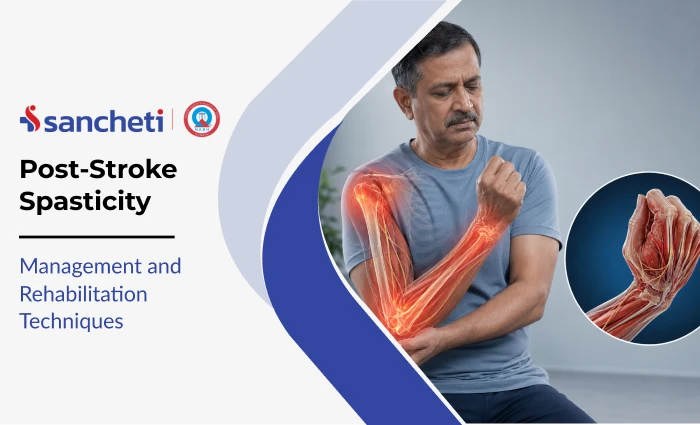
Post-stroke spasticity is an abnormal increase in muscle tone that develops after a stroke damages the brain’s motor control pathways, making muscles stiff, resistant to movement, and prone to involuntary contractions.
It affects over 4 in 10 stroke survivors to some degree, typically emerging in the weeks to months after a stroke, and left unmanaged, it can progress from a manageable stiffness into permanent contracture and significant disability.
At Sancheti Hospital, Pune, our Neurology Department and rehabilitation team manage post-stroke spasticity from its earliest, most treatable stage through to established chronic cases. This article explains why spasticity develops after stroke, how it is graded and diagnosed, and the full range of evidence-based treatment and rehabilitation options.
What Is Post-Stroke Spasticity?
A stroke damages parts of the brain that normally send inhibitory signals down to the spinal cord, regulating how strongly muscles contract in response to stretch. When this inhibitory control is lost, the spinal reflex circuits become overactive and unchecked. The clinical definition describes spasticity as a velocity-dependent increase in muscle stretch reflexes, meaning the faster a muscle is stretched, the stronger and more exaggerated its resistance becomes. This is part of a broader pattern called upper motor neuron syndrome.
This mechanism explains a pattern many patients and caregivers notice directly: a spastic limb may move with relatively little resistance when handled slowly and gently, but the same limb resists strongly and may even jerk back (clonus) when moved quickly. This is not the muscle being uncooperative; it is the underlying reflex circuit firing in proportion to the speed of the stretch, exactly as the underlying physiology predicts.
Spasticity is different from a fixed contracture. Spasticity is a reflex-driven, neurologically mediated increase in tone that can fluctuate and is, to varying degrees, responsive to treatment. A contracture is a permanent shortening of muscle and connective tissue that has occurred over time, often as a late, preventable consequence of unmanaged spasticity. This distinction directly shapes treatment, since contractures generally require different management than active spasticity.
Who It Affects
Studies examining stroke populations found that 42.6% of stroke survivors develop spasticity, with severe spasticity occurring in 15.6% of cases. Another study found prevalence estimates ranging from 4-46% within the first month after stroke, rising to 6.9-63% by 3-6 months, reflecting both genuine variation between patient populations and differences in how spasticity was measured across studies.
Key patterns worth understanding:
- In the upper limb, spasticity most commonly affects the elbow, wrist, and shoulder
- Spasticity prevalence and severity tend to increase over the first few months after stroke
- The most consistent predictors of developing spasticity are greater initial muscle weakness, more severe stroke, and greater overall disability in the early period after stroke
- Spasticity is significantly associated with lower functional independence scores and reduced quality of life at 12 months
Grading Spasticity and Common Patterns
Spasticity severity is graded clinically using the Modified Ashworth Scale (MAS), the most widely used tool in both clinical practice and research. The examiner moves the affected limb through its range of motion and grades the resistance felt.
| Grade | Clinical Finding |
|---|---|
| 1 | Slight increase in tone, with a catch and release, or minimal resistance at the end of range |
| 1+ | Slight increase in tone, with a catch followed by minimal resistance through the remainder of the range |
| 2 | More marked increase in tone through most of the range, but the limb is still easily moved |
| 3 | Considerable increase in tone; passive movement is difficult |
| 4 | Affected limb is rigid in flexion or extension |
A related but distinct tool, the Tardieu Scale, measures resistance at different speeds of movement specifically to distinguish true spasticity from a fixed contracture. This distinction is clinically important because it directly affects which treatments are likely to help.
Common Spasticity Patterns
| Region | Typical Pattern |
|---|---|
| Upper limb | Shoulder adduction and internal rotation, elbow flexion, forearm pronation, wrist and finger flexion, often described as a flexor synergy pattern |
| Lower limb | Hip and knee extension with ankle plantarflexion and inversion (equinovarus foot), affecting the swing phase of walking and increasing fall risk |
Symptoms
Beyond the core finding of increased, velocity-dependent muscle tone, post-stroke spasticity produces a recognisable cluster of symptoms that compound over time if not actively managed.
| Symptom | Clinical Impact |
|---|---|
| muscle stiffness after stroke and resistance to movement | Interferes with dressing, washing, and positioning the limb |
| Clonus (rhythmic involuntary muscle contractions) | Triggered by quick stretch; can interfere with standing and walking |
| Pain | Commonly accompanies spasticity, particularly at the shoulder, and can itself worsen tone |
| Abnormal posturing of the limb | Flexor pattern in the arm, equinovarus pattern in the leg, affecting appearance and function |
| Difficulty with hygiene and skin care | A tightly flexed hand can trap moisture, increasing risk of skin breakdown and infection |
| Impaired gait and increased fall risk | Equinovarus foot positioning disrupts normal foot clearance during walking |
| Progressive loss of range of motion | Untreated spasticity over months can progress to a fixed, no longer reflex-driven contracture |
Pain and Spasticity Often Reinforce Each Other
Pain from a spastic, malpositioned shoulder or limb can itself increase muscle guarding and tone, while increased tone in turn worsens pain and limits movement that would otherwise help. Addressing pain directly, rather than treating it as a separate issue from the spasticity itself, is an important and sometimes overlooked part of effective management.
Diagnosis
Diagnosing and characterising post-stroke spasticity is a clinical process built around a structured examination, since no blood test or imaging study can diagnose spasticity directly.
Clinical Tone Assessment
The Modified Ashworth Scale is used to grade tone in each affected muscle group. The Tardieu Scale is used alongside it, particularly when the question of fixed contracture versus active spasticity needs to be answered, since it assesses resistance specifically at both slow and fast movement speeds.
Functional and Goal-Oriented Assessment
Equally important as the tone grade itself is what the spasticity prevents the patient from doing. Modern spasticity management is goal-directed: assessment includes specific functional questions (Can the hand be opened for hygiene? Does the equinovarus foot affect walking safety? Is shoulder positioning causing pain?) that directly shape treatment priorities, rather than treating a MAS grade as a target in itself.
Range of Motion and Pattern Documentation
Goniometry (joint angle measurement) documents the current range of motion at affected joints and tracks change over time, particularly important for detecting early contracture formation before it becomes fixed and harder to reverse.
Excluding Other Contributing Factors
Pain, prior joint disease, peripheral nerve injury, and DVT can all coexist with or mimic aspects of post-stroke spasticity, and a thorough assessment considers these alongside the primary diagnosis rather than attributing every finding automatically to spasticity itself.
Treatment
Spasticity management follows a structured hierarchy, but it is worth being clear from the outset about where the evidence is genuinely strong and where common practices are less well supported than many patients expect.
Positioning and Early Mobilisation
Anti-spasticity positioning, specific lying and sitting positions that keep affected joints in a lengthened, functional position, is a foundational, evidence-supported part of early stroke rehabilitation, helping to prevent shoulder subluxation, pressure injury, and early contracture formation. Regular repositioning and early, appropriate mobilisation remain core practice from the earliest days after stroke.
Step 1 (First-Line for Focal Spasticity): Botulinum Toxin Injection
Current guidelines recommend intramuscular botulinum toxin type A (BoNT-A) injection as first-line treatment for focal post-stroke spasticity. Injected directly into overactive muscles, it temporarily blocks the nerve signal causing excessive contraction, reducing tone for approximately three to four months per injection cycle. It is supported by strong, consistent evidence for reducing tone, supporting passive function (hygiene, dressing, positioning). It is increasingly used to support active function as well when combined with a structured rehabilitation programme.
Step 2: Oral Medications
Oral antispastic medications (baclofen, tizanidine, dantrolene) act on tone throughout the body rather than in a specific muscle. They can be useful, particularly for more generalised spasticity, but carry significant systemic side effects, including drowsiness, weakness, and sedation, and current evidence does not establish that they are superior to focal botulinum toxin treatment for focal or multifocal spasticity.
Step 3: Intrathecal Baclofen
For severe, generalised spasticity not adequately controlled by the above measures, intrathecal baclofen, delivered continuously via a small pump implanted under the skin, directly into the spinal fluid, allows much higher local drug concentration with fewer systemic side effects than oral dosing. This is generally reserved for more severe, treatment-resistant cases, given the surgical component involved.
Step 4: Surgical Options
For spasticity that has progressed to a fixed contracture or severe spasticity not responding to the measures above, surgical options include selective neurotomy (cutting a portion of the nerve supply to an overactive muscle), tendon lengthening, and tendon transfer procedures. These are considered when a clear, specific functional or hygiene goal can be identified that surgery is likely to achieve, rather than as a generic escalation step.
Rehabilitation Therapy Throughout
A physiotherapist remains central at every stage of spasticity management, not only for positioning and selective stretching, but also for task-specific motor retraining, gait training for lower limb spasticity, and structuring the exercise programme that provides botulinum toxin’s temporary tone reduction with lasting functional value.
Recovery
Post-stroke spasticity does not follow a single, predictable recovery arc the way a healing fracture does, its course depends heavily on severity, how early it is identified, and how consistently it is managed.
Typical Course
| Timeframe | What Typically Happens |
|---|---|
| Weeks 1-4 post-stroke | Spasticity may not yet be apparent; early positioning and mobilisation begin regardless |
| 1-3 months | Spasticity, where it develops, typically becomes apparent and often increases during this window |
| 3-6 months | Spasticity prevalence and severity often peak in this period for those who develop it |
| 6-12 months and beyond | Spasticity may stabilise, improve with treatment, or in unmanaged cases, progress toward fixed contracture |
Intervening while spasticity is still a reflex-driven, reversible process gives meaningfully better functional outcomes than starting treatment after a fixed contracture has already formed.
With appropriate treatment, most patients achieve a meaningful reduction in tone and improvement in passive function (e.g., ease of hygiene, dressing, and positioning), with a smaller but still substantial proportion also achieving improvement in active function. Spasticity management is generally an ongoing process rather than a single completed treatment, with repeat botulinum toxin injection cycles and continued rehabilitation forming the long-term plan for most patients with significant focal spasticity.
Prevention
Spasticity itself, as a direct consequence of the brain injury from stroke, cannot be entirely prevented. What can be meaningfully reduced is its severity and its progression to fixed contracture and disability, and this is where early, proactive management has the most leverage.
- Early anti-spasticity positioning: starting correct limb positioning from the earliest days after stroke, before spasticity is even clinically apparent, helps protect joints and soft tissue
- Early mobilisation: getting the patient moving and out of bed as early as medically appropriate supports both general stroke recovery and reduces the risk of severe spasticity and contracture
- Regular repositioning: systematic repositioning every 1-2 hours in the early period after stroke reduces pressure injury risk and supports joint protection
- Early specialist assessment: Flagging early signs of increasing tone to the rehabilitation team promptly, rather than waiting for spasticity to become disabling
- Pain management: since pain and spasticity reinforce each other, proactively managing shoulder and limb pain reduces one of the drivers of worsening tone
- Individualised, not routine, splinting: where splinting is used, it should be targeted to a specific contracture-prevention goal in a high-risk joint, rather than applied as a default.
Key Takeaways
- Early intervention is the biggest differentiator, as treating spasticity before it progresses can prevent permanent muscle shortening and preserve long-term mobility.
- Post-stroke spasticity is more than muscle stiffness; it affects independence, mobility, hygiene, pain levels, and overall quality of life if left unmanaged.
- Recovery depends on personalised, goal-driven care rather than symptom reduction alone, with treatment focused on improving meaningful daily functions such as walking, dressing, and self-care.
- Rehabilitation is a continuous journey, not a one-time treatment, requiring a combination of therapy, medical interventions, and ongoing monitoring for the best outcomes.
- Managing spasticity requires distinguishing between reversible muscle overactivity and irreversible contractures, since each demands a different treatment approach.
- Pain and spasticity create a reinforcing cycle, making comprehensive management essential to improve comfort, movement, and functional recovery.
- Successful recovery is built on a multidisciplinary approach in which neurologists, rehabilitation specialists, physiotherapists, and caregivers work together to prevent long-term disability.
- At Sancheti Hospital, Pune, our Neurology Department and rehabilitation team prioritise early identification of post-stroke spasticity and build individualised, goal-directed treatment plans rather than applying a one-size-fits-all protocol.
Frequently Asked Questions (FAQs)
Q1. When does spasticity usually appear after a stroke, and should I be worried if my loved one’s limb feels stiff early on?
Spasticity typically becomes noticeable in the weeks to the first few months after stroke, often increasing in severity through the three-to-six-month mark before stabilising. Some early stiffness or changes in tone in the days immediately following a stroke can occur, but established spasticity in its fully recognisable form generally develops over this longer timeframe rather than appearing instantly. Noticing increasing stiffness, resistance to movement, or abnormal limb positioning during this window is exactly the situation in which raising it promptly with the rehabilitation team is valuable, since earlier identification and treatment are consistently linked to better outcomes than waiting to see if it resolves on its own.
Q2. Will stretching and exercises alone fix the stiffness, or do we need medication or injections?
This is a genuinely important point of clinical honesty: stretching and positioning alone, while a reasonable and supportive part of overall care, have not been shown in good-quality research to reduce established spasticity on their own meaningfully. A study found that four weeks of daily stretching had little to no effect on wrist contracture after stroke. For spasticity significant enough to affect hygiene, dressing, positioning, or walking, botulinum toxin injection combined with a structured rehabilitation programme in Pune has stronger evidence supporting it.
Q3. How often will botulinum toxin injections be needed, and does the effectiveness wear off over time?
Botulinum toxin’s effect on a given muscle typically lasts approximately three to four months, after which the nerve signal it temporarily blocked returns gradually, and the spasticity in that muscle returns to its prior level unless other changes have occurred in the meantime. This means injections are generally repeated on a three-to-four-month cycle for as long as ongoing treatment is needed, rather than being a one-time procedure. There is no strong evidence that the treatment loses effectiveness with repeated cycles for most patients; in fact, a sustained reduction in tone over several cycles, achieved alongside consistent rehabilitation therapy, can sometimes lead to genuine functional gains.
Q4. Is it our fault if my family member’s hand has become permanently contracted despite our efforts?
No, and this is worth stating plainly. Contracture formation reflects a combination of the severity of the underlying spasticity, the timing of treatment relative to when spasticity began, and the biological behaviour of the specific muscles involved, not a failure of effort by family or caregivers. Even with appropriate positioning and engagement with rehabilitation, some degree of contracture can still occur, particularly in more severe spasticity or where access to timely specialist treatment was limited. If contracture has developed, the appropriate next step is a specific conversation with the rehabilitation or surgical team about what targeted options, including surgery in some cases, are now appropriate.
Q5. Can spasticity improve on its own as the brain heals from the stroke?
Some change in spasticity over time occurs as the brain undergoes its natural recovery process after a stroke. In milder cases, tone may improve somewhat without specific spasticity treatment. However, this is not a reliable basis for a wait-and-see approach, particularly for spasticity significant enough to affect function or hygiene. The evidence consistently favours active, early management over waiting, both because untreated spasticity can progress toward fixed contracture, which is considerably harder to address than active spasticity, and because the window in which interventions like botulinum toxin and rehabilitation produce the best functional outcomes is generally earlier rather than later in the disease course.