Home
Home PG College
 Patient Login
 Sancheti Clinic
 Contact Us
 Download Reports
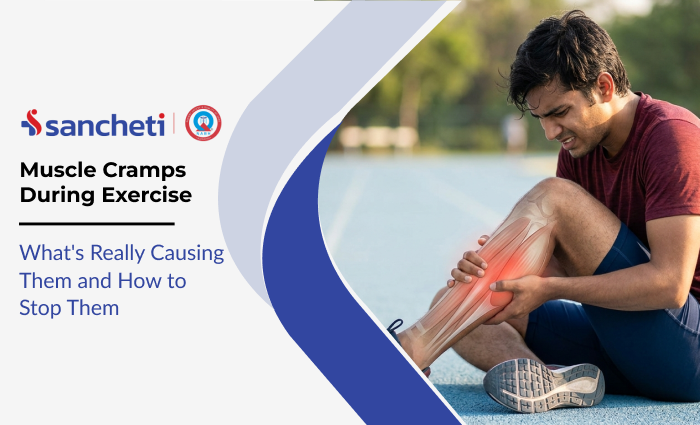

Muscle Cramps During Exercise: What’s Really Causing Them and How to Stop Them
Exercise-induced muscle cramps are among the most common — and most misunderstood — problems in sport. Almost every athlete has experienced one: a sudden, involuntary, intensely painful contraction that stops them in their tracks and refuses to release on demand.
The standard advice — drink more water, eat a banana — is so embedded in sports culture that most athletes accept it as settled science. It isn’t. In short: the real cause of muscle cramps during exercise is far more complex than dehydration alone, and athletes who keep cramping despite drinking adequately are likely dealing with something the electrolyte theory cannot explain.
At Sancheti Hospital, Pune, our sports medicine team works with athletes across multiple disciplines who present with recurrent cramping that has not responded to conventional hydration strategies.
What Is a Muscle Cramp and What Is Happening Physiologically?
A muscle cramp is an involuntary, sustained, painful contraction of a skeletal muscle or part of a muscle. Unlike a voluntary contraction, a cramp does not respond to the athlete’s attempts to relax it, and it produces abnormal electrical activity in the muscle that can be measured on electromyography (EMG).
Cramps during exercise most commonly affect the muscles that are actively working — the calves and hamstrings in runners, the quadriceps in cyclists, the forearm muscles in racket sport players, and the abdominal muscles in swimmers. They tend to occur late in prolonged or intense exercise, and they are more common in hot and humid conditions.
The fact that cramps are involuntary contractions that arise from within the neuromuscular system — not simply from a dehydrated or electrolyte-depleted muscle — is the key to understanding why they happen and how to address them effectively.
Dehydration Theory: Why It Doesn’t Tell the Full Story
For decades, the dominant explanation for exercise-associated muscle cramps (EAMC) has been fluid and electrolyte loss — specifically the depletion of sodium, potassium, magnesium, and calcium through sweat. This theory holds that when electrolyte concentrations fall below a critical threshold, muscle excitability increases and cramping results.
It is an appealing explanation, and electrolyte loss during exercise is real and physiologically meaningful. But the dehydration and electrolyte theory has significant problems when examined against the evidence:
- Athletes who cramp and those who don’t in the same race conditions are often equally dehydrated and equally depleted in electrolytes
- Cramps in exercise typically affect only the muscles that are working hardest, not all muscles equally — which a systemic electrolyte deficiency would not explain
- Intravenous fluid replacement does not reliably terminate active cramps
- Some athletes cramp in cool conditions during short-duration exercise, where sweating and electrolyte loss are minimal
This does not mean hydration is irrelevant — adequate fluid and electrolyte intake remains important for performance and safety. But it does mean that dehydration is probably a contributing factor in some athletes rather than the primary cause of cramping in most.
Neuromuscular Fatigue Theory: The More Complete Explanation
The most well-supported current explanation for exercise-induced muscle cramps is the neuromuscular fatigue hypothesis, developed through research by Professor Martin Schwellnus and colleagues over the past two decades.
This theory proposes that cramps arise from altered neuromuscular control at the spinal level when a muscle becomes fatigued. Under normal conditions, the nervous system regulates muscle contraction through a balance of excitatory signals (from muscle spindles, which detect stretch) and inhibitory signals (from Golgi tendon organs, or GTOs, which detect tension). When muscle fatigue accumulates, this balance is disrupted:
- The muscle spindle becomes hyperactive, sending increased excitatory signals to the motor neuron
- The Golgi tendon organ becomes less effective at inhibiting the motor neuron, because a fatigued muscle generates less tension per contraction
- The net result is a state of uncontrolled motor neuron excitation — a cramp
This explains several observations that the electrolyte theory cannot: why cramps affect working muscles specifically, why they are more common late in exercise when fatigue is greatest, why athletes who are poorly conditioned relative to the demands of their event cramp more often, and why passive stretching — which activates the GTO and triggers inhibitory signals — is so effective at terminating an active cramp.
Athletes who experience recurring hamstring pain should be aware that repeated cramping in the posterior thigh during exercise can in some cases mask or coexist with underlying hamstring pathology — the two are worth differentiating with a proper clinical assessment rather than attributing all posterior thigh symptoms to cramp alone.
Risk Factors: Who Cramps More and Why
Understanding muscle cramp risk factors helps explain why some athletes cramp repeatedly while others in identical conditions never do:
- Inadequate conditioning relative to exercise intensity — the most consistently identified risk factor. Athletes who train at a lower intensity than the event demands will fatigue earlier and cramp more.
- Increased exercise duration and intensity — cramping rises with both, consistent with the fatigue hypothesis
- Previous history of cramping — one of the strongest predictors of future cramps
- Older age — neuromuscular control declines with age, increasing susceptibility
- Hot and humid conditions — heat accelerates fatigue and increases sweat-related electrolyte losses, creating compound risk
- Inadequate warm-up — muscles that are not neurologically prepared for high-intensity work are more susceptible to early fatigue-induced cramping
- Sleep deprivation and high stress — both impair neuromuscular function and lower the threshold for cramping
- Certain medications — statins, diuretics, and some antihypertensives are associated with increased cramping frequency, likely through effects on muscle metabolism or electrolyte balance
In cases where cramping is severe, frequent, occurs at rest, or is associated with other neurological symptoms, it is worth ruling out underlying neuromuscular disorders that can present with cramp-like symptoms — particularly in older athletes or those with no clear sports-related trigger.
What to Do When a Cramp Strikes: Immediate Management
When a cramp occurs during exercise, the most effective immediate interventions work by activating inhibitory pathways in the neuromuscular system:
Passive static stretching of the cramping muscle is the most reliable termination strategy. Stretching increases GTO activation, which sends inhibitory signals to the overexcited motor neurons and allows the contraction to release. For a calf cramp, this means dorsiflexing the foot by pulling the toes upward. For a hamstring cramp, straightening the knee while the hip is flexed.
Reducing exercise intensity or stopping removes the fatigue stimulus that is driving the cramp, allowing the neuromuscular system to reset.
Pickle juice has gained attention in the sports science literature as a surprisingly effective rapid cramp terminator — more effective than water and faster than electrolyte replacement could explain. The proposed mechanism is a neurally-mediated reflex triggered by the strong sensory stimulus of vinegar in the mouth and throat, which activates inhibitory pathways centrally. This fits the neuromuscular model well and explains why the effect is seen within seconds — far too fast for any fluid or electrolyte absorption to occur.
Prevention: What the Evidence Actually Supports
Training Load and Conditioning
The single most important prevention strategy is adequate sport-specific conditioning. If an athlete is cramping at kilometre 30 of a marathon but training runs peak at 20 kilometres, the solution is not more electrolytes — it is building the neuromuscular endurance to match race demands without reaching the fatigue threshold at which cramping occurs. A well-structured conditioning program developed through physiotherapy and rehabilitation that addresses not just cardiovascular fitness but neuromuscular endurance and sport-specific strength is the most durable prevention strategy available.
Hydration and Electrolyte Strategy
While hydration is not the primary cause of most cramps, it is a contributing factor in susceptible athletes — particularly those who are heavy sodium sweaters (identifiable by the white salt marks left on skin and clothing after training). For these athletes, a proactive electrolyte strategy — sodium-containing sports drinks, salt supplementation in long events, and pre-event sodium loading in very hot conditions — reduces cramping frequency meaningfully.
General hydration guidelines during exercise: 400–800 ml per hour adjusted for sweat rate and conditions, with electrolytes included for sessions exceeding 60–90 minutes or performed in heat.
Warm-Up Quality
A thorough warm-up that includes dynamic movements and progressive loading of the muscles most at risk for cramping prepares the neuromuscular system for high-intensity work and reduces early-onset fatigue. Athletes who skip warm-ups or transition rapidly from rest to maximal effort have higher cramping rates in the first stages of competition.
Sleep and Recovery
Chronically fatigued athletes — whether from insufficient sleep, inadequate recovery between sessions, or accumulated training stress — have measurably impaired neuromuscular function. Addressing sleep quality and recovery practices is an underappreciated but genuinely effective component of cramp prevention that athletes often overlook in favour of nutrition-focused strategies.
Addressing Referred Pain and Muscle Tension
In some athletes, what presents as a recurring cramp in a specific muscle group is better explained by myofascial pain syndrome — trigger points within a muscle that cause referred pain and abnormal muscle tension patterns that lower the threshold for cramping in adjacent or overlapping muscles. This is worth considering in athletes who cramp in the same location repeatedly despite optimal hydration and conditioning.
When to See a Doctor
Most exercise-induced muscle cramps are benign and manageable through the strategies described above. However, certain presentations warrant formal medical assessment:
- Cramps that occur at rest, particularly at night
- Cramps affecting multiple muscle groups simultaneously
- Cramping accompanied by muscle weakness, wasting, or sensory changes
- Severe, prolonged cramps that do not resolve with stretching within a few minutes
- Cramping beginning after starting a new medication
- Cramps in an athlete with a known systemic condition — thyroid disorder, diabetes, kidney disease — that can disrupt neuromuscular function
Our sports medicine specialists at Sancheti Hospital assess cramping athletes systematically — evaluating training load, hydration practices, conditioning level, medication history, and where indicated, blood markers of electrolyte balance and muscle enzyme levels — to identify which factors are genuinely driving the problem rather than applying a one-size-fits-all solution.
Key Takeaways
- Exercise-induced muscle cramps are caused primarily by neuromuscular fatigue — an imbalance in excitatory and inhibitory signals at the spinal level when a muscle becomes overtaxed — rather than dehydration alone.
- Dehydration and electrolyte loss are contributing factors in some athletes, particularly heavy sodium sweaters in hot conditions, but they do not explain most cases of cramping.
- Passive stretching is the most reliable immediate termination strategy because it activates the inhibitory Golgi tendon organs.
- The most effective long-term prevention is adequate sport-specific conditioning that builds the neuromuscular endurance to match the demands of the event without reaching the fatigue threshold at which cramping occurs.
- Hydration strategy, warm-up quality, sleep, and recovery all contribute meaningfully to cramp prevention and should be optimised together.
- Cramps that occur at rest, affect multiple muscle groups, or are accompanied by neurological symptoms warrant formal medical evaluation to rule out an underlying systemic or neuromuscular condition.
- At Sancheti Hospital, Pune, our sports medicine specialists take a thorough, evidence-based approach to recurrent cramping — addressing training, nutrition, and neuromuscular factors together rather than defaulting to electrolyte replacement as the only answer.
Frequently Asked Questions (FAQs)
Q1. Why do I cramp even when I drink plenty of fluids during exercise?
This is one of the most common questions we hear — and it is precisely what the neuromuscular fatigue hypothesis explains. If your conditioning level is insufficient for the exercise intensity or duration you are attempting, fatigue will drive cramping regardless of hydration status. The solution lies in improving training-specific endurance, not simply increasing fluid intake.
Q2. Is magnesium supplementation effective for preventing exercise cramps?
The evidence for magnesium supplementation in exercise-associated muscle cramps is mixed. It is more consistently effective in cramps at rest — particularly nocturnal leg cramps in older adults — than in exercise-induced cramping in athletes. Athletes with confirmed magnesium deficiency benefit from supplementation, but routine supplementation in athletes with normal magnesium levels does not reliably reduce cramping frequency.
Q3. Why do cramps seem to get worse in hot weather?
Heat accelerates muscle fatigue by increasing the metabolic rate of working muscles and impairing neuromuscular transmission efficiency. It also increases sweat rate, raising the risk of electrolyte losses in susceptible athletes. The combination of faster-onset fatigue and greater electrolyte depletion creates compound risk — which is why acclimatisation to hot conditions before competing in them is an important cramp prevention measure.
Q4. Can regular stretching before exercise prevent cramps?
Static stretching before exercise has limited evidence for preventing cramps and is no longer recommended as the primary warm-up modality. Dynamic warm-up movements that progressively load the muscles at risk are more effective at preparing the neuromuscular system for high-intensity work. Stretching after exercise, however, helps maintain muscle length and tissue quality — which may reduce cramping susceptibility over time.
Q5. Are some people simply more prone to cramping than others?
Yes. Individual susceptibility to cramping has a genuine biological basis — differences in neuromuscular control, motor neuron excitability, sweat composition, and muscle fibre type distribution all influence how easily a person cramps. Athletes with a strong family history of cramping, those who are heavy salt sweaters, and those with naturally higher baseline neuromuscular excitability will always need to be more deliberate about conditioning, hydration, and recovery than their less cramp-prone peers.