Home
Home PG College
 Patient Login
 Sancheti Clinic
 Contact Us
 Download Reports
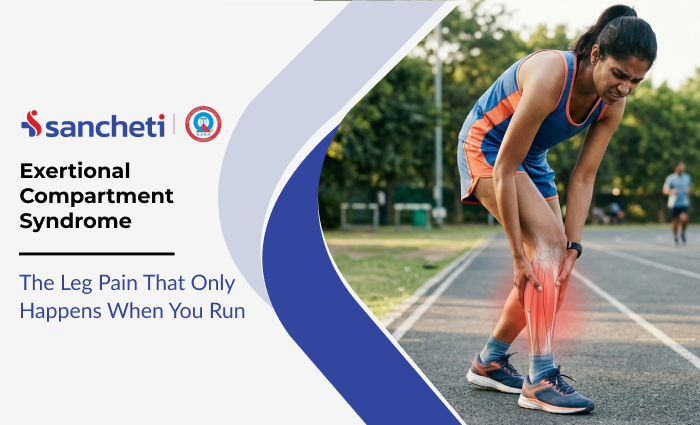

Exertional Compartment Syndrome: The Leg Pain That Only Happens When You Run
Exertional compartment syndrome is one of the most misdiagnosed causes of leg pain in athletes — largely because it does not behave like most injuries. The pain appears reliably during running, builds to the point of forcing the athlete to stop, and then clears almost completely within minutes of rest. Repeat the run, and the same thing happens.
In short: the muscles of the leg swell during exercise, pressure builds inside a rigid fascial compartment faster than it can escape, and the result is a predictable cycle of pain, tightness, and functional shutdown that only exercise triggers.
At Sancheti Hospital, Pune, our sports medicine and orthopaedic team regularly evaluates athletes — runners, footballers, military recruits, and kabaddi players — who have been living with this pattern for months, often told it is shin splints or a muscle cramp, and managed accordingly with little improvement.
What Is a Fascial Compartment and Why Does Pressure Matter?
The muscles of the lower leg are organised into four distinct compartments — anterior, lateral, deep posterior, and superficial posterior — each enclosed within a tight sleeve of connective tissue called fascia. This fascia is largely inelastic: it does not stretch significantly in response to pressure from within.
During exercise, working muscles increase in volume by up to 20% as blood flow surges and metabolic activity rises. In most athletes, the fascia accommodates this expansion without issue. In athletes with chronic exertional compartment syndrome (CECS), the compartmental pressure rises to a level that compresses the small blood vessels supplying the muscle, reducing oxygen delivery and triggering the characteristic pain, tightness, and weakness that forces them to stop.
Crucially, the pressure normalises quickly once exercise stops — which is why symptoms resolve within minutes of rest, and why the injury leaves no obvious physical finding when the athlete is examined at rest.
How It Differs From Acute Compartment Syndrome
This distinction is important and frequently causes confusion. Acute compartment syndrome — typically following a fracture, crush injury, or severe soft tissue trauma — is a surgical emergency in which dangerously elevated compartment pressure causes irreversible muscle and nerve damage within hours without immediate fasciotomy. It does not resolve with rest.
Chronic exertional compartment syndrome is a fundamentally different condition. Pressures rise with activity and fall with rest, damage is not occurring between episodes, and the athlete is not in danger during rest periods. However, compartment syndrome in any form should be formally assessed — the clinical distinction matters enormously for management, and misidentifying one as the other leads to either unnecessary alarm or dangerous under-treatment.
Who Gets Exertional Compartment Syndrome?
CECS is predominantly an injury of young, active athletes who run significant volumes. The most commonly affected group includes:
- Distance runners and sprinters
- Football and field sport players
- Military personnel undergoing high-volume march and run training
- Dancers and gymnasts
- Kabaddi players whose sport demands explosive repeated lower limb loading
The anterior compartment is most frequently affected, producing pain and tightness over the front of the shin. The deep posterior compartment is the second most common — and also the most frequently confused with medial tibial stress syndrome (shin splints) because both produce pain along the inner border of the shin.
Both legs are affected in approximately 80% of cases, though one side often becomes symptomatic first.
Symptoms: The Pattern That Points to the Diagnosis
What makes exertional compartment syndrome symptoms so distinctive — and so useful diagnostically — is their predictability:
- Pain, tightness, or a pressure sensation in the lower leg that begins after a consistent period of running — often 10–20 minutes into a run, or at a specific pace threshold
- The discomfort escalates progressively if running continues, sometimes to the point where the athlete cannot maintain form or must stop completely
- Numbness or tingling in the foot or toes is common when the anterior compartment is involved, caused by compression of the peroneal nerve as pressures rise
- Foot drop — weakness of ankle dorsiflexion — can occur transiently in severe anterior compartment involvement
- Symptoms resolve within 5–20 minutes of stopping activity
- The following morning, the athlete is completely symptom-free and can reproduce the exact same pattern in the next training session
This exercise-dependent, rest-resolving pattern is the hallmark. Athletes who describe their leg pain as constant at rest, or who wake with pain during the night, are more likely dealing with a different diagnosis — stress fractures being the most important to rule out, as they produce night pain and bony tenderness that CECS does not.
Why It Gets Misdiagnosed So Often
Exertional compartment syndrome is chronically underdiagnosed for several interconnected reasons.
First, the clinical examination at rest is almost entirely normal. There is no swelling, no point tenderness, no loss of range of motion — nothing that triggers alarm during a standard consultation. Unless the clinician is specifically thinking about CECS, the normal examination leads to reassurance and a diagnosis of muscle tightness or shin splints.
Second, the symptom description — leg pain that comes on with running — is common to several conditions. Medial tibial stress syndrome, Achilles tendinitis, popliteal artery entrapment, and nerve entrapment syndromes all produce exercise-related lower leg pain and must be differentiated carefully. Even hamstring pain radiating distally can occasionally be confused with posterior compartment symptoms in athletes who present without a clear mechanism.
Third, many athletes self-manage for months — reducing mileage, stretching more, trying different footwear — without improvement, and often without seeking medical attention until the symptoms significantly impair performance or daily function.
Diagnosis: How CECS Is Confirmed
The gold standard for diagnosing chronic exertional compartment syndrome is intracompartmental pressure measurement — a procedure where a needle pressure monitor is inserted into the affected compartment before exercise, immediately after exercise, and at five and fifteen minutes post-exercise. Diagnostic criteria (the Pedowitz criteria) specify elevated pre-exercise pressure, and critically elevated post-exercise pressures that normalise slowly, as confirmation of the condition.
This test requires the athlete to exercise to symptom reproduction immediately before measurement — which means it must be performed in a setting equipped for both exercise testing and sterile pressure measurement. It is not widely available, which is another reason the diagnosis is delayed in many athletes.
MRI with exertional protocols and near-infrared spectroscopy are emerging as non-invasive alternatives but are not yet the standard of care.
Conservative Treatment: What Works and What Doesn’t
Unlike most overuse injuries, CECS does not respond reliably to conservative management — and this is one of the most important facts for athletes and clinicians to understand. The underlying problem is structural: the fascia is too tight relative to the muscle volume it contains during exercise, and no amount of stretching, strengthening, or load modification changes that fundamental relationship.
That said, conservative measures are typically trialled first, particularly in athletes who cannot immediately commit to surgery or who have mild, tolerable symptoms:
- Activity modification — reducing running volume or intensity to below the symptom threshold provides relief but does not resolve the condition. Most athletes find this an unsatisfactory long-term solution.
- Gait retraining — transitioning to a forefoot strike pattern has been shown in some studies to reduce anterior compartment pressures during running and provide meaningful symptom improvement in a subset of athletes. This requires supervised physiotherapy and rehabilitation with a therapist experienced in running biomechanics.
- Orthotic correction — addresses biomechanical contributors such as overpronation that may increase posterior compartment loading.
- Stretching and foam rolling — provide symptomatic comfort but do not alter compartment pressure dynamics.
For athletes with mild symptoms and low sporting demands, conservative management may provide sufficient functional improvement. For competitive athletes wanting to return to full training without restriction, surgery is the only reliably curative intervention.
Surgical Treatment: Fasciotomy
Fasciotomy — the surgical release of the tight fascial compartment — is the definitive treatment for CECS and produces excellent outcomes in well-selected patients. The procedure involves making one or two small incisions in the leg and cutting the fascia longitudinally to permanently enlarge the compartment, allowing the muscle to expand freely during exercise without pressure build-up.
The procedure is performed under general or regional anaesthesia, typically as a day-care surgery. Both legs are commonly released in the same operative session given the high rate of bilateral involvement. Our sports medicine team at Sancheti Hospital coordinates the pre-surgical pressure measurement, surgical planning, and post-operative rehabilitation to ensure the full diagnostic and treatment pathway is managed without unnecessary delay.
Recovery follows a structured progression:
- Week 1–2: Wound healing, gentle range-of-motion exercises, walking progressed as comfort allows
- Week 3–4: Light jogging introduced on flat surfaces
- Weeks 4–8: Progressive return to running volume and intensity
- Months 2–3: Full return to sport, including high-intensity training and competition
Return to sport success rates after fasciotomy for CECS are reported at 80–90% in the literature, with most athletes achieving full, unrestricted return to their pre-injury training levels.
Key Takeaways
- Chronic exertional compartment syndrome produces exercise-induced leg pain that consistently appears after a predictable period of running and resolves rapidly with rest — a pattern that is highly distinctive and diagnostically valuable.
- It is caused by elevated pressure within inelastic fascial compartments during exercise, reducing muscle blood flow and causing pain, tightness, and sometimes neurological symptoms in the foot.
- The clinical examination at rest is almost entirely normal, which is why the diagnosis is frequently missed and attributed to shin splints or muscle tightness.
- Confirmation requires intracompartmental pressure measurement performed before and after exercise to symptom reproduction.
- Conservative management — activity modification, gait retraining, orthotics — helps some athletes with mild symptoms but does not resolve the underlying structural problem.
- Fasciotomy is the definitive treatment, with 80–90% of athletes returning to full, unrestricted sport.
- At Sancheti Hospital, Pune, our sports medicine and orthopaedic specialists offer the full diagnostic and surgical pathway for CECS, tailored to each athlete’s sport, training demands, and return-to-play goals.
Frequently Asked Questions (FAQs)
Q1. Is exertional compartment syndrome the same as shin splints?
No, though they are frequently confused because both cause lower leg pain during running. Shin splints (medial tibial stress syndrome) produce pain along the inner border of the tibia that is often present both during and after activity, and there is typically bony tenderness on palpation at rest. CECS pain is compartmental, builds specifically during exercise, resolves quickly with rest, and leaves no tenderness on examination. Distinguishing between them matters because the treatments are entirely different.
Q2. Can exertional compartment syndrome get worse over time if left untreated?
The condition rarely causes permanent damage because pressures normalise with rest. However, untreated CECS typically becomes progressively more limiting — symptoms appear earlier in runs, at lower intensities, and the pain becomes more severe. Most athletes find their effective training volume shrinks significantly over time as the condition worsens, which is why early assessment and treatment planning is worthwhile rather than continuing to manage around it indefinitely.
Q3. Can CECS affect areas other than the lower leg?
Yes, though the lower leg is by far the most common site. Exertional compartment syndrome has been reported in the forearm — particularly in motocross riders and climbers — as well as the thigh and foot. The same pathophysiology applies: inelastic fascia, muscle swelling during exercise, and pressure-driven symptoms that resolve with rest.
Q4. How long do I need to stop running before fasciotomy surgery?
There is no requirement to stop running before surgery in CECS, unlike some injuries where active inflammation must settle. The timing of surgery is determined by how significantly symptoms are limiting training, the athlete’s schedule, and the surgeon’s assessment. Some athletes continue modified training right up until their surgical date.
Q5. Are there any risks of fasciotomy I should know about?
Fasciotomy for CECS is a well-established, low-risk procedure. Potential complications include wound healing issues, superficial nerve injury causing numbness along the incision site, haematoma formation, and — rarely — incomplete release requiring revision. Choosing a surgeon experienced in the specific anatomical approach for each compartment minimises these risks considerably.