Home
Home PG College
 Patient Login
 Sancheti Clinic
 Contact Us
 Download Reports
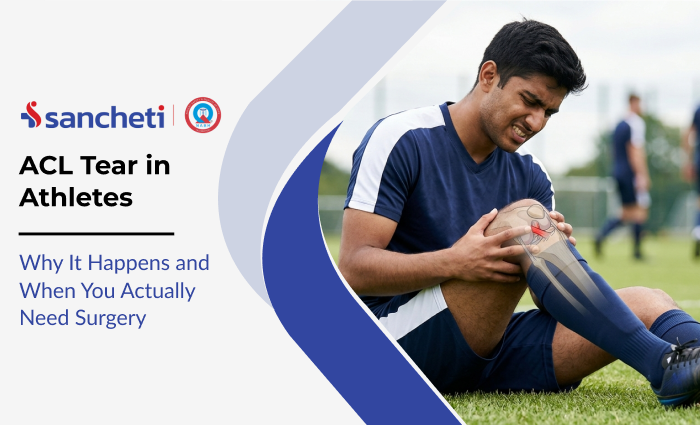

ACL Tear in Athletes: Why It Happens and When You Actually Need Surgery
An ACL tear (anterior cruciate ligament tear) is one of the most common and serious sports injuries affecting athletes of all levels. In short: an ACL tear occurs when the ligament connecting your thigh bone to your shin bone is overstretched or snaps — and surgery is typically needed when the knee becomes unstable and conservative treatment fails, especially in athletes wanting to return to sport.
What Is the ACL and Why Does It Matter?
The anterior cruciate ligament (ACL) is a thick band of tissue located inside the knee joint. It runs diagonally from the femur (thigh bone) to the tibia (shin bone) and plays a critical role in stabilizing the knee — especially during twisting, turning, and sudden stops.
When the ACL is torn, the knee loses its ability to stay properly aligned during movement. This can make everyday activities painful and high-impact sports nearly impossible without treatment.
You can learn more about ACL anatomy and function in our Health Library on Anterior Cruciate Ligament.
How Does an ACL Tear Happen? Common Causes in Athletes
ACL injuries in athletes rarely happen from direct contact. Most tears occur during non-contact movements that place sudden, high stress on the knee. The most common causes include:
- Sudden change of direction or pivoting on a planted foot
- Landing awkwardly from a jump (especially in basketball or volleyball)
- Abruptly stopping while running at full speed
- A direct blow to the outside of the knee (common in football and rugby)
- Hyperextension of the knee joint
Sports with the highest ACL tear risk include football, cricket, kabaddi, basketball, skiing, and gymnastics. Female athletes are also statistically at a higher risk of ACL tears than male athletes, likely due to differences in anatomy, hormones, and muscle activation patterns.
Recognizing the Signs: ACL Tear Symptoms
The moment of an ACL rupture is often dramatic. Athletes commonly report:
- A loud “pop” sound at the time of injury
- Immediate severe knee pain
- Rapid swelling within a few hours
- A feeling that the knee has “given out” or is unstable
- Difficulty bearing weight or straightening the leg fully
If you experience these symptoms after a sports injury, it’s important to seek medical attention right away. Delayed diagnosis can lead to further damage, including associated meniscus injuries, cartilage damage, or chronic knee instability.
Our team at Sancheti Hospital’s Sports Medicine Division provides prompt evaluation and imaging (MRI) to accurately diagnose ACL tears and plan the right course of treatment.
Diagnosing an ACL Tear: What to Expect
Diagnosis starts with a thorough clinical examination. Your orthopaedic specialist will perform tests such as the Lachman test and the anterior drawer test to assess how much the knee moves out of position. An MRI is the gold-standard imaging tool to confirm the tear, grade its severity, and check for any associated damage to the meniscus or other ligaments.
ACL tears are graded as:
- Grade 1 – Minor sprain, ligament stretched but intact
- Grade 2 – Partial tear with some loss of stability
- Grade 3 – Complete rupture, significant instability
Grade 3 tears are the most common form seen in athletes.
Do You Always Need Surgery for an ACL Tear?
This is one of the most common questions we hear at Sancheti Hospital — and the honest answer is: not always, but often yes for athletes.
Non-surgical (conservative) management may be appropriate if:
- You have a Grade 1 or partial Grade 2 tear
- You are an older, less active patient with low physical demands
- You are willing to modify your activity levels permanently
- The knee remains stable after a structured physiotherapy program
Conservative treatment typically involves RICE (Rest, Ice, Compression, Elevation), anti-inflammatory medications, and a supervised knee rehabilitation program focused on strengthening the quadriceps and hamstrings.
However, conservative treatment alone cannot restore the mechanical stability that a torn ACL once provided. For competitive athletes or anyone wanting to return to pivoting sports, surgery is generally the recommended route. Chronic knee instability can also lead to progressive joint damage over time — learn more about how this affects the joint on our Joint Instability page.
When Surgery Is Strongly Recommended
ACL reconstruction surgery is typically advised in the following scenarios:
- Complete (Grade 3) ACL rupture with knee instability
- Young, active athletes who want to return to sport
- Presence of combined injuries (torn meniscus, cartilage damage, or multiple ligament tears)
- Failed conservative treatment with persistent instability
- Patients involved in professions requiring heavy physical activity
At Sancheti Hospital, we perform ACL Reconstruction using minimally invasive arthroscopic techniques. The torn ligament is replaced with a graft — typically taken from the patient’s own hamstring or patellar tendon (autograft), or from a donor (allograft). This is a day-care or short-stay procedure with a well-established success rate for athletes.
The right surgical timing is also important. Performing surgery on a severely swollen knee can increase complication risk. Most surgeons prefer to wait until the initial swelling settles, usually 2–6 weeks post-injury.
What Happens During ACL Reconstruction Surgery?
Our orthopaedic surgeons at Sancheti Hospital perform ACL reconstruction under arthroscopic guidance — meaning the entire procedure is done through tiny incisions using a small camera. There are no large open cuts.
The steps involved:
- Small keyhole incisions are made around the knee
- The damaged ACL is removed
- A graft is harvested or prepared
- Tunnels are drilled into the femur and tibia to anchor the new ligament
- The graft is threaded through and secured with specialized fixation devices
- The incisions are closed and the knee is bandaged
The procedure typically takes 60–90 minutes. Our Arthroscopic and Sports Surgeries department handles a wide range of knee procedures using the same minimally invasive approach.
Recovery After ACL Surgery: What to Realistically Expect
Recovery from ACL reconstruction is a process — there are no shortcuts. Here’s a general timeline:
- Weeks 1–2: Pain management, elevation, initial physiotherapy, gentle range-of-motion exercises
- Weeks 3–6: Progressive weight-bearing, quadriceps activation, walking without crutches
- Months 2–4: Strengthening, balance training, sport-specific conditioning
- Months 4–6: Return to jogging, agility drills, sport-specific movements
- 6–9 months: Gradual return to competitive sport (with clearance from your surgeon)
It’s important to understand that the graft needs time to “ligamentize” — a biological process where the new tissue integrates with the bone and becomes fully functional. Rushing this timeline increases the risk of re-tear.
Associated injuries can also affect recovery. For example, if a meniscus tear is repaired alongside ACL reconstruction, the rehabilitation timeline may be extended. Our surgeons are experienced in managing these combined repairs — see our dedicated Meniscus Repair page for more details.
Key Takeaways
- The ACL is a crucial ligament for knee stability, especially during high-impact sports.
- Most ACL tears in athletes are non-contact injuries caused by sudden pivoting, landing, or stopping.
- Symptoms include a “pop,” immediate pain, rapid swelling, and knee instability.
- Surgery is not always mandatory — but it is strongly recommended for athletes, those with complete tears, or anyone with combined knee injuries.
- ACL reconstruction using arthroscopic techniques is safe, effective, and offers high success rates when combined with proper rehabilitation.
- Recovery takes 6–9 months on average. A structured rehabilitation program is just as important as the surgery itself.
- At Sancheti Hospital, Pune, our orthopaedic and sports medicine specialists offer comprehensive evaluation and individualized treatment plans for ACL injuries.
Frequently Asked Questions (FAQs)
Q1. Can I walk with a torn ACL?
Yes, many people can walk with a torn ACL, especially in the weeks after the acute swelling settles. However, the knee may feel unstable, particularly on uneven surfaces or during turning movements. Walking ability does not indicate that the ligament has healed or that surgery is unnecessary.
Q2. Is ACL surgery the only option for a complete tear?
Not always. Some older or less active patients with Grade 3 tears do manage with physiotherapy and activity modification. However, for anyone who wants to continue playing sport or has ongoing knee instability, surgery is generally the most reliable solution for restoring full function.
Q3. How do I know if my ACL tear is old or new?
A fresh ACL tear typically presents with sudden swelling, pain, and instability following a specific injury. Chronic or old ACL tears may cause less pain but persistent feelings of the knee giving way, especially during sport. An MRI will clearly show whether the tear is acute or chronic.
Q4. What is the risk of ACL re-tear after surgery?
Re-tear rates vary depending on factors like age, sport, graft type, and adherence to rehabilitation. On average, re-tear rates range from 5–25% in athletes who return to high-demand pivoting sports. Following a structured recovery program and not returning to sport prematurely significantly reduces this risk.
Q5. Can ACL tears be prevented?
While not entirely preventable, the risk can be significantly reduced through targeted neuromuscular training, proper landing mechanics, strengthening of the quadriceps and hamstrings, and using good footwear. Many professional sports teams include ACL prevention programs as part of routine training.