Home
Home PG College
 Patient Login
 International patients
 Contact Us
 Emergency
 Download Reports

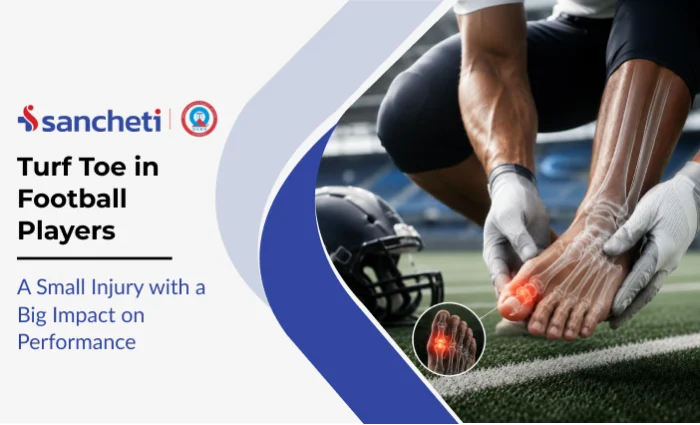

Turf Toe in Football Players: A Small Injury with a Big Impact on Performance
Turf toe is a sprain of the first metatarsophalangeal (MTP) joint — the joint at the base of the big toe — caused by forceful hyperextension of the toe, most commonly when pushing off a hard or artificial surface.
In short: it happens when the big toe bends too far upward, straining or tearing the soft tissue structures beneath it. It may sound minor, but at Sancheti Hospital, Pune, we consistently see football players, cricketers, and field athletes sidelined for weeks — sometimes months — because this injury was not taken seriously early enough.
Every step, sprint, pivot, and jump involves the big toe. When that joint is injured, every movement on the field is compromised.
What Exactly Is Turf Toe?
The term “turf toe” was coined in the late 1970s when American football players began experiencing this injury more frequently after artificial turf surfaces were introduced. The harder, less forgiving surface, combined with flexible lightweight footwear, created the perfect conditions for the injury.
At its core, turf toe is a sprain of the plantar plate and surrounding capsuloligamentous complex of the first MTP joint. The plantar plate is a thick, fibrocartilaginous structure on the underside of the joint that acts as a primary stabiliser during push-off.
The sesamoid bones — two small bones embedded in the flexor hallucis brevis tendon beneath the first MTP joint — are also often involved. They act like pulleys, helping the big toe generate the power needed for propulsion. When the joint is forcefully hyperextended, these sesamoids can fracture, the plantar plate can partially or fully tear, and the joint capsule can be disrupted.
How Does Turf Toe Happen in Football?
The mechanism is almost always the same: the foot is planted flat on the ground, the heel lifts, and an external force drives the body forward while the toe remains fixed — forcing the MTP joint into hyperextension beyond its normal range.
In football (both Indian and international variants), this happens during:
- Explosive push-off during sprinting from a standing or crouched position
- Tackling or being tackled while the foot is fixed on the ground
- Sliding or falling forward onto a planted foot
- Landing awkwardly after a header or aerial challenge
The injury is more common on artificial turf because the surface has less give than natural grass — the toe grips the turf and cannot rotate freely, magnifying the stress on the MTP joint. However, we do see it on grass fields as well, particularly when the surface is firm and dry.
Grading the Injury: Not All Turf Toe Is the Same
Like most ligament and soft tissue injuries, turf toe is classified by severity:
| Grade | Tissue Damage | Symptoms | Typical Recovery |
| Grade I | Stretching of plantar plate; no tear | Mild pain, minimal swelling, normal weight-bearing | 3–14 days |
| Grade II | Partial tear of plantar plate/capsule | Moderate pain, swelling, bruising; painful weight-bearing | 2–6 weeks |
| Grade III | Complete tear; possible sesamoid injury or fracture | Severe pain, significant swelling and bruising; unable to push off | 6 weeks to 6 months |
Grade I injuries are often managed on the field with taping and padding and may allow the athlete to continue playing with some discomfort. Grade II and III injuries are different — they require structured rest, immobilisation, and supervised rehabilitation. Attempting to play through a Grade III turf toe can cause long-term joint instability, hallux rigidus (stiff big toe), and chronic pain.
Symptoms: Recognising Turf Toe on and off the Field
| Symptom | What It Indicates |
| Pain at the base of the big toe | MTP joint involvement |
| Swelling around the first MTP joint | Inflammatory response to capsular injury |
| Bruising on the underside of the foot | Plantar plate or sesamoid disruption |
| Pain with push-off while walking or running | Plantar capsule under load stress |
| Reduced range of motion (especially upward) | Joint effusion or structural damage |
| Feeling of instability at the big toe | Ligament or plantar plate tear |
| A “pop” heard at the time of injury | Suggests Grade II–III injury |
The onset is usually acute — the athlete knows something has happened. However, chronic or repetitive low-grade turf toe can develop gradually in players who repeatedly stress the joint without allowing full recovery, and these cases are sometimes mistaken for general forefoot soreness.
What Makes It Different from a Regular Toe Sprain?
Many players (and sometimes coaches) dismiss turf toe as “just a sprained toe.” The key difference lies in which structures are involved and how critical they are to athletic function.
The first MTP joint is not just any joint. It bears up to 40–60% of body weight during normal walking, and the demands on it during running and cutting are significantly higher. The big toe is the final contact point before the foot leaves the ground during every stride. A compromised first MTP joint affects:
- Push-off power — reducing sprint speed and acceleration
- Balance during kicking — altering foot strike mechanics
- Pivot ability — making directional changes painful and unstable
- Overall gait pattern — forcing compensatory movement at the ankle, knee, and hip
Football players with inadequately treated turf toe frequently develop problems up the kinetic chain — Achilles tendinitis, knee pain, and even hip stress — because they unconsciously shift load away from the painful toe. Pain at the bottom of the foot should always be assessed in the full context of the athlete’s biomechanics, not just the local area of complaint.
Diagnosis: What Investigations Are Needed?
A clinical examination by an experienced orthopedic or sports medicine specialist is the starting point. The examiner will assess:
- Point tenderness at the first MTP joint (dorsal vs. plantar)
- Range of dorsiflexion and plantarflexion compared to the opposite foot
- The dorsiflexion-compression test — pain on passive hyperextension confirms MTP involvement
- Stability of the joint in all planes
Imaging:
| Investigation | Purpose |
| X-ray (weight-bearing) | Identifies sesamoid fractures, avulsion fractures, and joint space changes |
| MRI | Gold standard — visualises plantar plate tear, capsular injury, sesamoid bone marrow oedema |
| Ultrasound | Useful for dynamic assessment of the plantar plate in real-time |
| CT scan | Used when sesamoid fracture morphology needs detailed evaluation |
An MRI is particularly important for Grade II–III injuries before deciding on treatment, and is essential if surgery is being considered. At Sancheti Hospital, our foot and ankle specialists ensure a complete imaging workup before any treatment plan is finalised — because the treatment for a sesamoid fracture differs from that for a pure capsular tear, even if the symptoms seem identical.
Treatment: Matching the Approach to the Grade
Grade I — Active Rest and Taping
- Buddy taping of the big toe to limit hyperextension
- Stiff-soled footwear or a carbon fibre insole insert to reduce MTP motion
- Ice and anti-inflammatory medications for the first 48–72 hours
- Modified training — pool running, cycling, and upper body work to maintain fitness
- Return to play typically within 1–2 weeks with ongoing taping
Grade II — Immobilisation and Rehabilitation
- Short-leg walking boot or cast for 1–3 weeks to protect the healing plantar plate
- Non-weight-bearing or partial weight-bearing in the acute phase
- Physiotherapy: range of motion exercises, intrinsic foot muscle strengthening, gait retraining
- Rigid orthotic insole with a first MTP extension cutout to offload the joint on return to sport
- Return to play typically between 3–6 weeks, with full taping protocol
Grade III — Extended Recovery, Possible Surgery
- Strict non-weight-bearing in a cast for 4–6 weeks
- MRI repeated to monitor plantar plate healing
- Prolonged physiotherapy: toe flexor strengthening, proprioceptive training, sport-specific drills
- Return to play can take 3–6 months
Surgery is indicated for Grade III injuries that involve:
- A displaced sesamoid fracture
- Complete plantar plate rupture with MTP joint instability
- Failure to improve after adequate conservative management
- A tibial sesamoid fracture with proximal migration (sesamoid retraction)
Surgical procedures may include plantar plate repair, sesamoidectomy (removal of a fragmented sesamoid), or debridement of scar tissue. Our foot and ankle surgery team at Sancheti Hospital approaches these cases with the aim of restoring full push-off function — the non-negotiable requirement for any serious athlete.
Turf Toe vs. Other Forefoot Conditions: A Quick Comparison
Football players sometimes present with forefoot pain that may or may not be turf toe. Here is how it compares with similar conditions:
| Condition | Location | Mechanism | Key Differentiator |
| Turf Toe | First MTP joint (plantar/dorsal) | Hyperextension of big toe | Pain on MTP dorsiflexion; plantar plate involvement |
| Sesamoiditis | Under the first metatarsal head | Repetitive loading, no acute event | Gradual onset; no ligament disruption |
| Hallux Rigidus | First MTP joint | Degenerative/post-traumatic | Loss of dorsiflexion; joint stiffness; X-ray changes |
| Hallux Valgus (Bunion) | First MTP joint (medial) | Structural deformity | Visible deformity; pain on footwear contact |
| Morton’s Neuroma | Third/fourth web space | Nerve compression | Burning, numbness between toes; no MTP instability |
| Stress Fracture | Metatarsal shaft | Overuse / repetitive loading | Gradual onset; tenderness along bone, not joint |
Sesamoiditis — often confused with turf toe — tends to have a more insidious onset without the acute hyperextension mechanism. However, the two conditions can coexist, and sesamoid involvement must always be ruled out in any Grade II–III turf toe.
Rehabilitation: The Road Back to the Pitch
Recovery from turf toe is not just about letting the pain subside. It requires a structured return-to-sport programme, because the demands of football on the first MTP joint are intense. A typical phased approach:
Phase 1 — Protection (Week 1–3 depending on grade) Rest, ice, anti-inflammatory treatment, rigid footwear. Goal: reduce inflammation and protect healing tissue.
Phase 2 — Mobility and Load Introduction (Week 3–6) Gentle range of motion exercises. Toe curls, marble pickups, towel scrunches. Begin walking on flat surfaces without a protective boot.
Phase 3 — Strengthening and Proprioception (Week 6–10) Single-leg balance, calf raises with toe-off, resistance band exercises. Transition to sport-specific training surfaces.
Phase 4 — Sport-Specific Conditioning (Week 10 onwards) Straight-line running, followed by curved runs, then cutting, sprinting, and kicking drills. Taping maintained throughout.
Clearance criteria before return to play:
- Full, pain-free range of MTP dorsiflexion
- Equal push-off strength compared to the uninjured side
- Pain-free completion of sport-specific drills including sprinting and cutting
Our sports medicine division at Sancheti Hospital works with athletes through every phase of this rehabilitation, ensuring they return to play at full capacity — not just symptom-free.
Prevention: Can Turf Toe Be Avoided?
Not entirely — contact sports carry inherent risks. But several strategies significantly reduce the likelihood of sustaining a first MTP sprain:
- Footwear choice: Shoes with a stiffer forefoot sole reduce the amount of MTP dorsiflexion possible during push-off. Overly flexible football boots on hard surfaces are a known risk factor.
- Carbon fibre insoles: Pre-made or custom orthotic plates that limit toe extension can be used prophylactically in high-risk players.
- Taping: Preventive taping of the first MTP joint during high-risk matches and training sessions reduces injury incidence in players with a previous history.
- Surface awareness: Recognising that hard artificial turf or dry, firm natural grass increases risk and adjusting training load accordingly.
- Ankle sprain prevention programmes: Players with a history of ankle sprains often develop compensatory foot mechanics that increase forefoot stress — addressing ankle stability reduces indirect turf toe risk.
Key Takeaways
- Turf toe is a sprain of the first metatarsophalangeal joint, most commonly caused by forceful hyperextension of the big toe during push-off or contact.
- It is graded I to III — Grade I returns quickly; Grade III can sideline a player for up to six months.
- The injury is deceptively serious because the big toe is central to every athletic movement: sprinting, pivoting, kicking, and jumping.
- MRI is essential for accurate grading and identifying sesamoid involvement before a treatment plan is confirmed.
- Most Grade I and II injuries respond well to conservative treatment — taping, rigid insoles, physiotherapy, and a structured return-to-sport programme.
- Grade III injuries, particularly those with plantar plate rupture or sesamoid fracture, may require surgery.
- Playing through turf toe without proper treatment leads to chronic joint instability, hallux rigidus, and long-term performance loss.
- Prevention involves choosing appropriate footwear, using insole support, and pre-match taping for at-risk athletes.
Frequently Asked Questions (FAQs)
Q1. Can a football player continue playing with turf toe?
With a Grade I injury, some players continue with taping and modified footwear — though this should only happen after a proper clinical assessment, not a self-diagnosis on the sideline. Grade II and III injuries should not be played through. Continuing to load a partially or fully torn plantar plate significantly increases the risk of converting a treatable injury into a chronic, career-affecting problem.
Q2. How is turf toe different from gout in the big toe?
Both cause pain and swelling at the first MTP joint, but they are entirely different conditions. Gout is a metabolic disorder caused by uric acid crystal deposition — it typically presents with intense redness, heat, and throbbing pain without a specific injury event, and is confirmed by blood tests and joint fluid analysis. Turf toe follows a clear mechanism of injury and involves ligamentous or capsular damage, confirmed on MRI. A specialist can distinguish the two easily on examination.
Q3. Does turf toe cause permanent damage?
If treated appropriately, most cases resolve without permanent consequences. However, poorly managed or repeatedly re-injured turf toe can lead to hallux rigidus (arthritis-related stiffening of the big toe joint), chronic MTP instability, or sesamoid non-union — all of which significantly and permanently affect athletic performance. Early diagnosis and proper management are the best protection against long-term damage.
Q4. Are certain positions in football more prone to turf toe?
Yes. Forwards, wingers, and midfielders who frequently sprint, cut, and strike the ball are at higher risk because of the repeated explosive push-off demands on the first MTP joint. Goalkeepers diving with the toe planted and defenders making explosive lateral movements are also at risk. Essentially, any position involving sustained high-intensity foot-ground contact carries exposure.
Q5. What type of footwear is safest to prevent turf toe on hard ground?
Football boots designed specifically for hard ground (HG) or firm ground (FG) with a stiffer forefoot and distributed stud placement provide better protection than ultra-flexible speed boots with minimal outsole rigidity. A carbon fibre orthotic plate inserted into the boot adds an additional layer of MTP joint protection and is commonly used in players returning from a previous turf toe injury.