Home
Home PG College
 Patient Login
 Sancheti Clinic
 Contact Us
 Download Reports
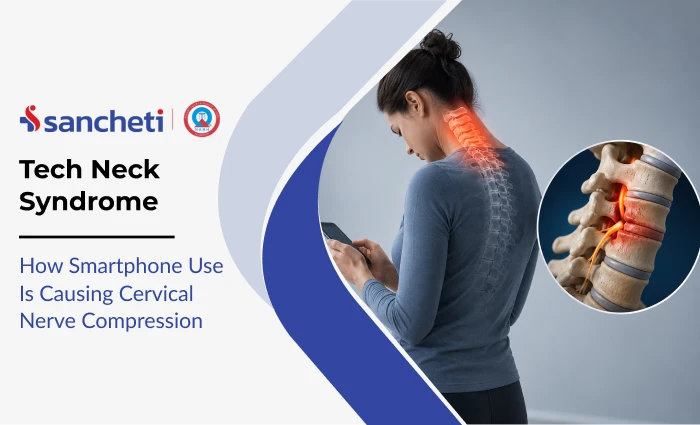

Tech Neck Syndrome: How Smartphone Use Is Causing Cervical Nerve Compression
Tech neck is a pattern of cervical spine injury caused by sustained forward head posture during smartphone or screen use, producing chronic overload on the neck muscles, accelerated disc degeneration, and, in progressive cases, compression of the cervical nerve roots that supply the arms and hands.
What begins as muscle tightness can progress, over months and years of uncorrected posture, to structural nerve damage that requires active medical intervention.
At Sancheti Hospital, Pune, our Spine Department is seeing younger patients with cervical disc herniations and nerve compression than in previous decades, a shift that correlates directly with smartphone screen time and remote working patterns.
What Is Tech Neck?
The cervical spine is designed to carry this load efficiently when the head is balanced directly over the shoulders.
When the head tilts forward to look at a phone or screen, the effective load on the cervical spine increases dramatically. A 2014 biomechanical analysis by orthopaedic surgeon Kenneth Hansraj, published in Surgical Technology International, modelled this relationship across flexion angles:
| Head Flexion Angle | Typical Activity | Effective Load on Cervical Spine |
|---|---|---|
| 0° (neutral) | Standing upright, head over shoulders | 4.5-5.4 kg |
| 15° | Glancing down slightly | 12.2 kg |
| 30° | Typical smartphone use, head dropped | 18.1 kg |
| 45° | Deep phone use, seated or lying | 22.2 kg |
| 60° | Phone in lap, maximum flexion | 27.2 kg |
At 60 degrees of flexion; the typical angle when reading a phone held in the lap, the cervical spine carries roughly five times its neutral load. Repeated and sustained exposure to this load, for hours daily over years, is the biomechanical mechanism that drives tech neck from postural habit to structural spinal injury.
Who It Affects
Tech neck does not spare any age group, but it predominantly affects young and working-age adults who spend the most hours on screens. The epidemiological picture is stark:
Approximately 64% of smartphone users experience neck pain correlated with excessive use and prolonged cervical flexion, particularly at angles greater than 30 degrees (Hakami et al., 2024-25). Users spending more than four hours per day on smartphones exhibit significantly greater cervical flexion and higher rates of neck and shoulder discomfort compared to lower-use controls.
Another study of adult smartphone users found an overall prevalence of cervical spine degeneration of 54%, rising to 72% in those using smartphones for more than six hours per day, compared to 28% in moderate users. These figures indicate that excessive smartphone use does not merely cause temporary muscle strain, it accelerates structural degeneration of the cervical disc.
The condition is not limited to older adults. Spine surgeons globally are reporting disc herniations and radiculopathy in patients in their twenties and thirties whose spinal imaging shows degenerative changes previously associated with patients in their fifties; changes that correlate directly with screen exposure and forward head posture.
Stages of Tech Neck Progression
Tech neck does not arrive as a sudden event. It progresses through identifiable stages, each representing increasing structural involvement. Understanding the stage determines the urgency and nature of intervention.
| Stage | What Is Happening | Symptoms | Reversibility |
|---|---|---|---|
| Stage 1
Muscular Strain |
Forward head posture chronically overloads posterior cervical muscles and upper trapezius. Sustained low-level muscle activation causes fatigue and localised myofascial pain | Neck stiffness, tightness across shoulders, upper trapezius tenderness, tension headaches | Fully reversible with postural correction and physiotherapy |
| Stage 2
Disc Stress and Early Degeneration |
Sustained compressive loads accelerate disc dehydration and loss of disc height, particularly at C5-C6 and C6-C7; the most mechanically stressed levels in flexion | Axial neck pain, reduced rotation and extension, morning stiffness, referred pain to the shoulder blade | Partially reversible; structural disc changes persist but symptoms can be controlled |
| Stage 3
Cervical Nerve Root Compression (Radiculopathy) |
Disc bulge or herniation narrows the neural foramen, compressing the exiting nerve root. Osteophytes (bone spurs) may compound the narrowing | Radiating arm pain, tingling or numbness in the hand or fingers along a dermatomal pattern, grip weakness | Requires active treatment; 75-90% resolve with structured conservative care |
| Stage 4
Spinal Cord Compression (Myelopathy) |
Severe or multilevel stenosis reduces the space available for the spinal cord itself, not just the nerve roots. Cord compression causes upper motor neuron signs | Bilateral hand clumsiness, balance disturbance, gait problems, electric shock sensation down the spine on neck flexion (Lhermitte’s sign) | Progressive without surgery; surgical decompression recommended to prevent irreversible cord damage |
The progression is not inevitable. Most people who develop Stage 1 or 2 changes never progress to nerve compression if they address posture and screen habits. The danger is unrecognised progression; continuing high screen time and ignoring early symptoms until structural nerve involvement occurs.
Symptoms of Tech Neck
Symptoms of tech neck-related cervical nerve compression follow a predictable anatomical pattern based on which nerve root is compressed. The C6 and C7 nerve roots are the most commonly involved in cervical disc disease.
Early warning symptoms, present before nerve root compression is established:
- Neck pain and stiffness that worsens during or after screen use
- Upper trapezius tightness and tenderness on both sides
- Tension headaches originating from the base of the skull
- Reduced neck rotation, difficulty checking blind spots while driving
- Shoulder blade aching, particularly at the medial border
Symptoms that indicate nerve root compression is present and require assessment:
- Radiating pain from the neck into the arm or hand; sharp, burning, or electric in quality
- Tingling or numbness in the fingers; location maps to the compressed nerve root (see table)
- Weakness in grip, wrist extension, or shoulder movement
- Pain worsened by neck extension or lateral rotation toward the affected side (Spurling sign)
- Relief when the arm is elevated above the head; a classic sign of cervical radiculopathy
Diagnosis for Tech Neck Syndrome
Diagnosis of tech neck-related cervical nerve compression combines clinical examination, provocative testing, and imaging. Each component contributes information that the others cannot provide alone.
Clinical Examination and Provocative Tests
Spurling Test: The examiner applies downward axial compression while rotating and laterally bending the neck toward the symptomatic side. Reproduction of arm or hand pain constitutes a positive test.
Shoulder Abduction Relief Sign: The patient places the hand of the symptomatic arm on top of their head. Relief of arm pain indicates that raising the arm reduces tension on the compressed nerve root.
Neurological examination: Motor strength testing in key myotomes, sensory assessment along dermatomes, and deep tendon reflex testing confirm the nerve root level and grade the severity.
Postural assessment: Measurement of forward head posture (craniovertebral angle), cervical lordosis, and thoracic kyphosis quantifies the postural component and guides rehabilitation priorities.
Investigations
MRI of the cervical spine: MRI visualises disc herniations, foraminal narrowing, nerve root compression, and spinal cord signal change. It confirms the level, determines the extent of compression, and identifies any cord involvement that would change the urgency of management.
X-ray (cervical spine with flexion-extension views): Identifies disc space height loss, osteophyte formation, and segmental instability.
Nerve Conduction Study (NCS) and EMG: Confirms nerve root dysfunction, identifies the specific level when clinical and imaging findings conflict, and quantifies the severity of motor nerve damage.
CT myelogram: Used when MRI is contraindicated or when bony foraminal stenosis detail is needed beyond what MRI provides.
Treatment of Tech Neck Syndrome
The treatment approach depends on the stage of the tech neck and the presence of nerve involvement. There is a favourable natural history that supports a stepwise approach that begins with conservative management before considering interventional options.
Step 1: Postural Correction and Behaviour Modification (All Stages)
The first and most important intervention is removing the cause. No other treatment fully compensates for ongoing forward head posture if screen habits are not addressed.
- Raise the phone to eye level rather than dropping the head, even partial correction reduces cervical load.
- Set screen time reminders: take a 2-3 minute movement break every 30-45 minutes of screen use.
- Use a phone stand or tablet holder to eliminate held-device posture
- Assess and correct the workstation: screen at eye level, keyboard height allowing elbows at 90°, chair supporting lumbar lordosis
Step 2: Physiotherapy (All Stages; Primary for Stage 1-3)
A structured physiotherapy and rehabilitation programme is the evidence-based cornerstone of tech neck treatment at all stages short of surgical urgency.
Core physiotherapy components for tech neck:
- Deep neck flexor retraining: The deep cervical flexors are selectively inhibited in forward head posture. Cranio-cervical flexion exercises, performed in supine with precise low-load activation, restore their function and reduce compressive load on the posterior structures
- Cervical retraction (chin tuck): Performed seated or standing, the chin is drawn horizontally backward without dropping, restoring the head over the shoulder axis.
- Scapular retraction and thoracic extension: Forward head posture is inseparable from rounded shoulders and thoracic kyphosis. Strengthening the scapular retractors (rhomboids, lower trapezius) and mobilising thoracic extension removes the postural foundation that drives the neck forward
- Neural mobilisation for radiculopathy: Gentle neurodynamic techniques mobilise the compressed nerve root within the foramen, reducing adhesion, improving nerve conduction, and decreasing radiating arm pain
- Cervical traction: Intermittent mechanical traction opens the intervertebral foramina and reduces disc pressure on the nerve root; useful as an adjunct in confirmed radiculopathy when foraminal narrowing is present
Step 3: Medication
- NSAIDs: reduce nerve root inflammation and disc-related pain; appropriate for short-term acute management
- Neuropathic agents: for burning or electric arm pain indicating nerve root irritation; not appropriate for uncomplicated muscle strain
- Short-course oral corticosteroids: can shorten pain duration in acute severe radiculopathy; use monitored carefully given systemic effects
Step 4: Epidural Steroid Injection (Stage 3: Refractory Radiculopathy)
When structured conservative management over 6-8 weeks fails to adequately control radicular arm pain, a transforaminal epidural steroid injection delivers anti-inflammatory medication directly to the compressed nerve root under fluoroscopic guidance. Evidence supports short-to-medium-term benefit in approximately 60% of patients. It functions best as a bridge to active rehabilitation rather than a standalone treatment.
Step 5: Surgery (Stage 3 Refractory or Stage 4)
Surgery is indicated when:
- Neurological deficit is progressive; increasing motor weakness, expanding area of numbness
- Symptoms are severe and have not responded to structured conservative treatment over 6-12 weeks
- Myelopathy (spinal cord compression) is confirmed; surgery should not be delayed
The Spine Department at Sancheti Hospital, Pune evaluates each patient’s age, stage, imaging, and functional goals before recommending any surgical approach.
Recovery Process of Tech Neck Syndrome
Recovery from tech neck-related cervical nerve compression follows different timelines depending on whether treatment is conservative, injection-based, or surgical. The nerve itself sets the pace of recovery once compression is relieved.
| Timeframe | Conservative | Post-Surgery (ACDF) |
|---|---|---|
| Week 1-2 | Pain management; postural correction; gentle movement begins | Hospital discharge 1-2 days; cervical collar if prescribed; limited activity |
| Weeks 2-6 | Physiotherapy begins; nerve gliding; deep neck flexor retraining | Wound healing; graduated range-of-motion exercises; collar weaned if used |
| Weeks 6-12 | Progressive strengthening; return to most activities; screen habit modification | Formal physiotherapy begins; strengthening starts; return to desk work |
| Months 3-6 | Full resolution of nerve symptoms in most acute cases; ongoing prevention programme | Return to most physical activities; fusion consolidating on imaging |
| Months 6-12 | Long-standing or severe compression may continue to improve as nerve regenerates | Full return to activity; monitoring for adjacent-segment disease |
Can Tech Neck Syndrome be Prevented?
Tech neck is one of the most preventable musculoskeletal conditions because its cause is known, measurable, and modifiable. Prevention does not require technology abstinence, it requires behavioural and ergonomic adjustment.
- Raise the phone to eye level: The single most effective intervention. It eliminates the flexion angle that multiplies cervical load. Even moving from 45° to 15° flexion reduces cervical load
- Screen time management: Limit continuous sessions to 30-45 minutes; set phone reminders or use app timers; the 20-20-20 rule (every 20 minutes, look 20 feet away for 20 seconds) applies to necks as well as eyes
- Optimise the workstation: Monitor top at eye level or slightly below; external keyboard and mouse when using a laptop; chair height and lumbar support correct before opening a screen
- Chin tucks daily: 3 sets of 10 cervical retractions every day takes under three minutes and directly counteracts the forward head posture accumulated during screen use
- Strengthen the upper back: Weak scapular retractors and thoracic extensors are predisposing factors for forward head posture. Rows, face pulls, and band pull-aparts strengthen the muscles
- Sleep position: Sleeping with more than one standard pillow forces the cervical spine into sustained flexion for 6-8 hours nightly, compounding daytime screen load. A single cervical pillow supporting the natural lordosis is appropriate for most adults
- Address early symptoms promptly: Neck stiffness and upper trapezius tightness that appear during or after screen use are Stage 1 signals. Addressing them with postural correction and targeted exercise at this stage prevents progression
At Sancheti Hospital, Pune, our Spine Department evaluates each patient’s stage of tech neck, nerve involvement, and functional goals, building a treatment plan from behavioural correction and physiotherapy through to surgical intervention where clinically indicated.
Key Takeaways
- Tech neck is caused by sustained forward head posture during screen use, which multiplies the effective load on the cervical spine from 10-12 lbs at neutral to up to 60 lbs at 60° of flexion.
- Tech neck progresses through four stages: muscular strain, disc degeneration, nerve root compression, and spinal cord compression . Early stages are reversible; progression to nerve compression requires active treatment.
- C7 is the most commonly compressed nerve root in cervical disc disease, followed by C6. The affected level determines the specific arm and hand symptoms.
- Physiotherapy combining manual therapy with targeted exercise is the evidence-based first-line treatment.
- Raising the phone to eye level is the single most effective prevention and treatment behaviour, reducing cervical load by up to 45% compared to head-in-lap phone posture.
- Myelopathy; spinal cord compression is a surgical urgency. Bilateral hand weakness, gait disturbance, or electric spine sensations require immediate MRI and specialist referral.
Frequently Asked Questions (FAQs)
Q1. Is tech neck a real medical condition or just a buzzword?
Tech neck is a colloquial term for a well-documented clinical phenomenon: cervical spine injury driven by sustained forward head posture during digital device use. The biomechanics are thoroughly studied, the structural damage is measurable on imaging, and the clinical presentations, from muscle strain to frank nerve root compression, are managed daily in spine and orthopaedic departments.
Q2. My arm is tingling, do I need an MRI immediately?
Not necessarily immediately, but you do need a clinical assessment. Arm tingling that is intermittent, appears only during prolonged screen use, and resolves fully with movement is more likely to reflect early nerve root irritation than established compression. This pattern can be evaluated clinically and often responds well to physiotherapy without imaging. However, if the tingling is constant regardless of position, an MRI of the cervical spine is warranted to identify the level and severity of compression before treatment planning. Do not delay assessment if weakness is present.
Q3. Can physiotherapy reverse damage already done to the discs?
Physiotherapy cannot reverse structural disc changes that have already occurred. What physiotherapy can do is prevent further progression, redistribute mechanical load away from the affected segment, strengthen the muscles that support the cervical spine, and reduce the clinical symptoms produced by the existing structural change. For nerve root compression specifically, physiotherapy addresses the neural inflammation and mechanical irritation that produce symptoms, even when the structural disc change persists.
Q4. My child uses a phone for 5+ hours daily, should I be concerned?
Yes, and with more urgency than for adults. Children’s cervical musculature is weaker, their intervertebral discs contain more water and are more susceptible to deformation, and their ligaments are less developed, making the paediatric cervical spine more vulnerable to postural load than the adult spine. Setting structured screen limits, enforcing upright posture during device use, and teaching children to hold phones at eye level are more than ergonomic advice, they are spine health interventions.
Q5. When should tech neck be treated with surgery rather than physiotherapy?
Surgery is not a first resort for tech neck-related cervical radiculopathy. It is appropriate in four specific situations: (1) progressive neurological deficit; increasing arm weakness or expanding numbness despite conservative management; (2) failure of structured conservative treatment over 6-12 weeks in a patient with confirmed nerve root compression on MRI; (3) severe, intractable radicular pain that is not responding to medication, injection, or physiotherapy; and (4) myelopathy; confirmed spinal cord compression, which should not be treated conservatively as the cord can be irreversibly damaged.