Home
Home PG College
 Patient Login
 Sancheti Clinic
 Contact Us
 Download Reports

Spine Specialist in Pimpri-Chinchwad: When to Consult for Back Pain
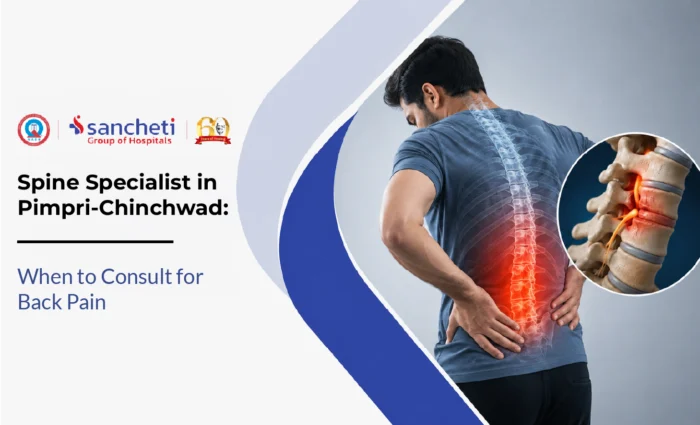
A spine specialist is an orthopaedic surgeon or neurosurgeon with advanced training in diagnosing and treating conditions affecting the spine, from common causes of back and neck pain to complex deformities, slipped discs, spinal fractures, and nerve compression.
For residents across PCMC, Sancheti Hospital’s Spine Department in Pune is the nearest tertiary referral centre for specialised spinal care. This guide explains the most common causes of back pain, the warning signs that require expert evaluation, when you should consult a spine specialist, and the treatment options available to help you regain mobility, reduce pain, and improve your quality of life.
What Is a Spine Specialist?
A spine specialist is a doctor, typically an orthopaedic surgeon or neurosurgeon with dedicated subspecialty training in spinal surgery, whose entire clinical focus is the spine. This is not a general practitioner who also sees back pain, and it is not a physiotherapist or chiropractor who treats musculoskeletal conditions broadly. A spine doctor in Pimpri-Chinchwad diagnoses the precise structural source of spinal pain when one exists, determines which patients need surgery, performs minimally invasive and complex spinal procedures when indicated, and manages conditions like spinal deformities, tumours, and infections.
The distinction matters because back pain is one of the most over-imaged and under-correctly-treated conditions in primary care. Many patients receive X-rays or MRI scans too early, before conservative treatment has been tried. Many others with red flag symptoms that require urgent specialist assessment continue to wait. A spine specialist’s role is to apply clinical judgement to both directions: correctly identifying the majority of back pain that does not need advanced investigation, and correctly identifying the minority that genuinely does.
Who Needs Spine Specialist Care in Pimpri-Chinchwad
Back pain is extremely common in the PCMC region as the demographic and occupational profile of the area creates a specific pattern of spinal risk.
| Patient Group | Typical Spinal Conditions | Why Spine Specialist Care May Be Needed |
|---|---|---|
| Industrial and manufacturing workers | Disc herniation from lifting and awkward postures; lumbar strain; early degenerative disc disease | Occupational back pain is often managed inadequately; a spine specialist identifies whether structural damage is contributing |
| IT and desk-based workers | Cervical disc disease and neck pain from sustained screen work; lumbar pain from prolonged sitting | Cervical radiculopathy with arm symptoms, often benefits from early specialist assessment |
| Adults over 50 with chronic back pain | Spinal stenosis, degenerative spondylolisthesis, osteoporotic vertebral fractures | Walking-related leg heaviness from stenosis is frequently misattributed to peripheral vascular disease or arthritis |
| Younger adults with sciatica | Disc herniation with nerve root compression causing radiating leg pain | Disc herniations that don’t resolve after 6 weeks of treatment benefit from specialist review |
| Patients with prior surgery not recovering as expected | Failed back surgery syndrome, adjacent segment degeneration, implant-related pain | Complex revision assessment is a core subspecialty of dedicated spine centres |
Common Spinal Conditions Affecting Patients
The same spinal conditions appear across every population, but their relative prevalence in PCMC shifts with the occupational profile.
| Condition | Hallmark Symptoms |
|---|---|
| Disc herniation | Sharp, burning pain radiating from the lower back into the leg (sciatica) or from the neck into the arm; often worse with sitting and forward bending |
| Degenerative disc disease | Chronic, aching low back pain worsened by prolonged sitting, particularly common in PCMC’s desk-based and driving population |
| Lumbar spinal stenosis | Leg heaviness, pain, or cramping that comes on after walking a defined distance and is relieved by sitting or bending forward; often mistaken for poor circulation |
| Spondylolisthesis | Chronic low back pain, sometimes with leg symptoms; mechanical instability felt as a sense that the back “gives way” with certain movements |
| Cervical disc disease | Neck pain radiating into the arm, with numbness or tingling in the hand; in myelopathy, weakness and coordination difficulty affecting the hands or legs |
| Osteoporotic vertebral fracture | Sudden, severe mid- or lower back pain, often in women over 55 after a minor fall or even lifting; height loss over time |
Symptoms That Mean You Need a Spine Specialist
The following framework answers when a spine specialist assessment is genuinely needed in PCMC.
Tier 1: Go to the Emergency Department Immediately
- Loss of bladder or bowel control, or new urinary retention
- Saddle numbness (inner thighs, perineum)
- Rapidly progressive weakness in both legs
- Major trauma with back pain
Tier 2: Urgent Spine Specialist Referral Without Delay
- Unexplained weight loss, fever, or night sweats with back pain
- History of cancer with new or worsening back pain
- Back pain that is constant, unremitting, and worse at night or at rest
- Progressive neurological deficit: worsening weakness, numbness, or coordination difficulty
- Significant trauma in older adults or those on steroids, even from a minor fall
Tier 3: Appropriate Spine Specialist Referral (Not Urgent, But Indicated)
- Leg pain radiating below the knee that has not improved after structured management
- Back pain lasting beyond 12 weeks despite proper physiotherapy and analgesics
- Leg pain or weakness that comes on with walking and is relieved by sitting
- Neck pain with arm symptoms (numbness, tingling, weakness) persisting beyond 6 weeks
- You have had a previous spine surgery and have new or worsening symptoms
How a Spine Specialist Assesses Your Back Pain
A spine specialist assessment is a structured clinical process in which the physical examination findings, the symptom history, and any imaging are interpreted together.
Clinical History and Symptom Pattern
A spine specialist will ask several questions to retrieve a structured history of your issues to narrow the differential significantly before any examination begins.
Neurological Examination
The neurological examination tests the specific nerve roots that may be involved. Reflexes, strength in specific muscle groups, and sensation in dermatome distributions are systematically assessed.
Imaging: Requested to Answer a Specific Clinical Question
- X-ray: primarily for assessing alignment, vertebral height, and bony stability; used in trauma and spondylolisthesis assessment.
- MRI: the primary investigation for soft tissue, disc, nerve, and cord assessment; ordered when clinical findings suggest nerve root compression, stenosis, or red flag pathology.
- CT scan: preferred for bony detail; used for fracture assessment, pre-surgical planning, and when MRI is contraindicated.
- Nerve conduction study / EMG: requested when the level or severity of nerve involvement needs to be precisely defined before surgical planning, particularly for multi-level disease.
Treatment: Non-Surgical and Surgical Options
The framework for treatment follows the same principle that applies across all of spine care: try the least invasive, most evidence-supported option first, and escalate only when it fails or when the clinical picture makes escalation urgent.
Conservative Treatment (First-Line for Most Conditions)
A structured physiotherapy programme targeting the specific condition is the cornerstone of conservative management. For disc herniation, this means specific exercises to centralise pain and reduce nerve root pressure. For spinal stenosis, it means flexion-based exercises and gait training. For chronic non-specific back pain, it means progressive loading and movement confidence. Patient education, correcting the fear that movement damages the spine, and pain management are components of the same programme.
Minimally Invasive Spine Surgery (When Conservative Management Fails)
Modern spine surgery at a specialist centre is very different from what many patients expect. The majority of surgical procedures are routinely performed through small incisions using advanced 3D navigation, endoscopic guidance, and intraoperative imaging, resulting in less muscle damage, less blood loss, shorter hospital stays, and faster recovery compared to traditional open approaches.
Recovery After Spine Treatment
Recovery from spinal conditions and spine surgery follows very different timescales depending on the treatment route taken. Setting realistic expectations from the outset is a core part of good specialist care.
Conservative Treatment Timeline
| Timeframe | Typical Progress with Structured Conservative Management |
|---|---|
| Weeks 1-4 | Pain management and activity modification; physiotherapy begins; avoid complete rest |
| Weeks 4-8 | Progressive active rehabilitation; most cases of acute disc herniation show meaningful improvement by this point |
| Weeks 6-12 | If no meaningful improvement, specialist assessment and imaging now appropriate |
| 3-6 months | Most non-surgical spinal conditions achieve maximum conservative improvement within this window |
| Beyond 6 months | Persistent symptoms at this stage warrant specialist review of the case, not continued identical treatment |
Post-Surgical Recovery (Selected Procedures)
| Procedure | Hospital Stay | Return to Light Activity | Full Recovery |
|---|---|---|---|
| Microdiscectomy (MISS) | Day case or 1 night | 2-3 weeks | 6-12 weeks |
| Decompression surgery | 1-2 nights | 3-4 weeks | 2-4 months |
| Minimally invasive TLIF fusion | 2-4 nights | 4-6 weeks | 4-6 months |
| ACDF (cervical) | 1-2 nights | 2-4 weeks | 2-3 months |
| Vertebroplasty / Kyphoplasty | Same day or 1 night | Days | Weeks to months (fracture healing) |
Preventing Back Pain From Becoming a Spine Problem
Most spinal conditions that end up requiring specialist care developed over years of manageable but ignored strain. Prevention and early self-management are the most effective tools available.
- Apply ergonomic principles at work: in manufacturing facilities, correct lifting technique, anti-fatigue mats for standing workstations, and rotation of repetitive tasks; in office environments, monitor height, chair support, and taking movement breaks.
- Build and maintain core strength: the paraspinal muscles, abdominals, and gluteal muscles support the spine; regular resistance exercise is the most effective structural protection.
- Maintain a healthy weight: each additional kilogram of body weight places proportionally greater compressive force through the lumbar discs and facet joints.
- Address back pain early: a first episode of significant back pain, managed properly with structured physiotherapy, has a high chance of full resolution.
- Do not self-prescribe bed rest: prolonged bed rest for back pain treatment in PCMC consistently worsens outcomes compared to staying active within pain limits.
- Manage osteoporosis: women over 50 and older adults with risk factors should be assessed for bone density; treating osteoporosis reduces the risk of vertebral compression fractures.
Key Takeaways
- Most back pain improves without surgery, but identifying the underlying cause early is essential to ensure the right treatment and prevent unnecessary investigations.
- Back pain accompanied by leg or arm pain, numbness, weakness, difficulty walking, or symptoms that persist despite treatment should not be ignored and may require specialist evaluation.
- A thorough clinical examination is more valuable than relying on imaging alone, as scans must always be interpreted alongside symptoms and physical findings.
- Surgery is only recommended when conservative treatment fails or when serious spinal conditions require timely intervention, making it one part of a broader treatment pathway rather than the first option.
- Recovery from spinal conditions depends on active rehabilitation, with structured physiotherapy playing a vital role in restoring strength, mobility, and long-term function after both surgical and non-surgical treatment.
- Recognising red flag symptoms and seeking timely specialist care can help prevent permanent nerve damage, disability, and prolonged pain.
- Healthy lifestyle habits, workplace ergonomics, regular strength training, weight management, and early treatment of back pain are the most effective ways to reduce the risk of chronic spinal problems.
- For patients across Pimpri, Chinchwad, Nigdi, Akurdi, Wakad, Bhosari, Tathawade, Hinjewadi, and the broader PCMC region, Sancheti Hospital’s Spine Department provides the full spectrum of spinal care, from first specialist consultation with back pain doctor through to minimally invasive surgery and post-surgical rehabilitation, at a single NABH-accredited specialist centre.
Frequently Asked Questions (FAQs)
Q1. My back pain has been there for a week. Should I go to a spine specialist or wait?
For most people, one week of back pain does not yet warrant a spine specialist. The right first step is structured conservative management: an appropriate analgesic, staying active within your pain limits (not bed rest), and ideally beginning physiotherapy. A spine specialist assessment becomes appropriate if the pain has not improved significantly after six weeks of genuine conservative management, if you have radiating leg pain (sciatica) below the knee, if you have any of the red flag symptoms described above, or if your back pain follows a major trauma. In the first week without red flags, the most useful thing you can do is move gently and see a physiotherapist.
Q2. I have sciatica, does that mean I need surgery?
Not in most cases. Sciatica resolves without surgery in the majority of patients with conservative management over six to twelve weeks. The evidence consistently shows that long-term outcomes with conservative management (where it succeeds) are comparable to surgery. Surgery is considered specifically for: sciatica that has not improved meaningfully after six to twelve weeks of structured conservative treatment; progressive neurological deficit (worsening weakness or numbness); or severe, disabling pain that is not responding to analgesics. The advantage of surgery in appropriate patients is faster pain relief, but the same eventual outcome can often be achieved without surgery in patients who can tolerate the recovery period.
Q3. My back pain doctor in Pimpri Chinchwad says I should have an MRI. Do I need it?
MRI is the right investigation for back pain treatment in PCMC region in specific circumstances: if you have been having back pain or sciatica for six weeks or more with inadequate improvement, if you have neurological symptoms (weakness, numbness, or bladder/bowel changes), if you have red flag symptoms suggesting serious pathology, or if you are being evaluated as a candidate for an injection or surgical procedure. MRI ordered in the first few weeks of ordinary back pain without any of these features produces imaging reports that frequently show disc bulges and degenerative changes, findings present in the large majority of adults over 40 regardless of whether they have pain. These findings are commonly misinterpreted as the cause of the pain, leading to unnecessary anxiety and sometimes to interventions that would not have been recommended by a specialist who had first assessed the clinical picture. An MRI scan is valuable information in the right clinical context; in the wrong clinical context, it creates more confusion than clarity.
Q4. What is the difference between seeing a spine doctor in Pimpri Chinchwad versus at Sancheti Hospital in Pune?
PCMC does not currently have a dedicated tertiary spine subspecialty centre of the kind that complex spinal conditions require. Primary care physicians and general orthopaedic practitioners in the PCMC area manage standard back pain well; the gap is in cases requiring minimally invasive spine surgery, complex deformity correction, spinal tumour surgery, revision surgery after a prior procedure, or 3D navigation-guided spinal procedures. For these cases, a subspecialty centre with dedicated equipment, volume, and subspecialty training makes a measurable difference to outcomes. Sancheti Hospital’s Spine Department is led by spine surgeons with fellowship training across multiple international spine centres and recognised expertise in minimally invasive and complex spinal procedures.
Q5. I have been living with chronic back pain for years. Is there still something that can be done?
Yes, in almost every case. Chronic back pain that has been present for years is not the same as untreatable back pain. Many patients with chronic back pain have never had their condition properly characterised, and are instead managing recurring symptoms without ever addressing what is actually driving them. A specialist assessment can provide a clear diagnosis, a clear explanation of the options, and a realistic plan, which itself has a well-documented positive effect on chronic pain outcomes, even before any treatment is started.