
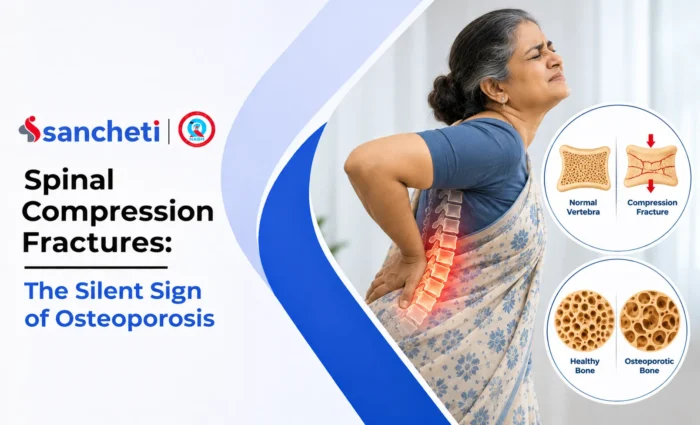

Spinal Compression Fractures: The Silent Sign of Osteoporosis
A spinal compression fracture is a collapse of one of the bones of the spine (a vertebra), most often caused by osteoporosis. It can happen with little or no injury — while bending, lifting or even coughing. About two-thirds cause no obvious pain or only gradual height loss and a stooped back, so they often go unnoticed. Yet one spine fracture is an important warning: it means the bones are fragile and the risk of another fracture is high. Finding it early allows osteoporosis to be treated.
This guide explains why these fractures are “silent”, the signs to look for in yourself or an ageing parent, and how they are diagnosed and treated.
What is a spinal compression fracture?
The spine is made of stacked bones called vertebrae. In a compression fracture, the front or middle of a vertebra collapses, so the bone becomes wedge-shaped or flattened. It most often affects the mid-back and the junction of the mid and lower back.
In older adults, most compression fractures are due to osteoporosis — a condition that makes bones thin and fragile. The NHS notes that in people with osteoporosis, even a cough or sneeze can cause partial collapse of a spinal bone. Vertebral fractures are the most common type of fragility fracture.
Less commonly, compression fractures are caused by a major injury, or by cancer or infection weakening the bone (see spinal fractures).
Why these fractures are often “silent”
The MSD Manual notes that about two-thirds of osteoporotic spine fractures cause no symptoms, or only height loss or a curved back. A 2020 review estimated that around two-thirds are never correctly diagnosed and so never treated.
They go unnoticed because:
- There may be no fall or injury to prompt a check-up.
- Pain can be mild and mistaken for everyday back ache or “age”.
- Height loss and stooping happen gradually and are often accepted as normal ageing.
- Fractures are missed on X-rays taken for other reasons, unless the spine is looked at specifically.
These fractures are common in India. In a study of 301 postmenopausal women in rural southern India, about 29% had moderate or severe vertebral fractures. The International Osteoporosis Foundation also reports that osteoporotic hip fractures in India tend to occur about a decade earlier than in Western countries.
Signs of a spinal compression fracture
When symptoms do occur, they may include:
- Sudden back pain after a minor strain, bend, lift or cough — often in the mid-back
- Pain that is worse standing or walking and eases when lying down
- Loss of height — a Canadian study found the risk of an existing spine fracture was higher in women who had lost at least 4 cm
- A stooped or rounded upper back (kyphosis), sometimes called a “dowager’s hump”
- Reduced space between the ribs and hips, a protruding tummy, or feeling full quickly after meals
- Difficulty breathing deeply if several fractures have reduced the space in the chest
The NHS notes that a stooped posture can develop when spinal bones have broken and struggle to support the body’s weight.
Signs to watch for in ageing parents
- Clothes or saris fitting differently — sleeves or hems suddenly too long
- Needing to look up more to meet your eyes, or a visible bend in the upper back
- New back pain after lifting a bucket, a grandchild or bending to pick something up
- Reluctance to walk or do daily tasks because of back ache
If you notice these, a check-up with a spine specialist or physician is worthwhile.
Who is at risk?
Anyone with weak bones can develop a compression fracture. Risk factors listed by the NHS include:
- Women after menopause, especially if menopause began before 45
- Older age (risk rises in both women and men)
- Taking high-dose steroid tablets for more than 3 months
- A parent who had a hip fracture
- Low body weight
- Smoking, heavy drinking and inactivity
- Medical conditions such as rheumatoid arthritis, hormone disorders or problems absorbing food
- A previous fragility fracture — of the wrist, hip, spine or elsewhere
How is a spinal compression fracture diagnosed?
- Examination and history — including measuring your height and comparing it with your tallest adult height
- Spine X-ray — shows the collapsed, wedge-shaped vertebra
- MRI — shows whether a fracture is new or old, and helps rule out other causes such as cancer or infection
- Bone density (DEXA) scan — measures bone strength; the NHS explains that a T-score below −2.5 indicates osteoporosis. Many DEXA machines can also check the spine for fractures at the same visit (vertebral fracture assessment)
- Blood tests — to check calcium, vitamin D, kidney function and other causes of bone loss
- Fracture-risk tools such as FRAX, which estimate your 10-year risk of breaking a bone
Sancheti offers bone density (DEXA) scans and spine imaging under one roof.
How are spinal compression fractures treated?
Treatment has two aims: ease the pain while the fracture heals, and treat the osteoporosis so another fracture doesn’t follow. Most compression fractures heal without surgery, with pain usually settling over about 6–8 weeks.
| Treatment | What it involves | Notes |
|---|---|---|
| Pain relief | Paracetamol, anti-inflammatories or other medicines prescribed by your doctor | Lets you keep moving, which helps recovery |
| Activity and short rest | Short periods of rest, then gentle walking as pain allows | Long bed rest weakens bones and muscles further |
| Brace or spinal support | A light brace for a few weeks in some cases | Used for comfort; not suitable for everyone |
| Physiotherapy | Posture, back-strengthening and balance exercises | Helps reduce pain and fall risk |
| Osteoporosis medicines | Bone-strengthening treatments such as bisphosphonates, denosumab or teriparatide, with calcium and vitamin D | Lowers the risk of further fractures; chosen by your doctor |
| Vertebroplasty or kyphoplasty | Bone cement injected into the fractured vertebra through a needle | Considered only for selected patients; see below |
| Spinal surgery | Decompression and fixation | Rarely needed; for nerve compression or an unstable spine |
What about vertebroplasty and kyphoplasty?
These procedures inject bone cement into the collapsed vertebra. Kyphoplasty first uses a small balloon to create space. They can help some people, but research results are mixed, so they are not right for every fracture:
- Trials comparing vertebroplasty with a placebo (sham) procedure found little extra benefit for many patients, so a 2018 Cochrane review advises against using it routinely for every osteoporotic fracture.
- Many spine specialists still offer these procedures to carefully selected patients, such as those whose severe pain does not settle with medicines, gentle activity and other treatment.
- As with any procedure, there are possible risks, which your surgeon will explain before you decide.
Most compression fractures settle without a procedure. If your spine specialist suggests vertebroplasty or kyphoplasty, ask how likely it is to help in your case and what the alternatives are.
Preventing the next fracture
The most important message about a spine fracture is that it is often the first of several. In a study published in JAMA, women who had a new spine fracture had a 19% chance of another spine fracture within the following year. Having an existing spine fracture increased the risk of a new one about five-fold.
This is why a compression fracture should always prompt an osteoporosis assessment. Steps that help:
- Get a bone health check. A DEXA scan, blood tests and a fracture-risk assessment.
- Start and stay on treatment if prescribed. Many bone-strengthening medicines have been shown to reduce new spine fractures within the first year of treatment, according to the Bone Health & Osteoporosis Foundation.
- Get enough calcium and vitamin D from food, sunlight and supplements if your doctor advises.
- Stay active with walking and supervised strength and balance exercises.
- Prevent falls — remove loose rugs and clutter, use night lights and grab bars, and have regular eye and hearing checks, as the NHS advises.
- Lift safely — bend at the knees, keep loads close and avoid heavy lifting and sudden twisting.
- Stop smoking and limit alcohol.
Older adults with several health conditions may benefit from care through Sancheti’s Geriatric Department, which can look at bone health, falls and medicines together.
When to see a doctor urgently
Seek prompt medical care if back pain comes with:
- Numbness, tingling or weakness in the legs
- Difficulty controlling the bladder or bowels
- Severe pain after a fall, accident or major injury
- A history of cancer, unexplained weight loss, fever or night sweats — these can point to a spinal tumour or infection rather than osteoporosis
- Pain that keeps getting worse or does not ease with rest
Frequently asked questions about spinal compression fractures
Can you have a spinal fracture and not know it?
Yes. About two-thirds of osteoporotic spine fractures cause little or no pain and may only show up as height loss or a stooped back. Many are found by chance on an X-ray.
Is losing height a sign of osteoporosis?
It can be. Some height loss is normal with age, but losing several centimetres — especially with a rounded upper back — may be a sign of spine fractures and should be checked.
How long does a compression fracture take to heal?
Pain usually improves over about 6–8 weeks, although some people have longer-lasting discomfort. The bone shape does not return to normal, but the fracture becomes stable.
Do I need to wear a back brace?
Not always. A brace may be suggested for comfort for a few weeks. Staying gently active and following a physiotherapy plan are usually more important.
Is cement injection (vertebroplasty) the best treatment?
Not for everyone. Research results are mixed, so cement procedures are usually considered for selected people whose severe pain does not settle with other treatment, after discussing the benefits and risks with a spine specialist.
Can a compression fracture happen without a fall?
Yes. In people with osteoporosis, bending, lifting or even coughing or sneezing can be enough to cause a spinal bone to collapse.
Can men get osteoporotic spine fractures?
Yes. Although women are at higher risk, men can also develop osteoporosis and spine fractures, especially with older age, steroid use, smoking or heavy drinking.
Can osteoporosis be reversed?
Treatment can strengthen bones and lower the risk of new fractures. Some medicines increase bone density, but existing spine fractures do not regain their original shape.
Don’t ignore the silent fracture
A spinal compression fracture is more than back pain — it is often the first visible sign of osteoporosis and a warning that more fractures may follow. Height loss, a new stoop or back pain after a minor strain deserve a check-up. Early diagnosis and bone-strengthening treatment can protect your spine and independence.
If you or a family member has these signs, Sancheti Hospital’s Spine Department and bone density (DEXA) scan service in Pune can help. You can book an appointment online. More information is on our vertebral compression fractures page.