Home
Home PG College
 Patient Login
 Sancheti Clinic
 Contact Us
 Download Reports

Hip Labral Tears: Symptoms, Diagnosis, and When Surgery is Needed
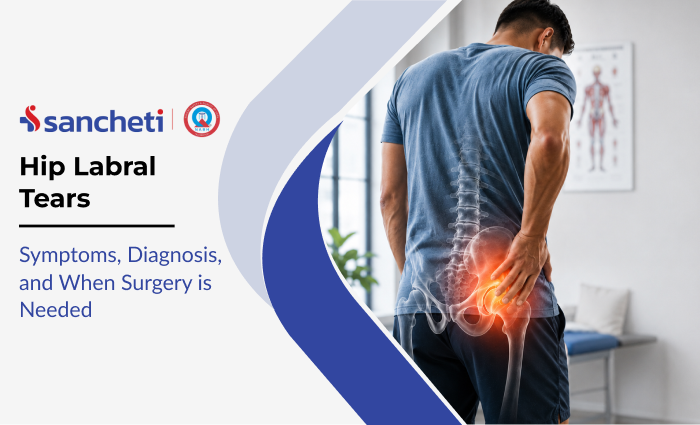
A hip labral tear is a damage to the ring of cartilage (the labrum) that lines the socket of the hip joint, and it can cause deep groin pain, clicking sensations, and reduced range of motion. While some tears heal with conservative treatment, others require surgical intervention.
This blog walks you through everything you need to know — from recognising early hip labral tear symptoms to understanding when hip labral tear surgery becomes necessary.
What Is a Hip Labral Tear?
The labrum is a tough, rubber-like tissue that acts as a seal around the hip socket. It keeps the ball of the femur (thigh bone) firmly in place, cushions the joint, and helps distribute load evenly across the hip. When this tissue tears — due to injury, repetitive motion, or structural issues — it can significantly affect hip function and quality of life.
Hip labral tears are more common than many people realise. They are frequently seen in athletes, active individuals, and patients with a condition called femoroacetabular impingement (FAI), where abnormal bone growth causes friction within the hip joint.
Common Causes of Hip Labral Tears
Understanding what causes a labral tear can help with both prevention and early diagnosis. The most common causes include:
- Femoroacetabular impingement (FAI): Abnormal shaping of the hip bones creates friction that gradually wears down the labrum. This is the single most common cause we see at Sancheti Hospital.
- Trauma or injury: A sudden fall, sports collision, or accident can directly tear the labrum.
- Repetitive hip movements: Dancers, footballers, cricketers, and runners are particularly susceptible due to repeated rotation and flexion.
- Hip dysplasia: An abnormally shallow hip socket places excessive stress on the labrum.
- Degenerative conditions: Age-related wear and tear can weaken the labrum over time.
Recognising Hip Labral Tear Symptoms
One of the challenges with this condition is that hip labral tear symptoms can be subtle at first and are often mistaken for a groin strain or general hip stiffness. Here is what to watch for:
Pain in the Groin or Hip
The most common symptom is a deep groin pain that may radiate to the front of the thigh or buttock. The pain often worsens with prolonged sitting, walking, or activities that involve rotating the hip.
Clicking, Locking, or Catching Sensation
Many patients describe a noticeable clicking or catching feeling in the hip — a telltale sign that something is mechanically wrong within the joint.
Stiffness and Reduced Range of Motion
You may find it increasingly difficult to bring your knee toward your chest, cross your legs, or perform low squats. This limited hip mobility is a classic indicator.
Hip Instability
Some patients report a sense that the hip might “give way,” particularly during weight-bearing activities.
If you are experiencing any combination of these symptoms, we strongly recommend an early orthopaedic evaluation. At Sancheti Hospital, early diagnosis consistently leads to better outcomes.
How Is a Hip Labral Tear Diagnosed?
An accurate hip labral tear diagnosis involves a combination of clinical examination and imaging studies.
Physical Examination
An orthopaedic specialist will assess your gait, hip flexibility, and strength. The FADIR test (Flexion, Adduction, Internal Rotation) is a widely used clinical manoeuvre — pain or discomfort during this test is strongly suggestive of a labral tear.
Imaging Studies
- X-rays: While X-rays cannot show soft tissue, they help identify underlying bone abnormalities like FAI or hip dysplasia that may have caused the tear.
- MRI scan for hip labral tear: A magnetic resonance arthrogram (MRA) — where a contrast dye is injected into the joint before the MRI — is considered the gold standard for visualising labral tears. It provides detailed images of the soft tissue, allowing precise assessment of the tear’s location and extent.
Diagnostic Injection
In some cases, a local anaesthetic is injected into the hip joint. Significant pain relief following the injection confirms that the hip joint (and likely the labrum) is the source of the problem.
Treatment Options: Conservative vs. Surgical
Conservative (Non-Surgical) Treatment
Not every hip labral tear requires surgery. Mild to moderate tears, especially in patients without significant bone abnormalities, are often managed successfully through:
- Physiotherapy: Targeted exercises to strengthen the hip stabilisers, correct movement patterns, and reduce joint stress
- Anti-inflammatory medications (NSAIDs): To manage pain and swelling
- Activity modification: Temporarily reducing or avoiding activities that aggravate the hip
- Corticosteroid injections: For short-term pain relief and to facilitate rehabilitation
At Sancheti Hospital, our approach begins conservatively. We only recommend surgery when non-surgical methods have not provided sufficient relief after an adequate trial period, typically 3 to 6 months.
When Is Hip Labral Tear Surgery Needed?
Surgery is considered when:
- Conservative treatment has failed to relieve pain or restore function
- The tear is large or structurally complex
- There is significant mechanical instability in the joint
- An underlying cause like FAI or hip dysplasia needs to be corrected simultaneously
- The patient is young and active with long-term hip health at stake
Hip Arthroscopy: The Preferred Surgical Approach
Hip arthroscopy for labral tear is a minimally invasive procedure and is now the preferred surgical method worldwide. Using a tiny camera and specialised instruments inserted through small incisions, the surgeon can:
- Repair the torn labrum by reattaching it to the bone using suture anchors
- Debride (trim) irreparably damaged tissue
- Correct bone abnormalities associated with FAI — smoothing down excess bone to prevent future impingement
Hip arthroscopy offers significant advantages over open surgery: smaller incisions, less blood loss, faster recovery, and a lower risk of complications.
Hip Labral Tear Surgery Recovery Time
One of the most common questions we receive at Sancheti Hospital is: How long does recovery take?
- Initial recovery (walking with crutches): 2 to 6 weeks
- Return to light activities: 6 to 12 weeks
- Return to sports or high-impact activity: 4 to 6 months, depending on the extent of repair
Physiotherapy is a critical part of the recovery process and begins almost immediately after surgery to restore strength and mobility progressively.
Hip Labral Tear vs. Other Hip Conditions
It is worth noting that hip labral tears can mimic several other conditions, including:
- Hip flexor strain
- Snapping hip syndrome (coxa saltans)
- Hip bursitis
- Early hip osteoarthritis
This is why a thorough clinical and imaging assessment is essential before beginning any treatment. At Sancheti Hospital, our orthopaedic team has extensive experience in differentiating these conditions and delivering accurate diagnoses.
Can a Hip Labral Tear Heal on Its Own?
The labrum has a limited blood supply, which means its natural healing capacity is restricted. Minor, stable tears in patients with no underlying structural problems may stabilize with conservative care. However, larger tears or those associated with FAI are unlikely to fully heal without addressing the root cause. Delaying diagnosis can allow the tear to worsen and may increase the risk of early hip osteoarthritis.
Key Takeaways
- A hip labral tear is damage to the cartilage ring of the hip socket and can cause groin pain, clicking, stiffness, and instability.
- Common causes include femoroacetabular impingement (FAI), trauma, repetitive motion, and hip dysplasia.
- Diagnosis involves physical examination, X-rays, and an MRI arthrogram for accurate soft tissue assessment.
- Many tears can be managed with physiotherapy, medications, and activity modification.
- Surgery — typically hip arthroscopy — is recommended when conservative treatment fails or when structural correction is needed.
- Recovery after surgery ranges from 4 to 6 months for full return to activity, with physiotherapy playing a central role.
- Early diagnosis and treatment significantly improve long-term outcomes.
Frequently Asked Questions (FAQs)
Q1. Can I continue exercising with a hip labral tear?
Low-impact activities like swimming and cycling are generally tolerated, but high-impact or rotational movements should be avoided until you have been properly assessed. Always consult your orthopaedic specialist before continuing any exercise programme.
Q2. Is a hip labral tear a permanent condition?
Not necessarily. With appropriate treatment — conservative or surgical — most patients achieve significant pain relief and return to normal activity. However, an untreated tear can progress and increase the risk of joint degeneration over time.
Q3. What happens if a hip labral tear is left untreated?
Without treatment, the torn labrum continues to experience mechanical stress, which can accelerate cartilage wear and eventually contribute to hip osteoarthritis. This is why early evaluation is important, even if symptoms seem mild.
Q4. Is hip arthroscopy a major surgery?
No. Hip arthroscopy is a minimally invasive, day-care or short-stay procedure performed under anaesthesia. Most patients are discharged the same day or within 24 hours and begin walking (with crutch support) very soon after.
Q5. At what age do hip labral tears typically occur?
Hip labral tears can occur at any age but are most commonly diagnosed in adults between 20 and 40 years old, particularly in active individuals and athletes. In older adults, tears are more likely to be associated with degenerative changes.