Home
Home PG College
 Patient Login
 Sancheti Clinic
 Contact Us
 Download Reports
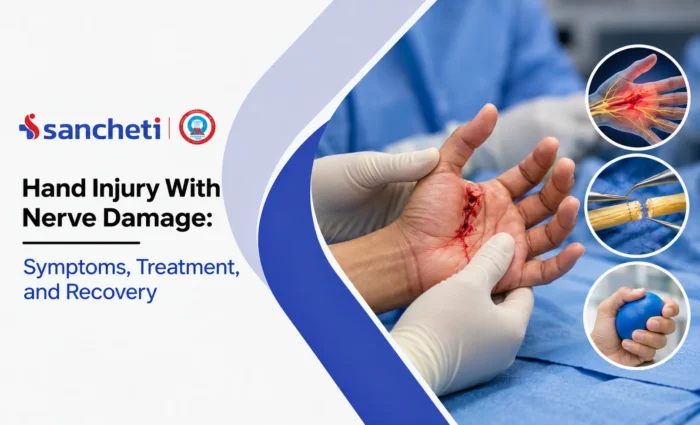

Hand Injury With Nerve Damage: Symptoms, Treatment, and Recovery
A hand nerve injury is easy to underestimate. The hand can often still move after a nerve is damaged, which leads many people to delay seeking care, and with nerve injuries, delay genuinely affects the outcome.
Recognising nerve damage in the hand early, understanding what treatment involves, and knowing what recovery actually looks like can make the difference between a full return of function and a permanent deficit.
What is a Hand Nerve Injury?
Nerves are the communication pathways between the brain and the hand, carrying two types of signals: motor signals that tell muscles to move, and sensory signals that carry back information about touch, temperature, and pain. A hand nerve injury disrupts one or both of these signal pathways, at any point from the wrist through to the fingertips.
Injuries range widely in severity. A nerve that has been bruised or compressed, without any structural tear, can recover on its own over weeks as the swelling resolves. A nerve that has been cut, whether by glass, a knife, machinery, or a severe fracture, will not reconnect on its own and needs surgical repair. Between these extremes sits a spectrum of stretching and crush injuries, where the outcome depends heavily on how much of the nerve’s internal structure survived the original trauma.
Three Main Nerves in Hand and What Each Controls
Damage to each nerve produces a distinct, recognisable pattern, which is often the first clue to which nerve is affected.
| Nerve | Sensation Supplied | Movement Controlled |
|---|---|---|
| Median nerve | Thumb, index, middle finger, half of ring finger | Thumb opposition and fine pinch grip |
| Ulnar nerve | Little finger and the other half of the ring finger | Most of the hand’s fine intrinsic muscles; grip strength |
| Radial nerve | Back of the hand | Wrist and finger extension (straightening) |
The ulnar nerve is the most frequently and severely injured of the three, largely because of its exposed path around the inside of the elbow and across the wrist. Left untreated, ulnar nerve damage produces the characteristic clawed posture of the ring and little fingers.
Symptoms of Nerve Damage in Hand Injuries
Nerve injury symptoms depend on which nerve is affected and how severely, but several patterns should prompt urgent assessment rather than a wait-and-see approach.
- Numbness or altered sensation: loss of feeling in a specific pattern, most often the thumb and index finger (median), little finger (ulnar), or back of the hand (radial), rather than the whole hand uniformly.
- Weakness in a specific movement: difficulty pinching, gripping, or straightening the wrist and fingers, depending on which nerve controls that motion.
- Clawing or abnormal finger posture: the fingers resting in a bent position that cannot be actively straightened, a hallmark of established ulnar nerve damage.
- Burning or tingling pain: a sensation radiating along the nerve’s path, sometimes worse at night, that can indicate compression or irritation rather than a complete tear.
- A visible wound near a nerve’s path: any deep cut at the wrist, palm, or fingers should raise suspicion of nerve involvement even if movement initially seems intact.
Causes and How Hand Nerve Injuries Happen
Hand nerve injuries fall broadly into two categories: sudden trauma and gradual compression, and the two require very different approaches to diagnosis and treatment.
- Lacerations: cuts from glass, knives, machinery, or workplace tools; the nerve and its protective sheath may both be divided, requiring surgical repair.
- Crush and fracture-related injuries: a fractured wrist or hand bone can directly damage the adjacent nerve, or compress it through swelling.
- Stretch injuries: forceful pulling of the arm, common in road accidents, can stretch nerve fibres beyond their capacity without an external wound.
- Chronic compression: sustained pressure from repetitive positioning, such as prolonged elbow bending compressing the ulnar nerve, or wrist compression producing carpal tunnel syndrome affecting the median nerve.
How a Damaged Hand Nerve is Diagnosed
Diagnosing a hand nerve injury starts with a detailed clinical examination that maps exactly which areas have lost sensation and which specific movements are weak or absent, since this pattern usually identifies the affected nerve before any test is run.
- Tinel’s sign: gently tapping along the suspected nerve path; a tingling sensation radiating into the hand suggests the level of injury or ongoing nerve regeneration.
- Two-point discrimination testing: measures how finely the patient can distinguish two separate points of touch, a sensitive indicator of sensory nerve function.
- Nerve conduction studies and EMG: measure the speed and strength of electrical signals travelling along the nerve, helping distinguish a complete tear from a milder compression or stretch injury.
- Ultrasound or MRI: used in selected cases to visualise the nerve directly, particularly where a mass, scarring, or the exact site of a suspected tear needs to be confirmed.
Hand Nerve Injury Treatment: Conservative Care and Surgery
Hand nerve repair in India achieves good motor recovery in 67.3% of patients and sensory recovery in 62.1%. (International Surgery Journal – India). Treatment depends entirely on the type and severity of injury identified during diagnosis. Not every hand nerve injury needs surgery, but every one needs an accurate assessment to determine which category it falls into.
- Observation and splinting: for bruised or mildly compressed nerves without a structural tear, protecting the hand and allowing swelling to resolve is often enough; most radial nerve injuries of this type recover within about three months
- Direct nerve repair: for a clean cut where the two nerve ends can be brought together without tension, they are reconnected under the operating microscope, ideally as soon as possible after the injury
- Nerve grafting: where a segment of nerve is missing or the gap is too wide for direct repair, a graft, often from a sensory nerve in the leg, bridges the defect
- Nerve decompression: for chronic compression injuries such as carpal tunnel or cubital tunnel syndrome, releasing the structures pressing on the nerve relieves the underlying cause
- Nerve or tendon transfer: considered when the original repair has not produced movement within 10-12 months, rerouting a working nerve or tendon to restore lost function
Recovery After Hand Nerve Repair
Nerve recovery is considerably slower than healing of skin, bone, or tendon, and understanding this pace prevents unnecessary alarm during the early recovery months.
| Stage | Timeframe | What to Expect |
|---|---|---|
| Immediate post-repair | 0-2 weeks | Splint protects the repair; no active stretching of the injured area |
| Early regeneration | 1-3 months | Tingling (Tinel’s sign) may be felt advancing along the nerve’s path as it regrows |
| Progressive recovery | 3-12 months | Sensation and movement gradually return, working from closer to the injury outward to the fingertips |
| Final assessment | 12-18 months | Full extent of recovery generally clear; further options considered if function remains incomplete |
Regenerating nerve fibres travel at approximately one millimetre a day, so recovery to the fingertips after a wrist-level injury can genuinely take the better part of a year. A physiotherapist guides hand therapy throughout this period, both to protect the healing nerve early on and to retrain fine motor skills as sensation and movement gradually return.
Why Delayed Treatment Makes Recovery Harder
The single biggest risk factor for a poor outcome after a hand nerve injury is delay, and this is precisely where hand nerve injuries are commonly mismanaged. Because the hand can often still perform many movements even with a significant nerve injury, using other muscles and nerves to compensate, people frequently underestimate the severity and wait to see if it improves on its own.
This delay matters because the muscles a damaged nerve controls gradually lose their capacity to respond the longer they go without a nerve signal, making late repair less effective even when it is technically still possible. At Sancheti Hospital in Pune, the Hand and Microvascular Department assesses suspected nerve injuries urgently for exactly this reason. For patients across Pune and beyond, prompt evaluation after any deep hand wound or sudden weakness is what preserves the full range of treatment options.
Key Takeaways
- A hand nerve injury can occur without visibly disrupting hand movement, which is exactly why it is so often missed or dismissed in the days after an injury.
- The median, ulnar, and radial nerves each produce a distinct, recognisable pattern of numbness and weakness. Identifying which nerve is affected from this pattern is usually the first step in diagnosis.
- Not every damaged hand nerve needs surgery. Bruised or mildly compressed nerves often recover with observation and splinting, while cut or torn nerves require surgical repair to have any chance of recovery.
- Hand nerve injury treatment options include direct repair, nerve grafting, decompression for chronic compression, and nerve or tendon transfer when the original repair has not restored function within 10 to 12 months.
- Nerve regeneration proceeds at roughly one millimetre a day, meaning recovery to the fingertips after a wrist injury can take close to a year. Delay in seeking treatment consistently worsens the final outcome.
- For any suspected nerve injury following a hand wound, Sancheti Hospital, Pune provides specialist assessment and microsurgical repair.
Frequently Asked Questions (FAQs)
Q1. I accidentally cut my hand and it healed fine, but my fingers still feel numb weeks later. Should I be worried?
Yes, this specific pattern, a wound that has healed on the skin surface while numbness persists underneath, is a classic sign that a nerve was damaged at the time of the original injury and was not identified or repaired. Skin heals in one to two weeks regardless of whether a nerve beneath it was cut, so a well-healed scar tells you nothing about whether the nerve underneath it is intact. Persistent numbness beyond two to three weeks after a cut, particularly in a specific pattern such as one or two fingers rather than the whole hand, warrants assessment by a hand specialist. The window for a technically straightforward direct nerve repair narrows the longer this is left, so this is worth acting on promptly rather than waiting to see if sensation returns on its own.
Q2. What is the difference between nerve damage that heals on its own and nerve damage that needs surgery?
The distinction comes down to whether the nerve’s structural continuity is intact. A nerve that has been bruised, stretched, or compressed without being torn retains its outer sheath, which acts as a conduit the nerve fibres can regrow through on their own, typically over several weeks to a few months. A nerve that has been fully cut, whether by a sharp laceration or a severe crush injury, has lost that conduit entirely, and the two ends will not find their way back to each other without surgical reconnection. Clinically, this distinction is made through examination, nerve conduction studies, and sometimes direct exploration in theatre, rather than by symptoms alone, since a severely stretched but intact nerve and a fully cut nerve can present with very similar initial symptoms of numbness and weakness.
Q3. Will I regain full feeling and movement after nerve repair surgery, or will there be permanent loss?
This depends on several factors, and setting realistic expectations before surgery is an important part of the consultation. Outcomes are generally best for injuries repaired promptly, in younger patients, and for injuries closer to the fingertips rather than higher up near the wrist or elbow, since the regenerating nerve has a shorter distance to travel and the target muscles have less time to lose their capacity to respond. Even with a technically excellent repair, some degree of permanent sensory difference, such as reduced fine discrimination or altered sensation, is common, particularly after severe crush or stretch injuries. Motor recovery, the ability to move the affected muscles, can be more variable and sometimes less complete than sensory recovery. Your surgeon will give you a realistic, injury-specific estimate rather than a general percentage, based on the nerve involved, the mechanism, and how promptly treatment began.
Q4. My little finger has started curling and I cannot straighten it fully. Is this related to nerve damage?
This is a strongly suggestive pattern for ulnar nerve involvement, particularly if it has developed gradually or followed an injury near the wrist, elbow, or palm. The ulnar nerve controls most of the small muscles inside the hand that keep the fingers in a balanced position; when it is damaged, these muscles lose their tone and the opposing forces from other muscle groups pull the ring and little fingers into a curled, claw-like posture that the person cannot voluntarily straighten. This is a well-recognised sign of established ulnar nerve dysfunction and should be assessed promptly rather than managed as a general hand stiffness problem. Depending on how long the pattern has been present and what is found on examination and nerve testing, treatment may range from nerve decompression to nerve repair or, in longstanding cases, tendon transfer surgery to restore the hand’s balance.
Q5. How is hand therapy after nerve repair different from ordinary physiotherapy?
Hand therapy after nerve repair is a specialised discipline that combines protecting the healing nerve with progressively retraining sensation and fine motor control, both of which require a different approach from general physiotherapy for muscles and joints. In the early weeks, the priority is protecting the repair site from tension through splinting and carefully limited movement, quite different from the early mobilisation encouraged after most orthopaedic surgeries. As sensation begins returning, patients often go through structured sensory re-education exercises, using touch, texture, and temperature stimuli to help the brain correctly interpret the signals coming from a nerve that is still regenerating and initially sends confusing or inaccurate information. This sensory retraining, alongside motor strengthening as movement returns, is why hand therapy for nerve injuries is typically delivered by therapists with specific training in peripheral nerve rehabilitation.