Home
Home PG College
 Patient Login
 Sancheti Clinic
 Contact Us
 Download Reports
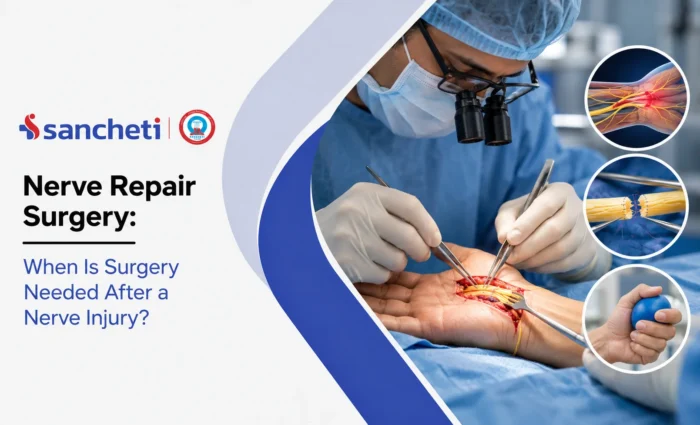

Nerve Repair Surgery: When Is Surgery Needed After a Nerve Injury?
Nerve repair surgery is not the automatic response to every nerve injury. Many nerve injuries recover on their own; others do not, and delaying surgery in those cases measurably worsens outcomes.
Knowing which category an injury falls into is the central question in nerve injury surgery. This guide explains how that decision is made, what the surgery involves once it is the right path forward, and what recovery genuinely looks like afterward.
What Is Nerve Repair Surgery?
Nerve repair surgery restores the structural continuity of a damaged peripheral nerve, the network of nerves outside the brain and spinal cord that carries movement and sensory signals to and from the limbs. It ranges from a straightforward reconnection of a cleanly cut nerve to complex procedures involving grafts or the rerouting of a healthy nerve to restore a function that can no longer be recovered directly through the original pathway.
The underlying biology explains why surgery is not always immediate or even necessary. After a nerve is damaged, the portion beyond the injury undergoes a process called Wallerian degeneration, breaking down over the following days as the body clears away the disconnected tissue. If the nerve’s outer sheath remains intact, regenerating fibres can find their way through it on their own, growing back toward their original target. If the sheath is disrupted or the nerve is fully divided, that natural pathway is lost, and surgery becomes the only route to meaningful recovery.
How Nerve Injuries Are Classified
Nerve injuries are graded by how much of the nerve’s internal structure survives, and this grading directly determines whether surgery is needed.
| Grade | What Is Damaged | Typical Management |
|---|---|---|
| Neurapraxia | Nerve bruised or compressed; structure intact | Observation; usually recovers within weeks without surgery |
| Axonotmesis | Nerve fibres damaged; outer sheath survives | Observed over months; regeneration monitored, surgery if it stalls |
| Neurotmesis | Nerve completely divided or structurally destroyed | Surgery required; spontaneous recovery is not possible |
This classification, first described by Sir Herbert Seddon in 1943, remains the framework surgeons use today to decide how urgently, and whether, surgery is needed.
When Nerve Injury Surgery Is Needed: Decision Framework
- Sharp, clean-cut injuries: a nerve divided by glass or a blade is generally repaired as soon as practically possible, since the cut ends are healthy and alignment is straightforward before scarring develops.
- Blunt or crush injuries with a divided nerve: repair is often deliberately delayed two to four weeks, allowing the damaged tissue at each end to declare itself clearly before the surgeon decides how much needs to be trimmed back to a healthy nerve.
- Closed injuries without an open wound: initial management is observation, since many of these injuries recover spontaneously; if no meaningful recovery is seen within two to five months, surgical exploration is recommended.
- No recovery within the expected biological window: a nerve that shows no signs of regeneration progress on clinical examination or nerve conduction studies by the expected timepoint needs surgical exploration regardless of injury type.
Peripheral Nerve Repair: Surgical Techniques
- Direct repair (neurorrhaphy): the two nerve ends are aligned and sutured together under the operating microscope; possible only when the ends can be joined without tension.
- Nerve grafting: when a gap is too wide for direct repair, a segment of nerve, often taken from a sensory nerve in the leg, bridges the defect and provides a scaffold for regeneration.
- Nerve conduits: a biodegradable tube guides regenerating fibres across small gaps, an alternative to grafting for short defects where donor site morbidity is best avoided.
- Neurolysis: a nerve trapped in scar tissue or compressed by surrounding structures is surgically freed, without needing to be cut and rejoined.
- Nerve transfer: a working, less critical nerve is rerouted to power a muscle whose own nerve supply cannot be repaired directly, most relevant for injuries close to the spinal cord.
Why Timing is a Big Factor in Outcome
Regenerating nerve fibres grow at approximately one to three millimetres a day, a rate that cannot be accelerated by surgical technique. This sets a hard biological limit on how quickly function can return, and it makes timing, not surgical skill alone, one of the most decisive factors in the final outcome.
The most important deadline in nerve surgery is the motor end plate window: if a motor nerve does not reach its target muscle within roughly 12 to 18 months of injury, the muscle’s own capacity to respond to a nerve signal degenerates permanently, and no amount of subsequent surgery can reverse this. For injuries far from the target muscle, a delayed diagnosis can consume much of this window before surgery even takes place. This is why any suspected nerve injury benefits from prompt specialist assessment rather than a wait-and-see approach extending for months.
Nerve Reconstruction for Delayed or Failed Repairs
Not every patient reaches a specialist within the ideal treatment window, and not every direct repair restores adequate function. Nerve reconstruction in these delayed or failed cases requires a different strategy than a fresh injury.
If a primary repair shows no meaningful motor recovery by 10 to 12 months, a nerve transfer is often considered before the motor end plate window closes entirely, since a second attempt at direct repair rarely improves on a failed first attempt. For patients presenting well beyond the useful window for nerve surgery itself, tendon transfer, relocating a working muscle’s tendon to restore a specific lost movement, becomes the more realistic reconstructive option. At Sancheti Hospital in Pune, these decisions are made using nerve conduction studies and clinical assessment together, rather than by elapsed time alone.
Recovery After Nerve Repair Surgery
Recovery from nerve surgery is considerably slower than recovery from most other surgical procedures performed in Pune or elsewhere, since it depends on biological regeneration rather than tissue healing alone.
| Stage | Timeframe | What to Expect |
|---|---|---|
| Immediate post-op | 0-2 weeks | Splint protects the repair; no stretching of the involved limb |
| Early regeneration | 1-4 months | Tingling may be felt advancing along the nerve as it regrows |
| Progressive recovery | 4-18 months | Sensation and movement return gradually, closer structures recovering before distant ones |
| Final outcome | 18-24 months | The extent of recovery is generally clear by this stage |
A physiotherapist guides rehabilitation throughout, from early protective splinting through to the sensory re-education and strengthening work that determines how completely a recovering nerve translates into usable function.
Signs a Nerve Injury Needs Specialist Assessment
Peripheral nerve injuries account for a meaningful proportion of trauma presentations, with an estimated 5% of all patients who sustain a significant traumatic injury also sustaining a peripheral nerve or brachial plexus injury, yet many go unrecognised in the initial assessment because the injured limb can often still move using other muscles nearby, masking the true extent of the damage.
- Numbness or weakness in a specific pattern following any deep wound, fracture, or dislocation.
- A wound that has healed on the skin surface while sensation in the surrounding area remains absent.
- Weakness that does not improve, or worsens, over the days following an injury.
- Any injury near a known nerve pathway, particularly at the elbow, wrist, or knee, even without visible deformity.
Key Takeaways
- Nerve repair surgery is needed for completely divided nerves and for injuries that show no spontaneous recovery within their expected biological window. Milder, structurally intact nerve injuries often recover without surgery.
- Nerve injury surgery timing depends on the mechanism: sharp cuts are repaired promptly, blunt divided nerves are often repaired after a short planned delay, and closed injuries are observed for two to five months before exploration.
- Peripheral nerve repair techniques include direct repair, grafting, conduits, neurolysis, and nerve transfer, each suited to a specific pattern of injury and gap size.
- The motor end plate window, roughly 12 to 18 months, is the hard biological deadline for nerve reconstruction to restore muscle function. Beyond it, tendon transfer becomes the more realistic option.
- Nerve regeneration proceeds at one to three millimetres a day regardless of surgical skill, which is why prompt diagnosis, not just prompt surgery, most strongly influences the final outcome.
- For assessment of a suspected nerve injury, Sancheti Hospital, Pune provides specialist diagnosis and microsurgical repair.
Frequently Asked Questions (FAQs)
Q1. How do doctors know whether a nerve injury will heal on its own or needs surgery?
The decision combines the mechanism of injury with structured monitoring over time. An open wound with a nerve visibly divided is a clear surgical indication from the outset. A closed injury, where the nerve was stretched or compressed without an open wound, is more uncertain initially, and the standard approach is careful observation with repeated clinical examination and, where needed, nerve conduction studies over the following weeks and months. Signs of advancing regeneration, movement of tenderness along the nerve’s path as it regrows, or measurable improvement in strength and sensation, indicate the nerve is recovering on its own.
Q2. Is it ever too late for nerve repair surgery to help?
For restoring motor function, yes, there is a genuine biological deadline. If a motor nerve does not reach its target muscle within roughly 12 to 18 months of injury, the motor end plate, the specific structure where nerve meets muscle, degenerates permanently and can no longer respond even if the nerve signal is eventually restored. This does not mean nothing can be done after this window closes; tendon transfer surgery, which relocates a working muscle to take over a lost movement, remains a genuine option well beyond this timeframe. Sensory recovery has a somewhat more forgiving, though still time-limited, window. This is precisely why any suspected nerve injury deserves assessment sooner rather than later, since the treatment options available narrow considerably the longer diagnosis and treatment are delayed.
Q3. What is the difference between nerve grafting and a nerve conduit?
Both bridge a gap in a nerve that is too wide to close by direct repair, but they use different materials and suit different situations. A nerve graft uses an actual segment of nerve tissue, typically harvested from a sensory nerve in the leg that leaves only a small area of numbness at the donor site, providing a biological scaffold that closely resembles the nerve being repaired. A nerve conduit is a manufactured, biodegradable tube that guides regenerating nerve fibres across the gap without requiring a second surgical site. Conduits are generally reserved for shorter gaps, typically under three centimetres, where the simplicity of avoiding a donor site outweighs the somewhat stronger regenerative scaffold a true nerve graft provides.
Q4. Will I need physiotherapy after nerve repair surgery, and for how long?
Yes, and it continues for considerably longer than physiotherapy after most other surgical procedures, often a year or more, because it needs to track the slow pace of nerve regeneration itself. In the early weeks, the focus is protecting the repair site through splinting and controlled, limited movement. As the nerve regenerates and begins reaching its target tissue, usually starting several months after surgery, therapy shifts toward sensory re-education, exercises that help the brain correctly interpret signals from a nerve that is still maturing, and progressive strengthening as muscle function returns. Patients who engage consistently with this extended rehabilitation process achieve measurably better functional outcomes than those who attend sporadically or stop once the surgical wound itself has healed.
Q5. Can a nerve injury cause permanent pain even after successful repair?
Yes, this is a recognised possibility that is worth understanding before surgery. Some patients develop chronic neuropathic pain following a nerve injury, which can persist even after a technically successful repair, since the pain in these cases often originates from how the nervous system has adapted to the injury rather than solely from the physical status of the nerve itself. This type of pain, described as burning, shooting, or electric in quality, is managed differently from ordinary post-surgical pain and may require input from a pain specialist alongside the nerve surgery team. Not every patient develops this complication, and its likelihood varies with the severity and mechanism of the original injury. Discussing this possibility honestly as part of your pre-operative consultation, rather than encountering it unexpectedly during recovery, is part of realistic treatment planning.