Home
Home PG College
 Patient Login
 Sancheti Clinic
 Contact Us
 Download Reports

Brachial Plexus Injury Recovery: Surgery, Rehabilitation, and What to Expect
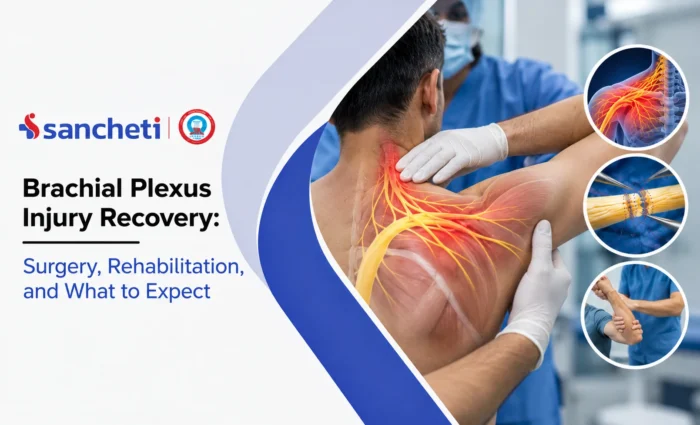
Brachial plexus injury recovery is one of the longest and most demanding journeys in orthopaedic medicine, often stretching across one to two years from the initial injury to the final functional outcome.
The brachial plexus is the bundle of nerves running from the neck into the arm, controlling nearly every movement and sensation from the shoulder to the fingertips. When it is damaged, brachial plexus treatment has to work with the nervous system’s own, often frustratingly slow, pace of healing.
What is Brachial Plexus Injury Recovery?
The brachial plexus is a network of nerves that originates in the neck and branches out to control movement and sensation throughout the shoulder, arm, and hand. An injury here, most often from a high-energy impact that stretches or tears these nerves, can leave part or all of the arm weak, numb, or completely paralysed.
Recovery is not a single event but a staged process. Nerves, unlike bone or muscle, heal extremely slowly, regenerating at roughly a millimetre a day once repaired. This means recovery unfolds over months, sometimes years, and involves distinct phases: an initial period of observation to see what the body can repair on its own, surgery if needed, and then a long rehabilitation phase to translate restored nerve signals into usable movement. Understanding this timeline is essential, because brachial plexus injury recovery genuinely cannot be rushed.
How Brachial Plexus Injuries Happen and Why Timing Matters
Most adult brachial plexus injuries result from high-energy trauma, particularly motorcycle accidents, where the shoulder and head are forced apart, stretching or tearing the nerve roots. Falls from height and severe sports collisions are the other common causes. In newborns, a difficult delivery can stretch these same nerves, producing what is known as obstetric brachial plexus palsy.
Timing shapes every decision that follows. An injury from a sharp, penetrating object is usually explored and repaired promptly. A closed injury from stretching or blunt trauma is different: surgeons typically observe for three to six months, since many of these injuries recover some function spontaneously as swelling resolves and the nerve heals on its own. If no meaningful recovery is seen by that point, surgery becomes the recommended path, and outcomes are consistently better when it happens within the first six to twelve months rather than later.
Brachial Plexus Treatment: Conservative Care vs Surgery
Not every brachial plexus injury needs an operation. Treatment follows a structured decision process based on injury severity and how the nerve responds over the observation period.
- Neurapraxia (mildest injury): the nerve is stretched but structurally intact; function typically returns within weeks to a few months without surgery.
- Axonotmesis (moderate injury): the nerve fibres are damaged but the surrounding sheath survives, allowing slow spontaneous regeneration that is monitored closely over several months.
- Neurotmesis (severe injury) or root avulsion: the nerve is completely torn, or pulled out from the spinal cord itself; spontaneous recovery is not possible, and surgery is the only route to restoring function.
Clinical examination, nerve conduction studies, and MRI together determine which category an injury falls into, and this classification, not the patient’s preference for avoiding surgery, drives the treatment decision.
Surgical Options: Nerve Repair, Grafts, and Transfers
- Direct nerve repair: for clean, sharp injuries, the two ends of the damaged nerve are reconnected under the microscope; only possible when the nerve ends can be brought together without tension.
- Nerve grafting: a segment of nerve, often taken from the leg, bridges a gap that cannot be closed by direct repair, providing a scaffold for regenerating fibres to grow through.
- Nerve transfer: a healthy, less critical nerve nearby is rerouted to power a paralysed muscle; used when the original nerve root has been torn from the spinal cord and cannot be repaired at all.
- Muscle transfer: for injuries presenting too late for nerve surgery to help, a functioning muscle and its nerve supply are relocated to restore a specific lost movement, such as elbow bending.
Recent studies on nerve transfer surgery report significant recovery of shoulder abduction and elbow flexion in the large majority of appropriately selected patients, making this the most transformative option for injuries that cannot be directly repaired.
Brachial Plexus Surgery Recovery: What to Expect Week by Week
The early post-operative period focuses on protecting the repair while the nerve slowly regenerates. Nerve transfer surgery restores shoulder abduction in 88.5% of patients and elbow flexion in 84.6% of patients (Journal of Clinical Orthopaedic Research – India).
| Timeframe | What Happens |
|---|---|
| Days 1-3 | Hospital stay for pain control and monitoring; arm typically immobilised to protect the repair site |
| Weeks 1-4 | Sling or brace continues; gentle passive movement of unaffected joints to prevent stiffness |
| Weeks 4-8 | Immobilisation gradually reduced; physiotherapy begins, focused on maintaining joint range of motion |
| Months 2-6 | Regenerating nerve fibres may begin reaching target muscles; earliest signs of returning movement can appear |
| Months 6-18+ | Continued nerve regeneration and targeted rehabilitation; functional strength builds progressively over this extended window |
Rehabilitation: Why Nerve Transfer Recovery Requires Retraining Your Brain
Rehabilitation after brachial plexus surgery involves something most patients do not expect: relearning how to move the arm, not just regaining strength in it. This is especially true after nerve transfer surgery, where a nerve that once controlled one movement, the wrist, for instance, is rerouted to power an entirely different one, such as elbow bending.
Early in recovery, patients are asked to think about the original movement (bending the wrist) to activate the new one (bending the elbow), while a physiotherapist guides repeated, deliberate practice. Over months, with consistent re-education, the brain gradually rewires this connection until the new movement becomes automatic. Skipping this structured retraining, even after a technically successful nerve transfer, means the restored nerve signal never translates into a movement the patient can actually use.
Nerve Injury Recovery Timeline: What Realistic Progress Looks Like
Nerves regenerate at roughly one millimetre a day, which sets a biological floor under how quickly recovery can happen, regardless of surgical skill.
| Injury Distance from Muscle | Approximate Time to First Signs of Recovery |
|---|---|
| Short distance (e.g. shoulder nerve transfer) | 3-6 months |
| Moderate distance (e.g. elbow flexion via nerve transfer) | 4-8 months |
| Longer distance (e.g. hand and finger function) | 12-18 months, sometimes longer |
| Root avulsion requiring extensive reconstruction | Often 18-24 months for full assessment of outcome |
This means a patient may see no visible improvement for many months even after a technically successful surgery, purely because the regenerating nerve has not yet reached the target muscle. This delay is expected, not a sign that the surgery has failed.
When to Seek Specialist Assessment
Any significant weakness, numbness, or loss of movement in the shoulder or arm following an accident warrants prompt specialist assessment, ideally within days rather than weeks, so the injury can be accurately classified and the observation clock can start correctly.
At Sancheti Hospital in Pune, brachial plexus injuries are managed by the Hand and Microvascular Department, which combines nerve mapping, microsurgical repair, nerve and muscle transfer techniques, and dedicated hand physiotherapy under one coordinated plan. For patients across Pune and beyond, this integrated approach matters because the surgical decision and the rehabilitation plan need to be designed together from the outset, not treated as separate stages handled by unconnected teams.
Key Takeaways
- Brachial plexus injury recovery is a long, staged process governed by how slowly nerves regenerate, typically one to two years from injury to final functional outcome.
- Closed injuries from stretching or blunt trauma are usually observed for three to six months, since many recover spontaneously. Surgery is reserved for injuries that show no meaningful recovery by that point, or that were severe enough at diagnosis to make spontaneous recovery unlikely.
- Nerve transfer surgery, rerouting a healthy nerve to power a paralysed muscle, has strong evidence of restoring shoulder and elbow function in patients with root avulsions that cannot be directly repaired.
- Brachial plexus surgery recovery timing follows a biological rule: nerves regenerate at roughly a millimetre a day, so recovery to distant muscles, particularly the hand, genuinely takes longer than recovery to nearby ones like the shoulder.
- Rehabilitation after nerve transfer is not just strengthening; it requires actively retraining the brain to associate a new signal with a new movement, a process that depends on consistent, structured physiotherapy.
- For an assessment after a suspected brachial plexus injury, Sancheti Hospital, Pune offers specialist nerve surgery and rehabilitation.
Frequently Asked Questions (FAQs)
Q1. My arm is still weak three months after a brachial plexus injury. Does this mean surgery has failed, or is it too early to tell?
Three months is genuinely too early to draw firm conclusions, whether or not surgery has already taken place. If you have not yet had surgery, three months is precisely the point at which many closed brachial plexus injuries are formally reassessed to decide whether spontaneous recovery is occurring, so ongoing weakness at this stage is an expected part of the decision-making process, not a failure. If you have already had nerve surgery, particularly a nerve transfer or graft, regenerating nerve fibres travel at roughly a millimetre a day, meaning it can take several months just for the repaired nerve to physically reach the target muscle before any strength can return at all. Persistent weakness at three months post-surgery is often still within the expected biological timeline. Your treating surgeon will use nerve conduction studies and clinical examination, not just visible movement, to track whether regeneration is progressing on schedule.
Q2. Is there a point after which brachial plexus surgery is no longer worth doing?
Yes, timing has a real and evidence-based impact on outcomes, particularly for nerve transfer surgery. Procedures performed within the first six months after injury consistently show the best results, and outcomes decline progressively as the interval between injury and surgery lengthens, with a meaningfully higher risk of poor recovery once more than twelve months have passed. This is because the muscle that the nerve is meant to reactivate gradually loses its capacity to respond as it remains denervated for longer, a process that becomes harder to reverse over time. This does not mean surgery becomes pointless after a year; muscle and nerve transfer options, along with other reconstructive techniques, can still offer meaningful functional improvement in delayed presentations. It does mean that earlier assessment and, where indicated, earlier surgery give a patient access to the full range of options with the best chance of success.
Q3. What does nerve transfer surgery actually feel like to relearn afterward?
Most patients describe the early rehabilitation phase after nerve transfer as unusual rather than painful. Because a nerve originally responsible for one movement has been rerouted to power a different one, the brain initially has to be tricked into activating the new muscle by thinking about the old movement. For example, after a common nerve transfer used to restore elbow bending, a patient might be asked to try to bend the wrist, which, through the rerouted nerve, now also activates the elbow flexor muscle. This feels strange and requires conscious, repeated effort at first. With consistent practice, guided by a physiotherapist experienced in nerve transfer rehabilitation, most patients find that the new movement gradually becomes automatic over several months, eventually requiring no more conscious thought than any other normal arm movement.
Q4. Will sensation return to my hand and arm after a brachial plexus injury, or only movement?
Both motor nerves, which control movement, and sensory nerves, which carry feeling, can be affected by a brachial plexus injury, and both can potentially be addressed through repair or transfer, depending on which specific nerve roots and branches were damaged. Sensory recovery generally follows the same slow, millimetre-by-day regeneration timeline as motor recovery, and often lags behind movement recovery in the overall timeline. Many patients notice altered or unusual sensations, such as tingling or a pins-and-needles feeling, as regenerating sensory nerves reach the skin, before normal sensation is fully restored. Some residual sensory difference, particularly in severe injuries involving root avulsion, is common even after a technically successful surgical outcome for movement, and this should be discussed explicitly with your surgical team as part of realistic expectation-setting before surgery.
Q5. How much physiotherapy is actually needed after brachial plexus surgery, and for how long?
Physiotherapy after brachial plexus surgery is not a brief add-on; it is an extended, central part of the treatment lasting as long as the nerve regeneration and functional retraining process itself, often a year or more. In the early weeks, physiotherapy focuses on protecting the repair and maintaining passive range of motion in joints that are not directly involved, preventing the stiffness that would otherwise complicate recovery later. As nerve signals begin reaching muscles, usually starting several months after surgery, therapy shifts to active re-education, the deliberate retraining described for nerve transfers, and progressive strengthening as the muscle responds. Sessions are typically frequent in the early active phase and gradually reduce in frequency as function becomes more independent, but a home exercise programme generally continues throughout the full recovery window. Patients who engage consistently with this process achieve meaningfully better functional outcomes than those who attend sporadically.