Home
Home PG College
 Patient Login
 Sancheti Clinic
 Contact Us
 Download Reports
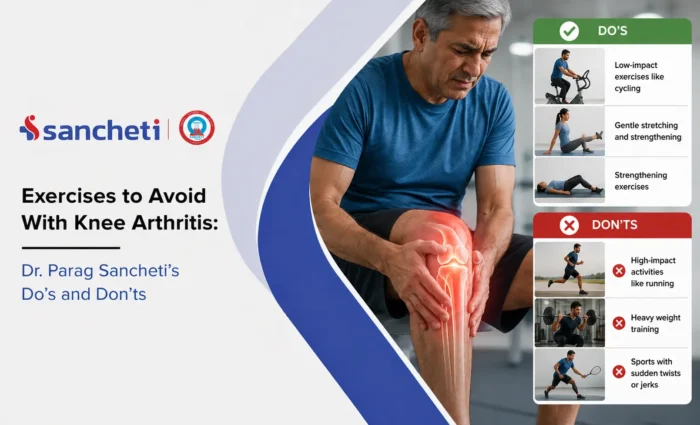

Exercises to Avoid With Knee Arthritis: Dr. Parag Sancheti’s Do’s and Don’ts
Knowing which exercises to avoid with knee arthritis matters as much as knowing which to do. The wrong exercise in the wrong range can accelerate cartilage damage and trigger inflammation. The right exercise, performed correctly, is one of the most effective treatments for knee arthritis available.
Dr. Parag Sancheti, Chairman and Managing Director of Sancheti Hospital, Pune, with over 34 years of knee surgery experience, gives every patient with knee arthritis a clear exercise guide. This article covers why it matters, which exercises are safe, and how to build an informed routine.
Right Exercise Philosophy for Knee Arthritis
The most damaging belief a patient with knee arthritis can hold is that exercise makes arthritis worse and that rest is protective. It does not, and it is not. Inactivity is one of the strongest predictors of faster OA progression. The joint’s cartilage is avascular; it receives nutrition through the mechanical compression and release of movement. Without regular loading, cartilage nutrition decreases, and breakdown accelerates.
This knee arthritis exercise guide is not about choosing between being active and protecting the joint. It is about choosing the right type of loading. High-impact, deep-flexion exercises place forces on damaged cartilage that it cannot tolerate without further breakdown. Low-impact, controlled-range exercises strengthen the muscles that protect the joint and maintain the movement that keeps cartilage nourished. The goal is to stay as active as possible within the limits damaged cartilage can handle and build the muscular support that reduces reliance on the cartilage surface as a shock absorber.
Why Exercise Matters More Than Most Patients Expect
Articular cartilage works like a sponge. Under load, it compresses and releases synovial fluid containing waste products. When load is released, it absorbs nutrients from the surrounding joint fluid. Regular movement is therefore not just safe for arthritic cartilage; it is how cartilage stays nourished. Stopping exercise to protect an arthritic knee removes the mechanism by which the remaining cartilage maintains itself (NCBI InformedHealth, 2024).
The muscular argument is equally important. Strong quadriceps and hip muscles absorb force before it reaches the cartilage surface. Quadriceps strengthening reduces knee pain in OA by 20-40% across multiple trials, with the effect operating through reduced joint loading rather than any change in the cartilage itself. Every patient who stops exercising because their knee hurts loses muscle mass that protects the joint, increasing load on the cartilage and worsening both pain and progression. Appropriate exercise is treatment, not a risk to manage.
Exercises to Avoid With Knee Arthritis
The exercises below cause harm through excessive compressive force, high-impact loading, or shear stress that damaged cartilage cannot tolerate.
| Exercise | Why |
|---|---|
| Deep squats beyond 90 degrees | Patellofemoral compressive force rises sharply past 60-90 degrees; presses kneecap into damaged cartilage |
| Full-arc leg extension machine | Creates high shear force through mid-range arc; damages patellofemoral cartilage under load |
| Jumping and plyometrics | Landing forces far exceed what damaged cartilage can absorb; causes acute loading spikes |
| Deep lunges | Extreme tibiofemoral and patellofemoral load at depth; partial-range lunges are safer |
| Running on hard surfaces (moderate to severe OA) | High-impact loading on damaged joint; transition to swimming or cycling first |
Safe Exercises for Knee Pain Due to Arthritis
The objective of safe exercise for knee arthritis is to strengthen the muscles around the joint, maintain joint mobility, and keep cartilage nourished, all without loading the damaged surfaces beyond what they can tolerate.
- Straight leg raises: lying flat with one knee bent, raise the straight leg to 45 degrees and lower slowly; strengthens the quadriceps without any compression through the knee joint itself.
- Short-arc quad sets (0-30 degrees): sitting with a rolled towel under the knee, straighten the leg through only the last 30 degrees of extension; strong quadriceps activation at the safest part of the flexion arc.
- Hip abductor exercises: side-lying leg raises and clamshells; strong hip abductors reduce the medial compartment loading that drives OA pain.
- Stationary cycling: 20-30 minutes at low resistance; improves quadriceps strength and range of motion without impact.
- Tai chi and water walking: Tai chi improves proprioception and balance, reducing fall risk; water walking allows full limb movement with significantly reduced joint loading.
A physiotherapist prescribes the specific combination appropriate for each patient’s current strength and OA severity.
Knee Flexion Principle: Why Depth Is Everything
The single most practical piece of knowledge for exercising with knee arthritis is this: the angle at which the knee bends determines how much force goes through the cartilage. At near-full extension, between 0 and 30 degrees of flexion, patellofemoral contact pressure is low. As flexion increases past 60 degrees, pressure rises substantially. Beyond 90 degrees, compressive force on both the patellofemoral joint and the medial and lateral compartments is very high.
This explains every specific rule in this guide. Squats are not inherently harmful; deep squats past 90 degrees are. Leg extensions are not inherently harmful; full-arc extensions from 90 to 0 degrees are. Short-arc quad sets from 30 to 0 degrees are safe and effective. Wall sits at 45-60 degrees are safer than wall sits at 90 degrees.
The principle also explains why swimming and cycling are so well-suited to knee arthritis: cycling maintains knee flexion in the 30-90 degree range with no axial load from body weight, keeping the joint mobile without the compressive spikes that high-impact loading or deep-flexion exercises generate.
Modifying Exercises You Already Do
Telling a patient with knee arthritis to avoid certain exercises without offering alternatives produces the exercise avoidance that accelerates the disease. Most exercises can be modified to reduce joint stress without eliminating the activity entirely.
- Squats: limit depth to 45-60 degrees and keep feet slightly wider than hip-width; partial squats against a wall (wall sits) allow precise depth control and are particularly well-tolerated.
- Lunges: shorten the step length and limit front knee flexion to 60 degrees; reverse lunges (stepping backward) are better tolerated than forward lunges for most knee arthritis patients.
- Running: reduce to shorter distances on softer surfaces (grass, track) with appropriate footwear; alternate running days with cycling or swimming.
- Yoga: many yoga poses load the knee in deep flexion (child’s pose, hero’s pose, full lotus); modify to avoid any pose that requires sustained knee flexion beyond 90 degrees.
- Cycling outdoors: adjust seat height so the knee is never fully compressed at the bottom of the pedal stroke; lower seat positions significantly increase joint stress.
Building a Weekly Exercise Routine With Knee Arthritis
A weekly exercise plan for knee arthritis should balance three elements: cardiovascular fitness to maintain general health and support weight management; strengthening to build the muscular protection the joint needs; and mobility to maintain the range of motion that keeps cartilage nourished.
- Days 1, 3, 5 (cardiovascular): 20-30 minutes of stationary cycling, swimming, or water walking at moderate effort; these are the sessions that maintain cardiovascular health and contribute to weight management.
- Days 2, 4 (strengthening): straight leg raises (3 sets of 15), short-arc quad sets, hip abductor exercises, calf raises; focus on slow, controlled movement and avoid pain during the exercise.
- Daily (mobility): 5-10 minutes of gentle knee flexion and extension through a comfortable range; ankle pumps; hamstring stretching; these take little time and maintain movement.
- The 2-hour rule: if pain is significantly worse two hours after exercise compared to before, the session was too intense, or the exercise choice was wrong; adjust the next session accordingly.
Key Takeaways
- Exercises to avoid with knee arthritis include deep squats past 90 degrees, full-arc leg extension machines, jumping and plyometrics, deep lunges, and running on hard surfaces for moderate to severe OA. Each causes compressive or shear loading that damaged cartilage cannot tolerate.
- The flexion angle is the most useful single concept for exercise selection. At knee flexion under 60 degrees, most exercises are safe. Beyond 90 degrees, compressive force on damaged cartilage is significant. Depth matters more than the exercise type.
- Straight leg raises, short-arc quad sets, hip abductor exercises, stationary cycling, swimming, and water walking form the evidence-based safe exercises for knee pain at most OA stages.
- Inactivity accelerates OA. The cartilage needs mechanical loading and release for nutritional supply. The goal is appropriate loading, not no loading.
- Most exercises can be modified rather than eliminated entirely. Adjust depth, impact, and surface rather than stopping activity.
- For a personalised knee arthritis exercise guide matched to your OA severity and current strength, book a consultation at Sancheti Hospital, Pune.
Frequently Asked Questions (FAQs)
Q1. Can I still go to the gym if I have knee arthritis?
Yes, with appropriate modifications. A gym provides access to the stationary bike, cable machines for hip abductor work, and a controlled environment for straight leg raises and short-arc exercises. Equipment to approach cautiously includes the leg extension machine (use short-arc only, low weight), the leg press (limit knee-bend depth), and any machine that locks the knee into deep flexion. Free weights for lower limb exercises should generally be limited to those that keep knee flexion under 60-70 degrees until the degree of arthritis and individual tolerance are better established. Swimming pools, where available, are an excellent gym adjunct for cardiovascular work. The key point is that the gym itself is not the problem; the exercise selection and depth within it is. A session with a physiotherapist in Pune to review your gym programme specifically for knee arthritis is the most efficient way to identify what to keep and what to change.
Q2. Is walking good or bad for knee arthritis?
Walking is appropriate for most patients with knee arthritis and should be maintained rather than stopped. It is lower-impact than running, keeps the joint mobile and cartilage nourished, supports weight management, and maintains cardiovascular health. The caveats are surface and footwear: walking on concrete without appropriate shock-absorbing footwear produces more joint stress than walking on grass or a soft track in well-fitted shoes. Duration and pace should follow the two-hour rule: if pain is notably worse two hours after the walk than before it started, reduce the duration or pace in the next session. Most patients with OA can walk for 20-30 minutes daily without harm. For patients with advanced OA where walking is producing significant pain, a temporary switch to pool walking or cycling while strengthening is established is a clinically sensible progression.
Q3. My physiotherapist has included squats in my programme. Should I avoid them?
No, follow your physiotherapist’s guidance over a general article’s, including this one. Squats prescribed in a clinical programme are almost certainly limited to a specific, shallow range of motion, probably 45-60 degrees of knee bend, and are prescribed because your current quadriceps strength and OA severity make them appropriate for you at this stage. The exercises to avoid with knee arthritis issues that are described in this article refer to deep squats below 90 degrees, not all forms of squat exercise. A correctly performed partial squat is a legitimate and beneficial exercise for knee OA. The important variables are depth, load, and pain response. If your prescribed squats cause pain during the movement rather than mild muscle exertion, report it to your physiotherapist so they can adjust the depth or load. Do not stop the programme; adjust it with the person who designed it.
Q4. How do I tell the difference between exercise discomfort and exercise damage?
This is one of the most practically important distinctions in OA exercise management. Muscle discomfort during and after exercise, the burning sensation during a set of straight leg raises, and the next-day ache in the quadriceps are normal adaptations and indicate the exercise is working. Joint pain during an exercise, meaning pain in or around the knee itself rather than the surrounding muscles, is a signal that the exercise is loading the joint beyond what it can currently tolerate. Sharp pain during an exercise is a clear stop signal. A dull ache that builds during the session and lasts significantly longer afterwards suggests the session was too long or too intense. The two-hour rule provides a practical guide: if pain at two hours post-exercise is at the same level or lower than before exercise, the session was appropriate. If it is significantly higher, something in the session needs to change.
Q5. Can regular exercise actually slow down knee arthritis progression?
The evidence points in that direction, though it is not as definitive as the evidence for pain and function. Quadriceps strengthening consistently reduces knee OA pain by 20-40% across trials, an effect comparable to many pharmacological interventions. The mechanism for slowing progression is plausible: stronger muscles reduce the compressive load through the cartilage with every step, reducing the rate of wear. Regular movement maintains cartilage nutrition, which supports the structural integrity of the remaining cartilage. Weight loss through exercise reduces the daily mechanical load. Taken together, these mechanisms do not reverse OA but plausibly slow its progression. Patients who consistently maintain appropriate exercise have better functional outcomes at 5 and 10 years than those who do not. Whether exercise definitively slows the radiological progression of OA is still an active research question, but its effect on pain, function, and quality of life is not.