Home
Home PG College
 Patient Login
 Sancheti Clinic
 Contact Us
 Download Reports
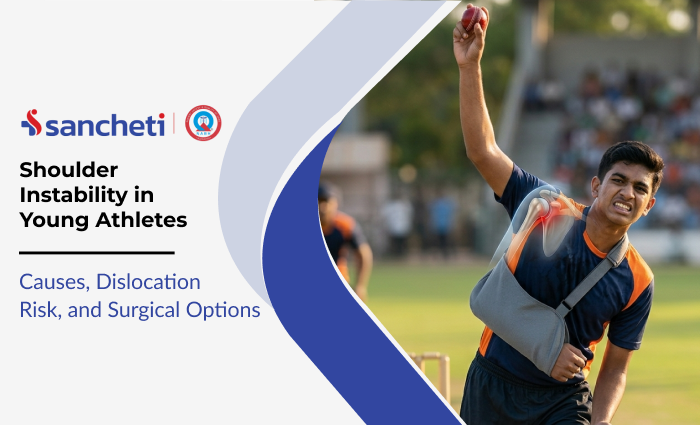

Shoulder Instability in Young Athletes: Causes, Dislocation Risk, and Surgical Options
Shoulder instability is one of the most common and consequential injuries in young athletes — and one of the most likely to recur without proper treatment. In short: when the ball of the shoulder joint slips partially or fully out of its socket, the structures that hold it in place are often permanently damaged, making every subsequent shoulder dislocation easier than the last. For young athletes in contact and collision sports, understanding this injury and addressing it correctly the first time can be the difference between a long career and a shortened one.
At Sancheti Hospital, Pune, our shoulder specialists regularly treat young athletes — from wrestlers and football players to gymnasts and cricketers — dealing with recurrent shoulder instability.
Why the Shoulder Is the Most Unstable Joint in the Body
Unlike the hip, where a deep ball-and-socket design provides inherent stability, the shoulder sacrifices stability for mobility. The glenoid — the socket — is shallow and flat, more like a golf tee than a true cup. The humeral head (ball) is significantly larger than the socket it sits in, meaning only a small portion of the ball is in contact with the socket at any given time.
This extraordinary range of motion — the shoulder can rotate through nearly 360 degrees — is what makes it so useful in sport. But it also means the joint depends almost entirely on soft tissue structures to stay in place: the glenoid labrum, the glenohumeral ligaments, the joint capsule, and the rotator cuff muscles working in precise coordination.
When any of these structures fail — through trauma, overuse, or inherent laxity — the result is shoulder instability.
Types of Shoulder Instability
Not all instability is the same, and the distinction matters for treatment planning.
Traumatic instability — the most common type in young athletes — occurs when a single forceful event drives the humeral head out of the socket. A tackle in wrestling, a fall on an outstretched arm in football, or an awkward landing in gymnastics are typical mechanisms. The force tears the anterior labrum away from the glenoid, producing what is known as a Bankart lesion — the defining injury of traumatic anterior shoulder instability.
Atraumatic instability — more common in hypermobile individuals and overhead athletes — develops gradually without a single identifiable injury. The capsule and ligaments stretch over time under repetitive loading, allowing the shoulder to sublux (partially slip) during activity without a full dislocation occurring.
Multidirectional instability (MDI) — where the shoulder is loose in more than one direction — is seen in athletes with generalised joint hypermobility, particularly gymnasts, swimmers, and young female athletes. This form responds best to rehabilitation and rarely requires surgery.
Why Young Athletes Are at Such High Risk of Recurrence
Age is the single strongest predictor of recurrence after a first shoulder dislocation. In athletes under 20, the recurrence rate after conservative management alone approaches 80–90%. In athletes aged 20–30, it remains around 60–70%. This is not simply because young athletes are more active — it is because the biological and biomechanical factors that predispose to re-dislocation are more pronounced in this age group.
Young athletes typically have greater muscle mass generating higher joint forces, participate in high-demand collision sports, and — crucially — have longer careers ahead of them during which an unstable shoulder will be repeatedly tested. A dislocated shoulder that is managed with rest and physiotherapy alone, without addressing the underlying structural damage, leaves a shoulder that is anatomically primed to dislocate again.
What Happens Inside the Shoulder During a Dislocation
When the humeral head is forced anteriorly (forward) out of the socket — the direction of over 95% of traumatic dislocations — the anterior labrum tears off the glenoid rim. This Bankart lesion destroys the primary static restraint to anterior translation of the humeral head. Without it, the inferior glenohumeral ligament — which normally tightens like a hammock when the arm is raised and externally rotated — loses its anchor point and can no longer prevent the joint from slipping forward.
At the same time, the humeral head often sustains a compression fracture on its posterior surface as it impacts the glenoid rim — a Hill-Sachs lesion. In large Hill-Sachs lesions, this bony defect engages with the glenoid rim during normal shoulder movement, creating a mechanical trigger for re-dislocation that cannot be addressed through rehabilitation alone.
Associated injuries are also common and must be assessed. Significant labral tears extending beyond the classic Bankart pattern, damage to the superior labrum producing SLAP tears, and injury to the rotator cuff — particularly in athletes over 35 — all influence how the instability is classified and treated. Concurrent rotator cuff injuries in young athletes after dislocation are less common but should not be missed, especially in those with persistent weakness after reduction.
Diagnosis: What the Assessment Involves
Clinical examination includes specific provocative tests — the anterior apprehension test, the relocation test, and the load-and-shift test — to confirm instability, direction and severity. A positive apprehension sign, where the athlete feels the shoulder is about to dislocate when the arm is placed in the vulnerable position, is highly specific for anterior instability.
Imaging begins with plain X-rays to confirm reduction after dislocation and identify bony lesions. MRI — ideally with intra-articular contrast (MR arthrogram) — provides the most detailed assessment of labral integrity, capsular laxity, ligament damage, and the presence of any associated cartilage or tendon injury. CT scan is used when significant bone loss at the glenoid is suspected, as quantifying this loss is essential for surgical planning.
Conservative Management: Who It Works For
Not every athlete with shoulder instability requires surgery. Conservative management through structured shoulder rehabilitation is appropriate in several situations:
- First-time dislocation in an athlete over 25 with low recurrence risk and low sporting demand
- Athletes with atraumatic or multidirectional instability, where rehabilitation addressing scapular control, rotator cuff strengthening, and proprioception consistently produces good outcomes
- Athletes unwilling or unable to undergo surgery at a particular time, as a bridge to later intervention
A well-structured physiotherapy and rehabilitation program for shoulder instability focuses on restoring dynamic stability through rotator cuff and periscapular muscle strengthening, neuromuscular retraining, and sport-specific movement patterning. The goal is to make the dynamic stabilisers compensate as effectively as possible for the damaged static restraints.
However, for young athletes in collision sports with a confirmed Bankart lesion and high recurrence risk, the evidence strongly favours early surgical stabilisation over prolonged conservative management — particularly after a second dislocation.
Surgical Options: Bankart Repair and Beyond
Arthroscopic Bankart Repair
The gold standard for traumatic anterior instability with an intact labrum and no significant bone loss is arthroscopic Bankart repair. The torn labrum is reattached to the glenoid rim using suture anchors, restoring the bumper effect of the labrum and re-establishing the tension of the inferior glenohumeral ligament.
Performed through small keyhole incisions with a camera and miniaturised instruments, the procedure offers excellent visualisation of the entire joint, minimal soft tissue disruption, and a shorter recovery compared to open surgery. Success rates exceed 90% in well-selected patients — those with intact glenoid bone stock and no large Hill-Sachs lesion.
Latarjet Procedure
When significant glenoid bone loss is present — typically when more than 20–25% of the glenoid surface has been eroded through repeated dislocations — an arthroscopic Bankart repair alone has unacceptably high failure rates. In these cases, the Latarjet procedure is the preferred option.
The Latarjet transfers the coracoid process (a bony projection on the scapula) along with its attached muscle to the front of the glenoid, restoring the bone surface area of the socket and creating an additional dynamic sling effect through the conjoint tendon. It is a more complex procedure than Bankart repair but produces highly durable results even in athletes with significant bone deficiency or those who have already failed a previous stabilisation surgery.
Remplissage
For athletes with a large Hill-Sachs lesion on the humeral head that is engaging with the glenoid, a remplissage — where the posterior capsule and infraspinatus tendon are anchored into the bony defect — is performed alongside Bankart repair to prevent the lesion from catching on the glenoid rim during arm elevation.
Recovery and Return to Sport After Surgery
Recovery following arthroscopic Bankart repair typically follows this timeline:
- Weeks 1–4: Arm in a sling, pendulum exercises, gentle passive range of motion
- Weeks 4–8: Active range of motion restored, rotator cuff and scapular strengthening begins
- Months 2–4: Progressive strengthening, proprioception training, sport-specific conditioning introduced
- Months 4–6: Contact and collision drills reintroduced in a controlled environment
- Months 6–9: Full return to competitive sport with surgeon clearance
The Latarjet procedure requires a slightly longer protection phase given the bony transfer, but return to sport timelines are broadly similar.
It is important to emphasise that return to sport after shoulder stabilisation is not determined by calendar time alone — it requires objective demonstration of adequate strength, range of motion, and sport-specific function before full clearance is given.
Key Takeaways
- Shoulder instability in young athletes is driven by structural damage — primarily a Bankart lesion — that does not heal reliably without surgical intervention in high-risk groups.
- The recurrence rate after conservative management alone in athletes under 20 approaches 80–90%, making early surgical stabilisation the evidence-based recommendation in most young, active patients after a second dislocation.
- The choice between arthroscopic Bankart repair and the Latarjet procedure depends on the degree of glenoid bone loss — a distinction that requires CT assessment and careful surgical planning.
- Atraumatic and multidirectional instability respond well to rehabilitation and rarely require surgery.
- Recovery after surgical stabilisation takes 6–9 months to full return to competitive sport, with structured rehabilitation essential throughout.
- At Sancheti Hospital, Pune, our shoulder specialists assess each athlete’s instability pattern, bone loss, and sporting demands to recommend the most appropriate and durable treatment pathway.
Frequently Asked Questions (FAQs)
Q1. Can a shoulder dislocation heal on its own without any treatment?
The joint can be reduced and pain can settle, but the structural damage — particularly the Bankart labral tear — does not heal back to its original anatomical position without intervention. The shoulder may feel functional between episodes, but the underlying vulnerability to re-dislocation remains and typically worsens with each subsequent event as more bone and soft tissue damage accumulates.
Q2. How many dislocations before surgery is recommended?
There is no fixed number. For young athletes in collision sports, many shoulder specialists now recommend surgical stabilisation after a second dislocation — and increasingly after the first, given the very high recurrence rates in this population. The decision depends on age, sporting demands, the severity of structural damage, and how much the instability is affecting quality of life and athletic performance.
Q3. Is there a risk of losing shoulder range of motion after Bankart repair?
A small reduction in external rotation — typically 5–10 degrees — is an accepted outcome of Bankart repair and is rarely functionally significant for most athletes. Overhead athletes, particularly cricketers and swimmers, require careful surgical technique to preserve as much external rotation as possible. This is discussed in detail during surgical planning at Sancheti Hospital.
Q4. What is the difference between a subluxation and a full dislocation?
A subluxation is a partial displacement where the humeral head moves out of the socket but spontaneously returns without manual reduction. Athletes often describe it as a “dead arm” sensation or a feeling that the shoulder slipped and came back. A full dislocation involves complete separation of the joint surfaces and requires reduction. Both indicate significant structural instability and warrant the same thorough evaluation.
Q5. Can shoulder instability come back after surgery?
Re-dislocation after well-performed arthroscopic Bankart repair occurs in approximately 5–10% of cases in appropriately selected patients. Risk is higher in athletes who return to collision sport too early, those with unrecognised bone loss treated with Bankart repair alone, and patients who do not complete their rehabilitation program. The Latarjet procedure, when indicated, has lower re-dislocation rates even in demanding contact sport environments.