Home
Home PG College
 Patient Login
 Sancheti Clinic
 Contact Us
 Download Reports
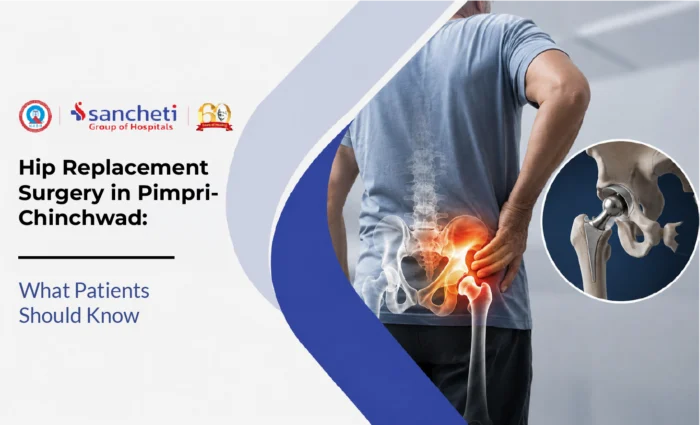

THip Replacement Surgery in Pimpri-Chinchwad: What Patients Should Know
Hip replacement surgery is a procedure that removes a damaged or diseased hip joint and replaces it with a durable prosthetic implant, eliminating chronic hip pain and restoring full mobility. For residents of Pimpri-Chinchwad (PCMC), hip joint disease is a common and often undertreated cause of disability, accepted as a normal part of ageing when targeted treatment could instead restore function entirely.
Sancheti Hospital’s dedicated Hip Department is the nearest specialist tertiary orthopaedic centre for PCMC patients. This article walks through everything a patient in the PCMC region should know before choosing hip replacement surgery in Pimpri Chinchwad: from candidacy and procedure type through to recovery and long-term implant care.
What Is Hip Replacement Surgery?
The hip is a ball-and-socket joint: the rounded head of the femur sits within the cup-shaped acetabulum of the pelvis, both surfaces lined with smooth cartilage that allows pain-free movement. When this cartilage wears away, when blood supply to the femoral head is lost, or when a fracture destroys the joint, the result is bone-on-bone contact, constant pain, and progressive loss of mobility.
Hip replacement surgery solves this structurally. The damaged bone and cartilage are removed and replaced with prosthetic components: a metal or ceramic ball on a stem inserted into the femur, and a cup liner fitted into the prepared acetabulum. The new joint recreates normal hip anatomy using durable, low-friction materials designed to last decades.
Outcomes from Indian centres confirm the procedure’s effectiveness: a prospective multi-centre study found that Harris Hip Scores (the standard hip function measure) rose from a mean of 9.2 before surgery to 89.6 after surgery, with implant survivorship of 97.7% at two years. Hip replacement is one of the most extensively evaluated and consistently successful procedures in modern medicine.
Who Needs Hip Replacement: Common Conditions in Pimpri-Chinchwad
Understanding which condition is causing the pain matters, because the appropriate procedure, implant type, and surgical approach each depend on the specific underlying diagnosis.
| Condition | Who It Most Affects | How It Damages the Hip |
|---|---|---|
| Osteoarthritis (OA) | Adults over 55, more common in women | Progressive cartilage loss causes bone-on-bone contact, joint space narrowing, and deformity over years; the leading global cause of hip replacement |
| Avascular Necrosis (AVN) | Often younger adults (30-55) | Disrupted blood supply causes the femoral head to collapse; accounts for up to 42% of hip replacements in some Indian centre studies versus a much smaller proportion in Western populations |
| Hip Fracture | Older adults, particularly women | Femoral neck fractures frequently require replacement rather than fixation in elderly patients to restore early mobility and reduce mortality risk |
| Inflammatory Arthritis | Any age | Immune-mediated joint destruction affecting cartilage and bone; often bilateral and progressing at a younger age than osteoarthritis |
| Developmental Dysplasia (DDH) | Typically detected in childhood | Abnormal socket shape causes abnormal joint loading and early cartilage destruction |
Types of Hip Replacement Surgery
The type of hip replacement surgery recommended depends on the underlying diagnosis, the patient’s age, activity level, bone quality, and the specific anatomy of the joint.
By Extent of Replacement
| Type | Best Suited For |
|---|---|
| Total Hip Replacement (THR) | Osteoarthritis, AVN with socket involvement, inflammatory arthritis, revision surgery; the most common procedure overall |
| Partial Hip Replacement (Hemiarthroplasty) | Hip fractures in elderly patients where the socket is intact and the goal is rapid mobilisation |
| Hip Resurfacing | Younger, physically active patients with good bone quality who wish to preserve bone stock for a potential future revision |
| Revision Hip Replacement | Implant loosening, significant bearing wear, late infection, dislocation, or prior component fracture |
By Fixation Method
- Cementless (biological) fixation: the implant surface allows bone to grow into it over weeks, creating a secure bond. Preferred for younger, more active patients with good bone quality.
- Cemented fixation: bone cement secures the implant immediately, giving early stability. Preferred for older patients or those with osteoporotic bone.
- Hybrid fixation: one component cemented, one cementless, combining approaches based on which component poses greater fixation challenges.
Symptoms That Indicate Hip Replacement May Be Needed
Not every patient with hip pain needs surgery, and hip replacement is considered only after conservative management has been genuinely and adequately tried. These specific symptom patterns indicate it is time for a specialist assessment.
| Symptom | Clinical Significance |
|---|---|
| Groin pain, particularly on weight-bearing or after prolonged sitting | Classic hip joint referral pattern; groin is the true pain zone for hip disease, not the outer thigh |
| Pain waking you at night | Indicates significant joint inflammation or advanced disease requiring more than analgesics |
| Stiffness making it difficult to put on shoes, socks, or cut toenails | Loss of hip internal rotation and flexion |
| A visible limp or change in walking pattern | The body compensates for hip pain by loading shifts |
| Steadily reducing walking distance over months | Progressive functional decline from ongoing joint destruction |
| Pain failing to respond to medicines, physiotherapy, and injections | Structural damage has advanced beyond what conservative management can address |
| X-ray showing advanced arthritis with matching symptoms | Radiological-clinical correlation confirming appropriate candidacy for surgical discussion |
How Candidacy for Hip Replacement Is Assessed
Evidence-based guidelines state that hip replacement is appropriate only when imaging confirms advanced joint disease and at least three months of conservative treatment have not provided adequate relief. The patient’s functional impairment is significant.
Clinical Examination
A hip specialist assesses range of motion, gait pattern, leg length, and functional impact on daily life. The spine, knee, and neurovascular status of the limb are also assessed, since pain from these structures frequently coexists with hip disease or mimics it.
Imaging
- Weight-bearing X-ray: shows joint space, bone quality, osteophyte formation, deformity, and alignment
- MRI: specifically used when AVN is suspected before collapse is visible on X-ray, or when soft tissue structures need assessment
- CT scan: used for 3D surgical planning in complex anatomy, revision cases, or DDH where standard implants may need modification
Pre-Operative Medical Assessment
Before proceeding, every candidate requires medical optimisation. Diabetes management to an HbA1c below 8% is specifically recommended. Patients with a BMI above 40 are advised to lose weight before surgery. Smoking cessation at least one month pre-operatively significantly improves wound healing.
The Procedure: What Happens During Hip Replacement Surgery
Hip replacement surgery at Sancheti Hospital’s Joint Replacement Department in Pune is performed in dedicated laminar airflow theatres with ultra-clean air filtration and anti-bacterial coatings, the same infection-control standard used in the most advanced joint replacement centres internationally.
Anaesthesia: Spinal anaesthesia is preferred for most hip replacements, numbing sensation from the waist down while the patient remains awake or lightly sedated.
The Operation: Through the chosen approach, the surgeon accesses the hip joint, removes the damaged femoral head and prepares the acetabular socket, and implants the prosthetic components.
Blood Loss and Infection Prevention: Tranexamic acid is used to minimise surgical bleeding. Pre-operative antibiotics are given at the start of every procedure. Surgical site infection rates in laminar-airflow theatres with appropriate prophylaxis are under 1% in high-volume orthopaedic centres. In diabetic patients, tight peri-operative glucose control is specifically required, since elevated blood glucose significantly increases infection risk.
Recovery After Hip Replacement Surgery
The pace of recovery surprises most patients. Most people expect weeks of immobility; the reality is that standing and taking first steps begin within hours of surgery, and the most important recovery work happens at home in the first six weeks, not in the hospital.
Recovery Timeline
| Timeframe | What to Expect |
|---|---|
| Day 1 after surgery | Standing and first steps with a walker under physiotherapy supervision; multimodal pain management begins |
| Days 2-4 | Walking increasing distances; stair practice before discharge; wound care established |
| Weeks 1-2 at home | Walker or stick for stability; light exercises daily; wound review and suture removal at 10-14 days |
| Weeks 2-6 | Progressive increase in daily walking; most light activities restored; physiotherapy continues |
| Months 1.5-3 | Return to desk work and driving (typically after 6 weeks); significant functional improvement; walking unaided |
| Months 3-6 | Strengthening progressing; return to most daily activities including stairs and moderate exercise |
| 6-12 months and beyond | Full activity restoration; long-term implant monitoring via annual X-ray review begins |
According to the American Academy of Orthopaedic Surgeons, most patients resume daily living and light activities independently within 3-6 weeks of hip replacement surgery.
Rehabilitation Phases After Hip Replacement Surgery
A structured physiotherapy programme transforms a technically successful hip replacement into an excellent functional outcome. Patients who consistently attend therapy and perform prescribed home exercises recover faster and achieve better long-term mobility.
- Phase 1: Early Recovery (Days 1–14)
Begin standing and walking with a walker under physiotherapy supervision from Day 1. Perform ankle pumps, gluteal sets, and gentle hip exercises to improve circulation and reduce clot risk. Learn hip precautions and keep the incision clean and dry until cleared. - Phase 2: Strength & Mobility (Weeks 2–6)
Progress from a walker to a walking stick as balance improves. Begin hip strengthening exercises, gait retraining, longer walks, and stair practice to restore normal movement. - Phase 3: Functional Recovery (Months 2–4)
Advance to resistance training, balance, and proprioception exercises to rebuild strength and stability. Plan a safe return to work with activity and ergonomic guidance. - Phase 4: Long-Term Care (4 Months+)
Resume low-impact activities like walking, swimming, and cycling. Avoid running and contact sports to minimise implant wear. Attend annual reviews with X-rays to monitor implant health and detect issues early.
Preparing Well and Protecting the Long-Term Outcome
The outcome of hip replacement is shaped as much by what happens before and after the operation as by the surgery itself. Several of the most influential factors are within a patient’s direct control.
- Optimise health before surgery: control blood glucose, optimise blood pressure, stop smoking at least one month pre-operatively, and review all regular medications with the surgical team.
- Reduce body weight: reducing excess weight lowers operative difficulty, complication risk, and long-term implant wear.
- Prepare the home environment: a raised toilet seat, a shower chair, a grabber tool for low objects, and a clear path from bed to bathroom remove the hazards responsible for most early post-operative falls.
- Build strength and fitness before surgery: pre-operative exercise, even when limited by hip pain, builds muscle mass and cardiovascular fitness that directly accelerates post-operative recovery.
- Attend all follow-up appointments: implant loosening and bearing wear are often asymptomatic for years; X-ray surveillance at recommended intervals allows early detection before catastrophic failure.
Key Takeaways
- Hip replacement is designed to restore mobility and eliminate pain caused by irreversible joint damage, making it a life-changing option for patients whose quality of life has significantly declined.
- The decision to undergo hip replacement is based on a combination of symptoms, functional limitations, imaging findings, and response to conservative treatment rather than age alone.
- Modern hip replacement surgery enables early mobilisation, with most patients beginning to walk within a day of surgery and steadily returning to normal activities over the following weeks and months.
- The long-term success of a hip replacement depends not only on the operation but also on consistent rehabilitation, strengthening exercises, and adherence to physiotherapy.
- Preparing well before surgery by optimising overall health, managing chronic conditions, and improving fitness can reduce complications and support a faster recovery.
- Choosing the right implant type and surgical technique requires an individualised assessment that considers the patient’s age, bone quality, diagnosis, and activity level.
- Protecting a hip replacement is an ongoing process, with healthy lifestyle habits, regular follow-up appointments, and timely monitoring helping maximise implant longevity and maintain long-term function.
- For patients across Pimpri-Chinchwad, Nigdi, Akurdi, Bhosari, Wakad, and the broader PCMC region, Sancheti Hospital, Pune‘s Hip Department offers complete hip replacement care, from first consultation through surgery, rehabilitation, and long-term implant follow-up, at a single specialised tertiary centre.
Frequently Asked Questions (FAQs)
Q1. How do I know if my hip pain needs replacement surgery or just physiotherapy and injections?
The clearest signal that surgery is the appropriate next step is three things together: imaging confirming advanced joint disease (significant cartilage loss and joint space narrowing on X-ray), symptoms substantially limiting your ability to walk, sleep, or carry out daily tasks, and a genuine trial of conservative treatment, physiotherapy, appropriate analgesics, and possibly a joint injection, that has not produced adequate, sustained relief over three months or more. Pain severity alone is not the determining factor, and a scan showing degeneration is not by itself an indication for surgery. A specialist assessment at Sancheti Hospital’s Hip Department will evaluate all three factors together and provide a clear, evidence-based recommendation.
Q2. What does hip replacement cost in PCMC, and what should I ask about before committing?
The cost of hip replacement surgery in Pune and the PCMC region varies based on the procedure type (total hip replacement, hemiarthroplasty, or resurfacing), the implant chosen (implant costs vary significantly between standard and premium options), the ward category, hospital stay duration, and whether physiotherapy is included in the package or billed separately.
Q3. How long will my hip replacement last, and will I need a second operation?
Modern hip implants are designed to last 20-30 years with appropriate patient selection, surgical technique, and post-operative activity management. The main factors that shorten implant life are high-impact repetitive activities such as running, excess body weight increasing joint forces, and implant infection. Annual review appointments with periodic X-rays monitor implant wear and catch any issues before catastrophic failure. Younger patients who receive hip replacement in their 40s or 50s have a statistically higher likelihood of eventually needing a revision, but this is a known, manageable reality that does not make surgery the wrong decision for a patient whose function is significantly and progressively declining from hip disease.
Q4. Is hip replacement safe for older adults and is there a maximum age?
There is no absolute age limit for hip replacement surgery in PCMC. Recommendations are based on functional status, overall medical condition, and what a patient stands to gain from surgery, not on age alone. Hip replacement consistently provides meaningful improvements in pain and function in older adults, including those in their 70s and 80s, when surgical fitness has been appropriately evaluated. Hip fracture specifically, which is common in elderly patients with osteoporosis, very frequently requires hip replacement as the most effective means of restoring mobility quickly, and prompt surgery in this setting is associated with lower overall mortality compared to delayed surgery.
Q5. Can I sit cross-legged after hip replacement?
This is one of the most practically important and culturally specific questions for patients in Pimpri-Chinchwad and across Maharashtra. The answer depends on the surgical approach used: patients who have had the posterior approach are typically advised to follow hip precautions that restrict extreme hip flexion, internal rotation, and adduction, particularly in the first three months, and some surgeons advise permanent modification of activities that require extreme hip bending, including full cross-legged sitting. Surgeons who use the anterior approach often apply fewer or shorter-duration restrictions on hip flexion. This question is worth raising explicitly with your hip surgeon in Pimpri Chinchwad before the operation is planned, so that the approach and implant design are specifically chosen with your daily lifestyle requirements in mind.