Home
Home PG College
 Patient Login
 Sancheti Clinic
 Contact Us
 Download Reports
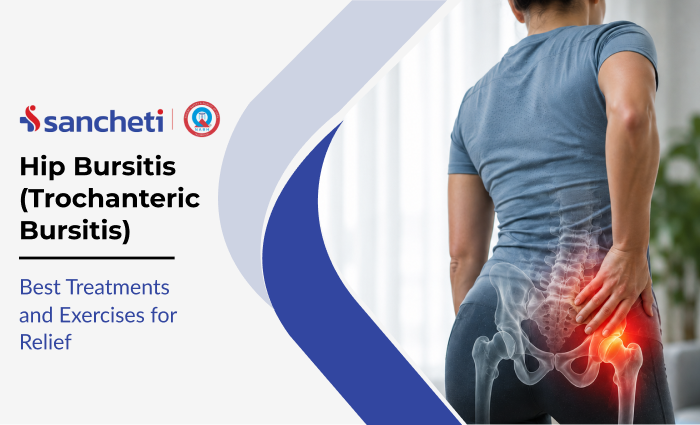

Hip Bursitis (Trochanteric Bursitis): Best Treatments and Exercises for Relief
If you’ve been dealing with persistent pain on the outer side of your hip, you may be suffering from hip bursitis, also known as trochanteric bursitis. The good news? With the right combination of treatments, exercises, and lifestyle adjustments, most people find significant relief — often without surgery.
In this blog, we’ll walk you through everything you need to know: what causes it, how it’s diagnosed, and the most effective hip bursitis treatment options available today.
What Is Hip Bursitis (Trochanteric Bursitis)?
The hip joint is cushioned by small fluid-filled sacs called bursae. When the bursa located near the greater trochanter — the bony point on the outer side of your hip — becomes inflamed, the condition is called trochanteric bursitis.
This inflammation causes sharp or aching pain along the outer hip and thigh, which often worsens when you walk, climb stairs, or lie on the affected side at night. It’s one of the most common causes of hip pain seen at orthopaedic centres like ours at Sancheti Hospital.
Who Gets Hip Bursitis?
Trochanteric bursitis can affect people of all ages, but it’s more common in:
- Middle-aged and older adults, particularly women
- Runners and cyclists who repeatedly stress the hip area
- People with one leg longer than the other or poor posture
- Those with conditions like rheumatoid arthritis or prior hip surgery
- Individuals who spend long hours standing or walking on hard surfaces
Understanding your risk factors is the first step toward effective hip bursitis management.
Common Symptoms to Watch For
Hip bursitis symptoms can develop gradually or come on suddenly. Key warning signs include:
- Outer hip pain that radiates down the thigh
- Tenderness when pressing on the outer hip
- Pain that worsens after sitting for long periods or getting up from a chair
- Difficulty sleeping on the affected side
- A dull ache during walking that can become sharp with activity
If you’re experiencing any combination of these symptoms, it’s important to consult an orthopaedic specialist for an accurate diagnosis.
How Is Hip Bursitis Diagnosed?
At Sancheti Hospital, our orthopaedic team typically diagnoses trochanteric bursitis through:
- Physical examination — checking for tenderness over the greater trochanter
- X-rays — to rule out bone abnormalities or hip arthritis
- MRI or ultrasound — to confirm bursa inflammation and assess surrounding soft tissues
Early and accurate diagnosis helps avoid unnecessary delays in treatment and prevents the condition from becoming chronic.
Best Treatments for Hip Bursitis
The majority of hip bursitis cases respond well to conservative (non-surgical) treatment. Here’s a breakdown of the most effective approaches:
1. Rest and Activity Modification
The first step is reducing activities that aggravate the bursa. This doesn’t mean complete bed rest — it means avoiding high-impact movements like running, stair climbing, or side-lying positions until inflammation settles.
2. Ice and Heat Therapy
- Ice packs applied for 15–20 minutes several times a day can help reduce inflammation in the early stage.
- Heat therapy is more useful for chronic stiffness and muscle tightness around the hip.
3. Anti-Inflammatory Medications (NSAIDs)
Non-steroidal anti-inflammatory drugs (NSAIDs) such as ibuprofen or diclofenac can help manage hip bursitis pain and swelling. Always take these under medical supervision, especially if you have a history of stomach or kidney issues.
4. Corticosteroid Injections
For moderate to severe cases that don’t respond to basic care, a corticosteroid injection directly into the inflamed bursa can provide fast and significant relief. At Sancheti Hospital, this is performed by experienced orthopaedic specialists under ultrasound guidance for precision and safety.
5. Physiotherapy
Physiotherapy for hip bursitis is one of the most effective long-term solutions. A trained physiotherapist will design a programme focusing on:
- Stretching tight muscles (especially the IT band and hip flexors)
- Strengthening the gluteal and hip abductor muscles
- Improving posture and gait mechanics
- Manual therapy techniques to reduce soft tissue tension
6. Platelet-Rich Plasma (PRP) Therapy
For chronic or recurrent cases, PRP therapy is an emerging treatment option that uses the patient’s own blood components to stimulate healing in the inflamed bursa. This is available at Sancheti Hospital as part of our advanced orthopaedic care.
7. Surgical Treatment (Rarely Needed)
Surgery is considered only when all conservative treatments fail after several months. Bursectomy — the surgical removal of the inflamed bursa — can be performed minimally invasively (arthroscopic) with a short recovery period.
Best Exercises for Hip Bursitis Relief
Hip bursitis exercises play a critical role in recovery and preventing recurrence. The goal is to reduce strain on the bursa by improving muscle balance and flexibility around the hip. Start gently and always stop if pain worsens.
Stretching Exercises
- IT Band Stretch Stand near a wall for support. Cross your affected leg behind the other and lean sideways away from the affected hip. Hold for 30 seconds. Repeat 3 times.
- Hip Flexor Stretch Kneel on the affected knee. Shift your weight forward gently until you feel a stretch at the front of the hip. Hold for 30 seconds.
- Piriformis Stretch Lie on your back, cross the affected leg over the other, and gently pull the opposite knee toward your chest. Hold for 30 seconds.
Strengthening Exercises
- Clamshells: Lie on your unaffected side with knees bent. Keeping your feet together, raise your top knee like a clamshell opening. Repeat 15 times. This strengthens the hip abductors.
- Side-Lying Leg Raises: Lie on your unaffected side, keep the top leg straight, and slowly raise it 30–45 degrees. Lower slowly. Repeat 15 times.
- Glute Bridges: Lie on your back with knees bent. Push through your heels to lift your hips off the floor. Hold for 3–5 seconds at the top. Repeat 15 times.
Tips to Prevent Hip Bursitis from Coming Back
Prevention is just as important as treatment. Here’s how to keep hip bursitis from recurring:
- Maintain a healthy weight to reduce load on the hip joint
- Warm up properly before exercise and cool down after
- Avoid prolonged sitting or standing on hard floors
- Wear supportive footwear and use orthotics if you have leg length discrepancy
- Sleep with a pillow between your knees to reduce hip stress when side-sleeping
- Progress exercise intensity gradually — don’t increase too fast, too soon
When Should You See a Doctor?
While mild hip pain may resolve with rest, you should visit an orthopaedic specialist if:
- The pain persists beyond 2–3 weeks despite home care
- You have significant swelling or redness over the hip
- The pain is affecting your sleep, walking, or daily activities
- You’ve had a recent hip injury or fall
At Sancheti Hospital, Pune, our orthopaedic and sports medicine team offers comprehensive evaluation and personalised treatment plans for hip bursitis and all related hip conditions. From diagnosis to physiotherapy and advanced interventions, we’re equipped to help you recover and return to an active life.
Key Takeaways
- Hip bursitis (trochanteric bursitis) is inflammation of the bursa at the outer hip, causing pain along the hip and thigh.
- It’s more common in middle-aged women, runners, and those with underlying joint conditions.
- Most cases are treatable with rest, physiotherapy, NSAIDs, and corticosteroid injections.
- Hip bursitis exercises targeting the IT band, glutes, and hip flexors are essential for recovery and prevention.
- Surgery is rarely needed and only considered after exhausting all conservative options.
- Early intervention and a structured rehabilitation plan lead to the best outcomes.
Frequently Asked Questions (FAQs)
Q1. Can hip bursitis go away on its own without treatment?
Mild cases may settle with rest and activity modification over a few weeks. However, without addressing the underlying causes — such as muscle weakness or poor biomechanics — it often recurs. Professional guidance ensures a more complete and lasting recovery.
Q2. Is walking good or bad for hip bursitis?
Gentle walking on flat surfaces is generally fine and can actually aid recovery by maintaining joint mobility. However, uphill walking, long distances, or walking on hard surfaces without proper footwear can aggravate symptoms. Listen to your body and reduce intensity if pain increases.
Q3. How long does it take to recover from trochanteric bursitis?
With consistent treatment, most patients notice significant improvement within 6–12 weeks. Chronic or severe cases may take longer. Sticking to your physiotherapy programme and avoiding aggravating activities are key to faster recovery.
Q4. Can hip bursitis be confused with hip arthritis?
Yes, both conditions can cause hip pain, but the location differs. Hip bursitis typically causes pain on the outer side of the hip, while hip arthritis usually causes pain in the groin or deep inside the joint. An orthopaedic evaluation with imaging helps distinguish between the two.
Q5. Is a corticosteroid injection safe, and how quickly does it work?
Corticosteroid injections are generally safe when administered by trained specialists. Most patients experience noticeable pain relief within 3–7 days. The effect can last from a few weeks to several months, and the injection is often combined with physiotherapy for best results.