
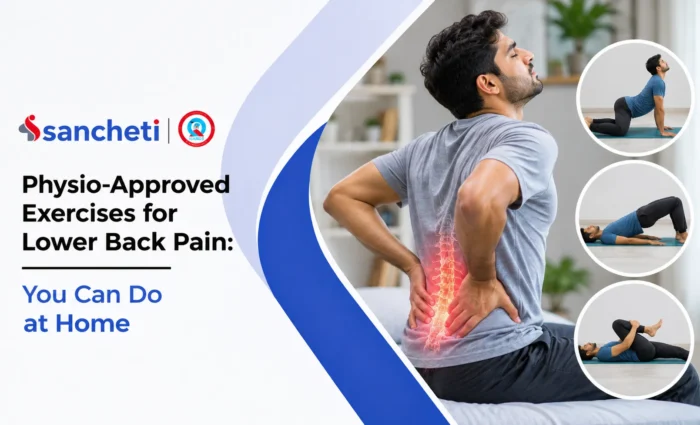

Physio-Approved Exercises for Lower Back Pain You Can Do at Home
The best exercises for lower back pain are gentle movements that keep your spine mobile, combined with simple strengthening and regular walking. Pelvic tilts, knee-to-chest stretches, bridges and walking are safe starting points for most people with everyday back pain. Staying active helps more than resting in bed, and most back pain improves within a few weeks. Check the warning signs below before you start, and stop any exercise that makes leg symptoms or pain clearly worse.
This guide gives you an eight-exercise routine, how often to do it, how to progress, and when to get help.
Should you rest or exercise with lower back pain?
Keep moving. The NHS advises staying active and continuing daily activities, and warns against staying in bed for long periods. Back pain usually improves on its own within a few weeks.
In the first few painful days, “exercise” may simply mean short walks around the house and gentle movements. As the pain eases, you can add the strengthening exercises below.
Before you start: a quick safety check
Most back pain is “non-specific”, meaning it comes from muscles, joints and ligaments rather than a serious problem. But some symptoms need a doctor before you exercise.
Go to emergency care immediately if you have back pain with:
- Numbness, tingling or weakness in both legs
- Loss of feeling around the genitals or back passage
- Difficulty passing urine, or loss of bladder or bowel control
- Pain after a serious fall or accident
These can be signs of cauda equina syndrome or a fracture, which need urgent treatment. Sancheti’s 24/7 emergency and trauma care is available at any hour.
See a doctor before exercising if your back pain comes with:
- Fever or feeling generally unwell
- Unexplained weight loss
- Pain that is worse at night or does not ease with rest
- A lump or swelling in your back, or a change in its shape
- Severe pain that started suddenly or is getting worse quickly
These warning signs are based on NHS guidance.
8 physio-approved exercises for lower back pain
Do these on a mat or firm bed, move slowly, and breathe normally — don’t hold your breath. Start with the gentle movers; add the strength builders once you can do the first four comfortably.
Gentle movers (1–4)
- Pelvic tilt
- Lie on your back with your knees bent and feet flat.
- Gently draw your belly button in and flatten your lower back into the floor by tilting your pelvis.
- Hold for 5 seconds, then let your back return to its natural curve.
Why it helps: gently moves the lower back and wakes up the deep tummy muscles. This exercise is taught by the Chartered Society of Physiotherapy.
- Knee-to-chest stretch
- Lie on your back with your knees bent.
- Hold behind one thigh and gently draw that knee towards your chest until you feel a comfortable stretch in your lower back.
- Hold for 15–20 seconds, lower, and repeat with the other leg.
Why it helps: eases stiffness in the lower back and buttock. If both knees together feels comfortable, you can progress to that.
- Knee rolls (lower-back rotation)
- Lie on your back, knees bent and together, arms out to the sides.
- Slowly let both knees roll to one side as far as is comfortable, keeping your shoulders on the floor.
- Hold for a few seconds, return to the middle, and roll to the other side.
Why it helps: gently rotates the spine and relaxes the muscles along the lower back.
- Child’s pose (back stretch)
- Start on your hands and knees.
- Slowly sit your hips back towards your heels, letting your arms stretch forward on the floor.
- Hold for 10–15 seconds, breathing slowly, then return.
Why it helps: a gentle stretch for the whole back. Skip it if bending forward sends pain down your leg. This and knee rolls appear in this physiotherapy routine.
Strength builders (5–8)
- Heel slides with core activation
- Lie on your back with knees bent and your back in a relaxed, natural position.
- Gently tighten your deep tummy muscles, as if drawing your belly button towards your spine.
- Slowly slide one heel along the floor until the leg is straight, then slide it back. Keep your back still. Alternate legs.
Why it helps: trains your core to steady your spine while your legs move, as shown by the Chartered Society of Physiotherapy.
- Bridge
- Lie on your back with knees bent and feet hip-width apart.
- Breathe out and lift your hips until your body forms a straight line from shoulders to knees.
- Hold for 3–5 seconds, then lower slowly.
Why it helps: strengthens the buttock and back muscles that support the lower spine.
- Dead bug (arm and leg lowers)
- Lie on your back with your arms pointing to the ceiling and your hips and knees bent at 90 degrees.
- Keeping your lower back gently pressed to the floor, slowly lower one arm overhead and the opposite leg towards the floor.
- Return and switch sides. Only go as low as you can without your back arching.
Why it helps: builds core control without loading the spine. Bridges and this exercise are among those recommended by a physiotherapist at Atlantic Health.
- Walking
Start with 5–10 minutes at a comfortable pace on flat ground and build up gradually. The NHS notes that walking, swimming, yoga and Pilates may all help ease back pain. Walking is free, needs no equipment and is easy to fit into the day.
How often should you do these exercises?
Consistency matters more than intensity. Use this as a general starting plan and adjust it to how your back responds; a physiotherapist can tailor it to you.
| Exercise group | Repetitions | How often | How to progress |
|---|---|---|---|
| Gentle movers (1–4) | 5–10 each, or hold stretches 10–20 seconds | 1–2 times a day | Increase range gently as stiffness eases |
| Strength builders (5–7) | 1–2 sets of 8–10 | 3–4 days a week | Add a set, or hold bridges longer, every 1–2 weeks |
| Walking (8) | Start at 5–10 minutes | Most days | Add 2–5 minutes every few days, aiming for about 30 minutes |
Many people notice less stiffness within one to two weeks; strength and confidence build over six to eight weeks. Keep going after the pain settles — regular exercise helps reduce the chance of back pain coming back.
How much pain is OK during exercise?
Some discomfort is normal when you start moving a sore back. Use this simple traffic-light guide:
- Green — carry on: mild discomfort (up to about 3 out of 10) that settles within an hour or so after exercising.
- Amber — ease off: pain that rises noticeably during the exercise or lasts into the next day. Do fewer repetitions, a smaller range, or skip that exercise for now.
- Red — stop and get checked: pain that shoots down a leg, new numbness or tingling, or pain that is clearly getting worse each time.
The NHS advises stopping exercises that make your pain worse and seeing a doctor for advice.
Matching exercises to your pain
Back pain often has a direction. Noticing what eases yours helps you choose where to start, an approach used in HealthLinkBC guidance:
- Pain eases when you sit or bend forward: start with knee-to-chest and child’s pose.
- Pain eases when you stand or lie flat: go gently with forward-bending stretches; start with pelvic tilts, bridges and walking.
- No position eases it: begin with pelvic tilts, knee rolls and short walks, and consider seeing a physiotherapist early.
Everyday habits that protect your back
- Break up sitting. Stand up and move for a minute or two every 30–45 minutes at a desk or during long drives.
- Lift smart. Hold buckets, shopping or children close to your body, bend at the hips and knees, and avoid twisting while lifting.
- Sit supported. If you sit on the floor for meals or prayer, use a cushion under your hips or sit against a wall, and change position often.
- Ease two-wheeler strain. Keep your back upright, avoid potholed shortcuts where possible, and take breaks on long rides.
- Use heat or cold. The NHS suggests a wrapped heat pack for stiffness or spasm and a wrapped ice pack for pain.
- Stay generally active. Walking, swimming, yoga or Pilates all count.
What does the evidence say about exercise for back pain?
- Exercise works. A Cochrane review of 249 trials with over 24,000 people found exercise probably reduces pain in long-lasting low back pain compared with no treatment or usual care. Side effects were few and mostly minor, such as temporary soreness.
- There is no single “best” exercise. Guidelines such as NICE NG59 recommend exercise programmes that may be strengthening, aerobic, mind–body (such as yoga or Pilates) or a combination. The best one is the one you will keep doing.
- Exercise helps prevent the next episode. A 2016 review found exercise combined with education lowered the risk of a new episode of back pain, while back belts and shoe insoles did not.
- Guidelines favour movement first. International experts writing in The Lancet recommend education, staying active and exercise as first-line care, with careful use of medicines, scans and surgery.
Common myths about back pain and exercise
- “Rest in bed until it heals.” Long bed rest tends to slow recovery; gentle movement is better.
- “Bending is bad for your back.” Your spine is designed to bend. Gradual, controlled bending is safe for most people.
- “A back belt will protect me.” Research has not shown that back belts prevent back pain.
- “If it hurts, I’m causing damage.” Mild discomfort during exercise is common and usually not a sign of harm — use the traffic-light guide.
- “I need a scan before I start.” Most back pain does not need a scan; it is needed mainly when warning signs are present.
When to see a physiotherapist or doctor
Home exercises suit most everyday back pain, but book an assessment if:
- Pain has not improved after a few weeks of home care
- Pain is stopping you working, sleeping or doing daily tasks
- Pain spreads below the knee, or you have tingling or numbness in a leg
- Pain is worse when you cough or sneeze
- You keep getting repeated episodes
- You are worried or struggling to cope
Pain travelling down the leg may be sciatica, often from a herniated disc. Other causes such as spinal stenosis, facet joint syndrome or sacroiliitis may need a tailored programme. A physiotherapist can check how you move, correct your technique and progress your exercises safely.
Frequently asked questions about lower back pain exercises
What is the best exercise for lower back pain?
There is no single best exercise. Research shows that strengthening, stretching, walking, yoga and Pilates all help; the best choice is a safe exercise you enjoy and will do regularly.
Is walking good for lower back pain?
Yes. Walking keeps the spine moving and the muscles working without heavy strain. Start with short, comfortable walks and build up gradually.
Should I exercise if my back hurts?
Usually yes, gently. Staying active speeds recovery for most people. Stop and get checked if pain shoots down your leg, you develop numbness, or any emergency warning signs appear.
How long does it take for back exercises to work?
Many people feel less stiff within one to two weeks. Strength and lasting improvement usually take six to eight weeks of regular exercise.
Which exercises should I avoid with lower back pain?
Avoid anything that causes sharp pain or sends pain down your leg. In a flare, hold off on heavy lifting, full sit-ups and fast twisting movements until the pain settles.
Can I do these exercises in the morning?
Yes, but warm up first. Backs are often stiffer after sleep, so start with a few minutes of walking or gentle movers before strengthening.
Are these exercises safe during pregnancy or after spine surgery?
Check with your doctor or physiotherapist first. Pregnancy and recovery from surgery need specific advice about which positions and exercises are safe.
Can exercise prevent back pain from coming back?
It helps. Research shows regular exercise, especially combined with education about back care, lowers the risk of future episodes. The benefit fades if you stop, so keep exercising.
Keep your back moving
For most people, lower back pain improves with time, gentle movement and a simple routine done consistently. Start with the gentle movers, add strength exercises as you feel better, walk most days, and use the traffic-light guide to pace yourself.
If pain is not settling, keeps returning or comes with leg symptoms, Sancheti Hospital’s physiotherapy and rehabilitation team and Spine Department in Pune can assess you and build a programme that fits. You can book an appointment online.