
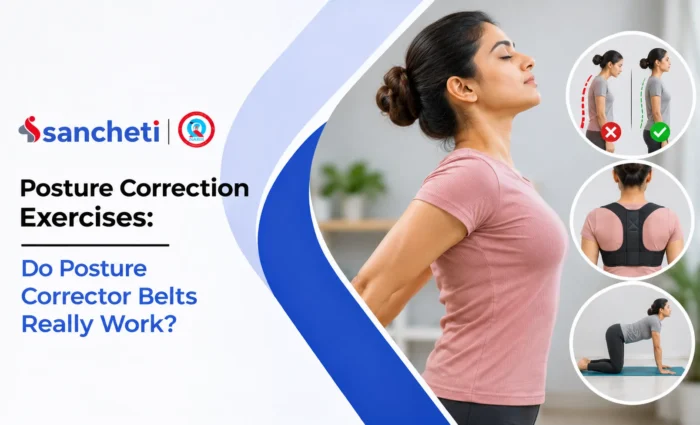

Posture Correction Exercises: Do Posture Corrector Belts Really Work?
Posture corrector belts can pull your shoulders back and remind you to sit up while you wear them, but there is little evidence that they change your posture once removed or relieve neck and back pain. Regular posture correction exercises, frequent changes of position and a better desk and phone setup are more useful for most people. A belt can be a short-term reminder, not a fix. Persistent pain, numbness or a visible curve in the spine should be checked by a doctor.
This guide explains what the research says about posture belts, and gives you seven simple exercises you can do at home or at your desk.
Do posture corrector belts really work?
It depends on what you expect them to do. The table summarises the evidence.
| Claim | What the evidence shows |
|---|---|
| Improves posture while worn | Likely. Belts and wearables can change shoulder and upper-back position, and a systematic review found immediate improvements in alignment and body awareness, especially with vibrating or app-linked devices. |
| Changes posture after you stop | Little evidence. Most studies measure short-term effects only. |
| Relieves neck or back pain | Not established. A scoping review of posture-correcting shirts found only six relevant studies, all in people without pain, and concluded there is no good-quality evidence to recommend them for musculoskeletal pain. |
| Is a substitute for exercise | No. The same wearables review concluded the evidence is not strong enough for firm clinical recommendations. |
In short: a belt is best thought of as a reminder, not a treatment.
Can a posture belt weaken your muscles?
This is a common worry, but it has not been well studied. The bigger problem is that a belt does nothing to build the muscles and habits that support your upper back. If wearing one replaces exercise and movement, you are unlikely to see lasting benefit.
When a brace is medically useful
Shop-bought posture belts are different from medical braces. A specialist may prescribe a fitted brace for specific conditions, such as some adolescents with scoliosis or Scheuermann’s kyphosis who are still growing. These braces are chosen, fitted and monitored by a doctor; a general posture belt is not a substitute.
If you still want to use a belt
- Use it for short periods — for example, 20–30 minutes at a time during desk work — rather than all day.
- Choose a comfortable fit. Stop if it causes pain, numbness or tingling in the arms, skin rubbing or difficulty breathing.
- Don’t sleep in it.
- Pair it with exercises so your own muscles do the work.
- Check with a doctor first if you have a spinal condition, osteoporosis, recent surgery or significant pain.
Does bad posture cause pain?
Less than most people think. Physiotherapy researchers writing in JOSPT in 2019 argued that the common belief that “incorrect” sitting or standing causes back pain has little strong evidence behind it. A review of 41 systematic reviews found no consensus that particular spinal postures cause low back pain.
What does seem to matter is staying in one position for too long. A review of studies measuring sitting time found that longer periods of sitting were linked to immediate increases in low back pain. Neck posture is a partial exception: forward head posture is associated with neck pain, and exercise programmes can improve both.
The practical message: there is no single “perfect” posture. Your best posture is your next one — change position often, and build strength so different positions feel comfortable.
7 posture correction exercises you can do at home
These exercises target the deep neck muscles, the muscles between your shoulder blades, and the chest and upper back — the areas most linked to forward head and rounded-shoulder posture. A meta-analysis of seven trials found that exercise can meaningfully improve forward head posture and may reduce neck pain.
Move slowly and stop any exercise that causes sharp pain, dizziness, or tingling in your arms.
- Chin tucks
- Sit or stand tall, looking straight ahead.
- Gently glide your chin straight back, as if making a double chin, without tilting your head down.
- Hold for 5 seconds, then relax.
Targets: deep neck flexors that help hold the head over the shoulders.
- Shoulder blade squeezes
- Sit or stand with arms relaxed by your sides.
- Draw your shoulder blades back and slightly down, as if trying to hold a pencil between them.
- Hold for 5 seconds, then release. Keep your shoulders away from your ears.
Targets: rhomboids and lower trapezius, which pull the shoulders back.
- Wall angels
- Stand with your back, head and bottom against a wall, feet slightly forward.
- Raise your arms to shoulder height with elbows bent, backs of the hands towards the wall.
- Slowly slide your arms up the wall and back down, keeping contact as far as is comfortable.
Targets: upper-back mobility and shoulder control.
- Doorway chest stretch
- Stand in a doorway with forearms on the frame, elbows at shoulder height.
- Step one foot forward and gently lean through until you feel a stretch across the chest.
- Hold for 20–30 seconds.
Targets: tight chest muscles that pull the shoulders forward.
- Upper-back extension over a chair
- Sit on a chair with a firm backrest that reaches the bottom of your shoulder blades.
- Support your head with your hands and gently lean back over the top of the backrest.
- Hold for a few seconds, then return. Don’t push into pain.
Targets: stiffness in the upper (thoracic) spine.
- Band or towel rows
- Loop a resistance band around a sturdy post, or hold a towel with a partner.
- Pull your elbows back close to your body, squeezing your shoulder blades together.
- Slowly return.
Targets: strength in the upper back muscles that support upright posture.
- Movement breaks
Every 30–45 minutes, stand up, roll your shoulders, look side to side and walk for a minute or two. This is the simplest posture exercise — and, given the evidence on sitting time, one of the most useful.
How often should you do posture exercises?
| Exercise | Repetitions | How often |
|---|---|---|
| Chin tucks, shoulder blade squeezes | 10 reps, 5-second hold | 2–3 times a day, including at your desk |
| Wall angels, upper-back extension | 8–10 reps | Once a day |
| Doorway chest stretch | 2–3 holds of 20–30 seconds | Once a day |
| Band or towel rows | 2–3 sets of 10–12 | 3 days a week |
| Movement breaks | 1–2 minutes | Every 30–45 minutes of sitting |
Studies of corrective exercise for forward head posture have typically used programmes of 4–12 weeks, about three sessions a week. Expect to feel less stiff within a couple of weeks; visible change takes longer and depends on keeping it up. A physiotherapist can check your technique and adjust the plan.
Everyday habits for better posture
- Raise your screen. Set the top of your monitor at about eye level, and lift your phone towards your face rather than dropping your head.
- Use a laptop stand with a separate keyboard and mouse if you work on a laptop for long hours.
- Support your back. Sit back in your chair; a small cushion or rolled towel can support the lower back.
- Vary your position. Alternate sitting and standing, and shift position whenever you feel stiff.
- On a two-wheeler, keep your elbows relaxed and take short breaks on long rides.
- Carry loads evenly. Use both shoulder straps on a backpack and split heavy shopping between both hands.
- Stay active overall. Walking, swimming, yoga or strength training all help your body tolerate different positions.
When “bad posture” needs a doctor
Most posture concerns are harmless, but see a doctor or the Sancheti Spine Department if you notice:
- A visible curve, hump, or one shoulder or hip higher than the other — especially in a child or teenager
- A stoop that is getting worse, particularly in older adults (this can be linked to osteoporosis-related fractures)
- Neck or back pain that does not improve after a few weeks
- Numbness, tingling or weakness in the arms or legs
- Pain that is worse at night or comes with fever or weight loss
These can point to conditions such as scoliosis, kyphosis, other spinal deformities or cervical spondylosis, which need proper assessment rather than a posture belt.
Frequently asked questions about posture correction
Do posture correctors work?
They can improve posture while you wear them and act as a reminder. There is little evidence that they produce lasting change or relieve pain on their own; exercise and regular movement are more effective.
How long should I wear a posture corrector each day?
There is no evidence-based limit. If you use one, keep to short periods, such as 20–30 minutes at a time, and stop if it causes pain or numbness.
Can posture correction exercises fix rounded shoulders?
They can help. Strengthening the upper back and stretching the chest improves shoulder position for many people, especially when combined with changes to screen height and sitting habits.
How long does it take to improve posture?
Most people feel less stiff within a few weeks. Studies of posture exercise programmes typically run for 4–12 weeks, and benefits depend on continuing the exercises.
Does slouching damage your spine?
No strong evidence shows that slouching itself damages the spine. Staying in any position for a long time can cause stiffness and discomfort, so the key is to change position often.
Are posture belts safe for teenagers?
Shop-bought belts are not a treatment for spinal curves in children or teenagers. If you notice a curve or uneven shoulders in a child, have them assessed by a spine specialist.
What is the best single exercise for posture?
There isn’t one. Chin tucks and upper-back exercises such as rows are good starting points, but regular movement throughout the day matters most.
Build strength, not dependence
Posture corrector belts may remind you to sit up, but they don’t build the strength or habits that make good posture comfortable. A few minutes of daily exercise, a better screen setup and frequent movement breaks will do more for your neck and back.
If you have ongoing pain, a visible spinal curve or arm or leg symptoms, Sancheti Hospital’s physiotherapy and rehabilitation team and Spine Department in Pune can assess you and design a programme that fits. You can book an appointment online.