
Types of Fractures Explained: Simple, Compound, Comminuted and More
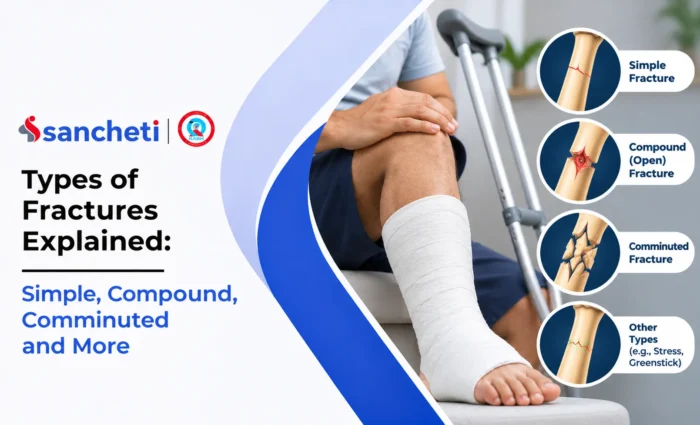
A fracture is a break in a bone, and doctors describe it by whether the skin is broken, how the bone has broken and how far the pieces have moved. The main types are simple (closed) fractures, where the skin is intact; compound (open) fractures, where the bone breaks through the skin; and comminuted fractures, where the bone shatters into three or more pieces. Others include greenstick, spiral, stress and pathological fractures. A compound fracture is a medical emergency because of the high risk of infection.
This guide explains each type in plain language, how to help someone with a suspected broken bone, and what treatment and recovery usually involve.
What is a fracture?
A fracture and a broken bone are the same thing — a partial or complete break in a bone. It happens when a force on the bone is greater than it can withstand, as described by AAOS OrthoInfo.
Fractures are usually caused by:
- Injury: falls, road accidents, sports injuries or a direct blow
- Overuse: repeated stress on a bone, as in long-distance running
- Weak bones: conditions such as osteoporosis or bone tumours that let a bone break with little force
How doctors describe a fracture
A fracture is rarely described by one word. Doctors combine several labels, so a report might read “closed, displaced, comminuted fracture of the tibia”. Each label answers a different question:
| Question | Possible answers |
|---|---|
| Is the skin broken? | Closed (simple) or open (compound) |
| Is the bone broken all the way through? | Complete or incomplete |
| Are the pieces still lined up? | Non-displaced (aligned) or displaced (out of position) |
| What shape is the break? | Transverse, oblique, spiral, comminuted, segmental and others |
| Why did it happen? | Injury, stress (overuse) or pathological (weakened bone) |
Knowing these layers makes it easier to understand your diagnosis and why your treatment plan looks the way it does.
Simple (closed) vs compound (open) fractures
This is the most important distinction for first aid and urgency.
- Simple (closed) fracture: the bone breaks but the skin over it stays intact. Many are treated with a cast or splint. Read more about simple (closed) fractures.
- Compound (open) fracture: a broken bone pokes through the skin, or a wound reaches down to the bone. Germs can enter the bone, so this is an emergency. Read more about compound fractures.
For open fractures, UK trauma standards (BOAST-4) recommend intravenous antibiotics within one hour of injury, and surgical cleaning of the wound soon after, to lower the risk of deep infection.
A note on the word “simple”: many people, and some doctors, use “simple fracture” to mean a closed fracture. Others use it to mean a single, clean break. If your report says “simple”, ask which meaning applies.
Types of fractures by pattern
The pattern describes the shape of the break, which often reveals how the injury happened and how it will be treated.
| Type | What it means | Common cause or setting |
|---|---|---|
| Transverse | Straight break across the bone | Direct blow |
| Oblique | Angled break across the bone | Angled force |
| Spiral | Break that twists around the bone | Twisting injury with the foot planted |
| Comminuted | Bone broken into three or more pieces | High-energy injuries, crush injuries |
| Segmental | Same bone broken in two places, leaving a “floating” segment | High-energy injuries |
| Impacted | Broken ends driven into each other | Falls from a height |
| Avulsion | Small piece of bone pulled off where a tendon or ligament attaches | Sudden muscle pull, sports |
| Compression | Bone squashed, usually a vertebra in the spine | Osteoporosis, falls |
| Greenstick | Bone bends and cracks on one side only | Children |
| Buckle (torus) | Bone side bulges outward without breaking through | Children, often the wrist |
| Stress (hairline) | Tiny crack from repeated stress | Runners, soldiers, sudden increase in activity |
| Pathological | Break through bone weakened by disease | Osteoporosis, bone tumours, infection |
Comminuted fractures
A comminuted fracture is one of the more serious patterns because there are several pieces to realign and hold in place. It usually follows a high-energy injury such as a road accident or a fall from height, and often needs surgery with plates, screws or rods. A comminuted fracture can be closed or open — the two descriptions are separate.
Fractures in children
Children’s bones are softer and more flexible than adults’, so they often break differently:
- Greenstick fractures: the bone bends and cracks on one side, like a young green twig.
- Buckle (torus) fractures: the bone compresses and bulges, commonly at the wrist after a fall on an outstretched hand.
- Growth plate fractures: breaks through the soft growing area near the end of a bone. These need careful follow-up because they can affect how the bone grows.
Children’s fractures usually heal faster than adults’, as this NHS fracture leaflet notes. Any child with a suspected broken bone, especially near a joint, should be seen by a doctor, ideally with input from a paediatric orthopaedic team.
Stress, pathological and fragility fractures
- Stress fractures are small cracks caused by repeated force rather than a single injury. They are common in runners and people who suddenly increase their activity, and often cause pain that builds during exercise and eases with rest.
- Pathological fractures happen when disease weakens the bone, such as a tumour, infection or severe osteoporosis, so a minor force causes a break.
- Fragility fractures occur from a fall from standing height or less, usually in older adults with osteoporosis. Common sites are the hip, wrist and spine — including vertebral compression fractures.
Fragility fractures are a growing concern in India. An International Osteoporosis Foundation audit reported that hip fractures in India tend to occur about a decade earlier than in Western countries. Anyone over 50 who breaks a bone after a minor fall should ask about a bone density (DEXA) scan, because treating osteoporosis can help prevent the next fracture.
Signs of a broken bone
It is not always obvious whether a bone is broken. Common signs, listed by HealthyWA and St John Ambulance, include:
- Pain at or near the injury, often worse with movement
- Swelling, bruising or discolouration
- A limb that looks bent, shortened or out of shape
- Difficulty or inability to move or put weight on the area
- A snap or crack heard at the time of injury, or a grating feeling
- A wound with bone visible (open fracture)
Hairline and stress fractures may cause only mild pain and swelling, so persistent pain after an injury should be checked with an X-ray.
First aid for a suspected fracture
If in doubt, treat the injury as a fracture.
- Check for danger and call for help. Call an ambulance for open fractures, suspected thigh, hip, pelvis, neck or back injuries, heavy bleeding, or if the person is very pale, sweaty or confused.
- Control bleeding. For an open fracture, press around the wound — not on the bone — and cover it with a clean dressing or cloth.
- Keep the injured part still. Support it in the position you found it with padding, pillows or folded clothes.
- Splint if you’re trained, immobilising the joints above and below the break. Support an injured arm in a sling.
- Don’t straighten the limb or push a bone back in. This can damage nerves and blood vessels.
- Don’t give food or drink in case surgery is needed.
- Suspected neck or back injury: don’t move the person unless they are in danger; wait for trained help.
These steps follow St John Ambulance guidance. In Pune, Sancheti’s 24/7 emergency and trauma care team is available at any hour for suspected fractures.
How fractures are treated
The aim is to line the bone ends up and hold them still while they heal. The right method depends on the type, location and stability of the fracture, and the person’s age and health.
| Treatment | When it is used | What it involves |
|---|---|---|
| Cast or splint | Stable, aligned fractures | Plaster or fibreglass holds the bone still; the most common treatment for broken bones |
| Closed reduction | Displaced fractures that can be realigned without surgery | The bone is gently moved back into place under pain relief or anaesthesia, then put in a cast |
| Open reduction and internal fixation (ORIF) | Unstable, displaced, comminuted or joint fractures | Surgery to realign the bone and fix it with plates and screws |
| Interlocking nailing | Long-bone fractures, such as the thigh or shin | A metal rod is placed inside the hollow centre of the bone |
| External fixation | Open fractures with severe soft-tissue damage, or as a temporary measure | Pins through the skin are connected to a frame outside the body |
| Rest and activity changes | Many stress fractures | Reducing load, sometimes with a boot or crutches |
After the bone has healed enough, physiotherapy and rehabilitation helps restore movement, strength and confidence.
How long do fractures take to heal?
Many fractures take around 6–12 weeks to heal, as noted in this NHS fracture leaflet, but time varies widely. Small bones of the hand or wrist may heal sooner, while thigh or shin fractures and complex or open fractures can take several months. Full strength and function often take longer than bone healing.
Factors that slow healing include:
- Older age
- Smoking — the same NHS leaflet notes that smoking slows healing
- Diabetes and poor nutrition
- Open, comminuted or infected fractures
- Moving the fracture too early, against medical advice
Possible complications
Most fractures heal well with proper treatment, but watch for:
- Compartment syndrome: severe, increasing pain under a cast or in a swollen limb, out of proportion to the injury, with tightness, numbness or pale skin. This is an emergency.
- Infection: especially after open fractures or surgery — fever, increasing redness, discharge or wound pain.
- Delayed healing or non-union: the bone heals slowly or not at all.
- Malunion: the bone heals in the wrong position, which may affect function.
- Stiffness or reduced strength in nearby joints, which physiotherapy can usually improve.
Seek urgent help if pain under a cast becomes severe, fingers or toes turn pale, blue or numb, or you develop chest pain or breathlessness after a fracture.
Frequently asked questions about types of fractures
What is the difference between a simple and a compound fracture?
In a simple (closed) fracture the skin is intact. In a compound (open) fracture the bone breaks through the skin or a wound reaches the bone, which carries a high risk of infection and needs emergency treatment.
Which type of fracture is the most serious?
Open fractures, comminuted fractures from high-energy injuries, and fractures of the spine, pelvis or thigh bone are usually the most serious, because of the risk of infection, bleeding or nerve damage.
Does a hairline fracture need a plaster?
Not always. Many hairline and stress fractures heal with rest and reduced activity, sometimes with a boot or splint. Your doctor will advise based on the bone involved and your symptoms.
Does every fracture need surgery?
No. Many fractures heal well in a cast or splint. Surgery is usually needed for displaced, unstable, open or comminuted fractures, and for some fractures involving joints.
Can you walk on a broken bone?
Sometimes, especially with small foot bones or stress fractures, but walking on a broken bone can make it worse. If walking is painful after an injury, get it checked before putting weight on it.
How do I know if my child’s bone is broken?
Look for pain, swelling, refusal to use the arm or leg, or a change in shape. Children may have greenstick or buckle fractures that look mild, so get an X-ray if pain persists.
Why did my bone break from a small fall?
A break from a minor fall can be a sign of weakened bones, often due to osteoporosis. Ask your doctor about a bone density test and treatment to lower the risk of further fractures.
Get the right care for a fracture
Knowing the type of fracture helps you understand your diagnosis, what treatment to expect and how long recovery may take. Most fractures heal well with prompt, appropriate care — and open fractures, deformity, severe pain or numbness always need urgent attention.
For a suspected fracture in Pune, Sancheti Hospital’s 24/7 emergency and trauma care and Accident & Trauma Department can assess and treat you at any hour. For follow-up care, you can book an appointment online.