
Growing Pains or Something Serious? Leg Pain in Children Explained
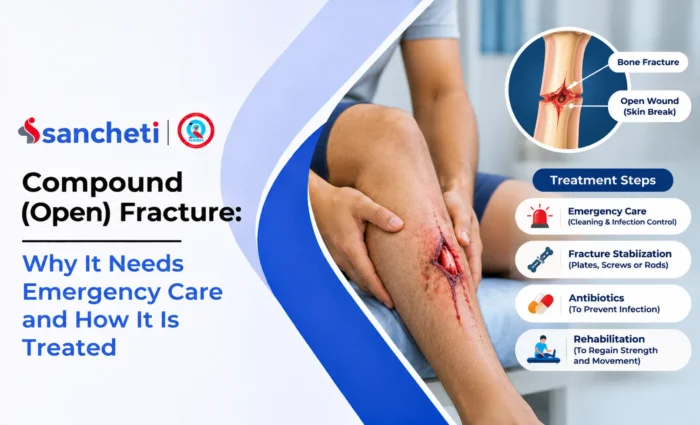
A compound fracture, also called an open fracture, is a broken bone with a wound in the skin that connects to the break — sometimes with bone visibly sticking out. It is a medical emergency because germs can enter the bone and cause a serious infection. Treatment starts with antibiotics as soon as possible, followed by surgery to clean the wound and stabilise the bone. Many people recover well, but early care in a hospital equipped for trauma surgery makes a real difference.
What is a compound fracture?
In a compound fracture, the skin over or near a broken bone is broken. According to AAOS OrthoInfo, this is most often caused by a bone fragment breaking through the skin at the moment of injury.
Compound fractures range widely in severity:
- Obvious injuries: bone visible through a large wound, often after a road accident or fall from height
- Hidden injuries: a small cut or puncture over a broken bone, with no bone showing
Both are treated as open fractures. Doctors assume that any wound near a broken bone is an open fracture until proven otherwise, because even a small wound can let germs reach the bone. In contrast, in a closed (simple) fracture, the skin stays intact.
Most compound fractures follow high-energy injuries such as road accidents, falls from height or industrial accidents, and people often have other injuries too. They can also happen after lower-energy falls or sports injuries.
Why a compound fracture is a medical emergency
The main danger is infection. Once the skin is broken, dirt, clothing fibres and bacteria can be driven deep into the wound and bone. A bone infection can be very hard to treat — the AAOS notes it may need long antibiotic courses and several operations, and in rare severe cases can threaten the limb.
Time matters. Infection risk is lowest when antibiotics are started early:
- UK trauma standards (BOAST-4) recommend intravenous antibiotics within one hour of injury.
- In one study of severe open shin-bone fractures, the infection rate was 6.8% when antibiotics were given within the first hour, compared with 27.9% when given after 90 minutes.
Other reasons for urgency include:
- Heavy bleeding from damaged blood vessels
- Damage to nerves, muscles and tendons around the bone
- Risk of compartment syndrome, a dangerous build-up of pressure in the limb
- Other injuries from the same accident that may be life-threatening
First aid for a compound fracture
If you are with someone who may have a compound fracture:
- Make the scene safe and call for an ambulance. Don’t move the person unless they are in danger, especially if a neck or back injury is possible.
- Control bleeding. Press firmly around the wound — not directly on any exposed bone — using a clean cloth or dressing.
- Cover the wound with a clean, preferably sterile, dressing or cloth to reduce contamination.
- Don’t push the bone back in or try to straighten the limb. This can drive dirt deeper and damage nerves and blood vessels.
- Keep the limb still. Support it in the position you found it with padding, folded clothes or a splint if you are trained.
- Don’t wash the wound with water or apply powders, oils or home remedies.
- Don’t give food or drink, as surgery is likely.
- Watch for shock: pale, cold, sweaty skin, fast breathing or confusion. Keep the person warm and lying down if possible.
These steps follow St John Ambulance guidance. Note where and how the injury happened — for example, on a farm, in a drain or on a road — because the level of contamination guides treatment. Sancheti’s 24/7 emergency and trauma care team in Pune can receive open-fracture patients at any hour.
How severe is a compound fracture?
Doctors grade open fractures using the Gustilo–Anderson classification, which looks at wound size, contamination and damage to soft tissues and blood vessels. Higher grades carry a higher infection risk and usually need more complex treatment.
| Grade | What it means in plain language | Typical treatment needs |
|---|---|---|
| I | Small, clean wound, usually under 1 cm | Antibiotics, wound cleaning, fracture fixation; wound often closes normally |
| II | Larger wound (about 1–10 cm) without extensive tissue damage | As above; may need more extensive cleaning |
| IIIA | Severe soft-tissue injury, but enough tissue left to cover the bone | Staged surgery; often external fixation first |
| IIIB | Severe injury with tissue loss; bone cannot be covered without reconstructive surgery | Repeated cleaning and a skin graft or flap |
| IIIC | Severe injury with damage to a major artery that needs repair | Emergency vascular repair alongside bone and wound care |
Grade definitions are based on the Gustilo–Anderson system. Heavy contamination, such as a farm injury, automatically places a fracture in grade III. Reported infection rates range from under 1% in grade I to around 30% in grade III injuries. The final grade is often confirmed in theatre, once the wound has been fully examined.
How a compound fracture is treated
Almost all compound fractures need surgery, and severe injuries are often treated in stages over several days or weeks. The usual journey, as described by AAOS OrthoInfo, looks like this.
1. In the emergency department
- Assessment: doctors check breathing, circulation and other injuries first, then examine the wound, nerves and blood flow in the limb.
- Antibiotics: given into a vein as early as possible.
- Tetanus protection: a tetanus booster is given if you have not had one in the last five years.
- Dressing and splint: the wound is photographed, covered with a sterile dressing, and the limb is splinted to limit movement and pain.
- Imaging: X-rays, and sometimes a CT scan, show the fracture pattern.
2. Surgery to clean the wound (debridement)
In theatre, the surgeon removes dirt, foreign material and dead or badly damaged tissue, then washes the wound thoroughly. The wound may need to be extended to reach all contaminated areas.
The timing depends on how severe the injury is. NICE guidance recommends immediate surgery for heavily contaminated wounds or when blood supply is threatened, within 12 hours for other high-energy injuries, and within 24 hours for the rest. The old idea of a strict “6-hour rule” for surgery is not well supported by evidence — early antibiotics and a thorough clean by the right team matter more.
3. Stabilising the bone
The broken bone must be held still so the wound and fracture can heal:
- External fixation: pins in the bone above and below the break are attached to a frame outside the limb. Most severe open fractures are first stabilised this way while the wound settles.
- Internal fixation: plates, screws or a rod inside the bone, such as interlocking nailing or open reduction and internal fixation (ORIF). This may be done at the first operation or later, once the wound is clean.
Comminuted fractures, where the bone is in several pieces, often need more complex fixation.
4. Closing or covering the wound
Smaller wounds can often be stitched once they are clean. Larger wounds may be covered temporarily with special dressings and antibiotic beads, then closed later with:
- A skin graft: a thin layer of skin taken from elsewhere on the body
- A local flap: muscle and skin moved from nearby to cover the bone
- A free flap: tissue moved from another part of the body with its blood supply reconnected under a microscope
This is why severe compound fractures are best managed by orthopaedic and plastic surgery teams working together.
Recovery and rehabilitation after a compound fracture
Recovery is usually longer than after a closed fracture. How long depends on the bone, the grade of injury, any infection and your general health.
- In hospital: antibiotics continue for a short period after surgery, the wound is checked regularly, and pain is controlled. More than one operation is common for severe injuries.
- At home: follow-up visits check the wound and X-rays track healing. You may need to protect the limb from full weight for weeks or months.
- Rehabilitation: physiotherapy and rehabilitation restores movement, strength and walking.
The AAOS notes that shin-bone (tibia) fractures, where bone lies just under the skin, tend to heal more slowly than thigh or upper-arm fractures, and that stiffness and weakness may keep improving for a year or more. Diabetes, circulation problems and smoking are linked to slower healing and higher infection risk, so controlling blood sugar and stopping smoking help recovery.
Possible complications and warning signs
The most common complications of compound fractures, listed by the AAOS, are:
- Infection: can appear early or months later, and can become a long-term bone infection (osteomyelitis)
- Non-union: the bone fails to heal because its blood supply was damaged
- Compartment syndrome: a painful pressure build-up that needs emergency surgery
- Stiffness, weakness or nerve damage in the injured limb
Contact your surgical team urgently if you notice:
- Fever or chills
- Increasing redness, warmth or swelling around the wound
- Pus, a bad smell or new discharge from the wound or pin sites
- Pain that is getting worse instead of better
- Severe pain, tightness, numbness or pale or blue fingers or toes in the injured limb
- A wound that opens up again
Frequently asked questions about compound fractures
What is the difference between a compound and a simple fracture?
In a compound (open) fracture, there is a wound that connects the broken bone to the outside. In a simple (closed) fracture, the skin is intact. Compound fractures carry a much higher risk of infection.
Is a small cut over a broken bone a compound fracture?
Often, yes. Doctors treat any wound near a fracture as an open fracture until proven otherwise, because even a small puncture can let germs reach the bone.
Why is a compound fracture an emergency?
Because infection risk rises quickly once bone is exposed. Early antibiotics and surgical cleaning greatly lower that risk, and urgent care also deals with bleeding and other injuries.
Do all compound fractures need surgery?
Almost all do. Surgery is needed to clean the wound thoroughly and to stabilise the bone so both can heal.
How long does a compound fracture take to heal?
It varies widely. Less severe injuries may heal in a few months, while severe injuries, especially of the shin bone, can take many months, and recovery of full strength can continue for a year or more.
Will I need more than one operation?
Many people with severe open fractures do. A first operation cleans and stabilises the injury, and later operations may repeat the cleaning, fix the bone internally or cover the wound with a graft or flap.
What is an external fixator?
It is a frame outside the limb, connected to pins in the bone, that holds the fracture steady. It allows the wound to be cared for and is often replaced later by internal fixation.
Can a compound fracture lead to amputation?
Rarely. Amputation may be considered only in the most severe injuries or in infections that cannot be controlled. Early, specialist treatment is the best way to protect the limb.
Fast, expert care makes the difference
A compound fracture is more than a broken bone — it is an open wound into the bone that needs urgent antibiotics and surgical care. Correct first aid, quick transfer to a trauma-equipped hospital and a staged treatment plan give the best chance of healing without infection.
In Pune, Sancheti Hospital’s 24/7 emergency and trauma care and Accident & Trauma Department provide round-the-clock assessment and surgery for open fractures. For follow-up care, you can book an appointment online. More details are on Sancheti’s compound fractures page.