Home
Home PG College
 Patient Login
 Sancheti Clinic
 Contact Us
 Download Reports
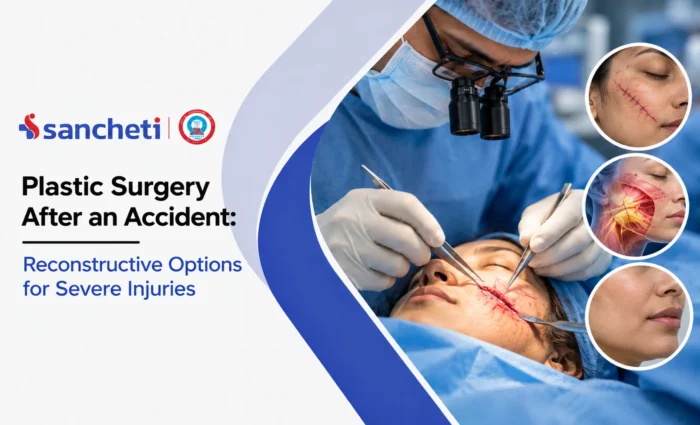

Plastic Surgery After an Accident: Reconstructive Options for Severe Injuries
Reconstructive plastic surgery after an accident restores what a severe injury has taken away, from exposed bone and torn tissue to complex facial and hand trauma. It rarely happens in a single operation.
For patients facing serious trauma, post-accident reconstructive surgery is a sequenced process, carefully planned across weeks or months. This guide explains how that process works and what patients can genuinely expect.
What Is Reconstructive Plastic Surgery After Accident Trauma?
Reconstructive plastic surgery after an accident is the surgical repair of tissue, bone, nerves, and blood vessels damaged in a traumatic injury, most often from road accidents, falls, or industrial incidents. It is distinct from emergency trauma care, which stabilises a patient and prevents immediate loss of life. Reconstruction begins once the patient is stable and focuses on restoring long-term form and function to the injured area.
The scope is broad by necessity, because severe accidents rarely damage a single, isolated structure. A road accident might combine an open leg fracture, a deep facial laceration, and nerve damage in the hand, each requiring a different surgical approach. Reconstructive teams work across the body, treating the face, hands, limbs, and trunk with the shared goal of restoring the patient’s independent function, not just closing wounds.
How Severe Accident Injuries Are Assessed and Prioritised
In the immediate aftermath of a serious accident, reconstructive planning follows, rather than competes with, life-saving emergency care. Once a patient is medically stable, the surgical team assesses the full extent of injury before deciding what needs to happen, and in what order.
- Immediate wound management: open wounds are cleaned and any dead or contaminated tissue removed, since infection is one of the biggest threats to a successful eventual reconstruction.
- Exposed bone or joint: an open fracture with bone visible through the skin needs coverage promptly, as delay significantly increases infection risk and complicates healing.
- Vascular assessment: confirming blood supply to an injured limb or digit is intact, or restoring it surgically, takes priority over most other reconstructive work.
- Deferred definitive repair: complex bone and soft tissue reconstruction is often deliberately delayed until swelling has settled and the wound has demonstrated it will not become infected.
Plastic Surgery for Accident Injuries: Body Regions Most Often Affected
Severe accidents produce a recognisable pattern of injury by body region, each requiring a distinct reconstructive approach.
| Region | Typical Injury | Reconstructive Focus |
|---|---|---|
| Face | Fractures, lacerations, soft tissue loss | Restoring bite, vision, and facial symmetry with minimal visible scarring |
| Hands | Crush injuries, tendon and nerve damage, amputation | Restoring grip, sensation, and fine motor function |
| Limbs | Open fractures, large soft tissue defects | Wound coverage, limb salvage, and restoring weight-bearing function |
| Scalp and skull | Avulsion injuries, soft tissue loss | Coverage using local tissue or free flap reconstruction |
| Trunk and genitalia | Blunt or penetrating soft tissue trauma | Wound closure and functional restoration, often requiring staged procedures |
Reconstructive Surgery for Severe Injuries: Core Techniques
- Skin grafting: a thin layer of skin covers a wound with a healthy blood supply beneath it; suited to superficial defects without exposed bone or tendon.
- Flap surgery: tissue with its own blood supply, including a free flap microsurgically reconnected at a distant site, covers deeper defects where bone, tendon, or joint is exposed.
- Nerve and vascular repair: severed nerves and blood vessels are reconnected under the microscope, essential for restoring both sensation and tissue viability.
- Bone fixation and grafting: fractured bone is stabilised with plates or external fixation, often coordinated directly with the plastic surgery team when soft tissue coverage is needed over the same site.
- Reimplantation: a severed finger, hand, or limb is surgically reattached when the amputated part and the patient’s condition make this viable.
The combination used depends entirely on the specific injury; most severe accident cases require more than one of these techniques working together.
Limb Salvage: Saving a Limb After Severe Trauma
Limb salvage is the deliberate attempt to save a severely injured limb from amputation through a combination of vascular repair, bone fixation, and soft tissue reconstruction. It is one of the most demanding areas of trauma reconstruction, requiring close coordination between orthopaedic and plastic surgery teams from the earliest hours after injury.
The decision to pursue limb salvage over amputation depends on several factors assessed together: whether blood supply to the limb can be restored or is already intact, the extent of nerve damage and whether meaningful sensation and function can realistically return, the condition of the remaining bone and soft tissue, and the patient’s overall medical stability. Limb salvage is not always the better outcome for every patient; a well-fitted prosthesis can sometimes offer better long-term function than a salvaged limb with limited sensation and mobility, and this trade-off is discussed openly with the patient wherever the decision is genuinely close.
Staged Reconstruction Pathway After a Major Accident
Complex accident reconstruction is almost never completed in a single procedure. A typical pathway for severe multi-region trauma unfolds over several distinct stages, each building on the one before it.
- Stage 1, damage control: within the first 24 to 72 hours, wounds are cleaned, unstable fractures are stabilised, and any threat to limb or life is addressed.
- Stage 2, definitive coverage: within one to two weeks, grafts or flaps close wounds that cannot heal on their own, using the technique best suited to what lies beneath each specific defect.
- Stage 3, secondary reconstruction: over the following months, further procedures address scar contractures, residual deformity, or function that has not returned as hoped.
- Stage 4, refinement: once healing is complete, scar revision or minor corrective procedures fine-tune the final result, sometimes a year or more after the original injury.
Post-Accident Reconstructive Surgery Recovery Timeline
Recovery from multi-stage trauma reconstruction spans a considerably longer timeline than a single planned procedure.
| Stage | Timeframe | Focus |
|---|---|---|
| Acute hospitalisation | 1-4 weeks | Wound stabilisation; initial coverage; close monitoring for infection or graft failure |
| Early rehabilitation | 1-3 months | Physiotherapy begins; splinting; scar and swelling management |
| Functional recovery | 3-12 months | Strength and mobility rebuild; secondary procedures planned if needed |
| Long-term review | 1-2 years | Assessment of final functional outcome; scar revision if appropriate |
A physiotherapist is involved from early in this pathway, since prolonged immobility after major trauma leads to stiffness and muscle loss that complicate every later stage of reconstruction.
Why Multidisciplinary Trauma Care Matters
India performed 6,77,040 surgical procedures in 2024, placing it seventh globally and accounting for 3.9% of the world’s surgical market. Severe accident cases rarely stay within one specialty’s remit; an orthopaedic surgeon stabilising a fracture, a plastic surgeon covering the wound, and a vascular surgeon repairing a damaged artery may all need to work on the same limb within hours of each other.
At Sancheti Hospital in Pune, plastic and reconstructive surgery works alongside orthopaedic trauma, hand and microvascular surgery, and faciomaxillary surgery under one coordinated system. For patients across Pune facing complex, multi-region trauma, this integration is what allows each stage of reconstruction to be planned with the whole injury in view, rather than one body part at a time.
Key Takeaways
- Reconstructive plastic surgery after an accident restores function and appearance following severe trauma, working alongside emergency and orthopaedic care rather than replacing it.
- Severe accidents often injure multiple body regions at once. Plastic surgery for accident injuries commonly addresses the face, hands, limbs, and trunk in a single coordinated treatment plan.
- Reconstructive surgery for severe injuries relies on a core set of techniques, grafts, flaps, nerve and vascular repair, and bone fixation, combined according to what each specific wound requires.
- Limb salvage weighs the chance of restoring meaningful function against the outcomes achievable with a well-fitted prosthesis, a decision made jointly with the patient rather than assumed by default.
- Post-accident reconstructive surgery is staged, typically progressing from damage control through definitive coverage to secondary reconstruction and, ultimately, refinement, often unfolding over a year or more.
- For an assessment after a severe accident, Sancheti Hospital, Pune provides coordinated trauma and reconstructive care.
Frequently Asked Questions (FAQs)
Q1. How soon after an accident does reconstructive surgery begin?
It depends on what the injury needs. Life-threatening problems are addressed immediately as part of emergency trauma care, before any reconstructive planning begins. Once the patient is stable, wound cleaning and initial stabilisation, including coverage of any exposed bone, typically happen within the first few days, since delay significantly increases infection risk. More complex, definitive reconstruction, the specific flap or graft that will provide lasting coverage, is often deliberately planned for one to two weeks after injury, allowing swelling to settle and giving the surgical team a clearer picture of exactly what tissue has survived and what has not.
Q2. Will I need more than one surgery after a severe accident?
For significant trauma involving deep wounds, exposed bone, or multiple injured areas, yes, more than one procedure is the norm rather than the exception. The staged approach exists because different aspects of recovery genuinely need to happen at different times: initial wound stabilisation cannot safely be combined with definitive reconstruction, and secondary procedures to address contractures, residual deformity, or incomplete function often cannot be assessed accurately until the initial healing has fully settled, sometimes several months later. This is a planned, deliberate pathway rather than a sign that earlier surgery went wrong. Patients are generally given a realistic outline of the expected number of stages early in their treatment, though the exact plan often adapts as healing progresses.
Q3. How is the decision made between trying to save an injured limb and amputation?
This is one of the most difficult decisions in trauma reconstruction, and it is made jointly by the surgical team and the patient wherever time allows, based on a realistic assessment of several factors together. These include whether blood supply to the limb is intact or can be restored, how much nerve damage has occurred and whether useful sensation and movement are likely to return, the condition of the remaining bone and soft tissue, and the patient’s overall medical fitness for a long reconstructive process. It is worth understanding that saving a limb is not automatically the better outcome for every patient; a limb with intact bone and skin but no meaningful sensation or movement can sometimes provide a worse quality of life than a well-fitted prosthesis, which is why this decision is discussed honestly rather than assumed.
Q4. Will I regain full function and appearance after reconstructive surgery for a severe injury?
Most patients regain substantial function and a good cosmetic result, but perfect restoration to the pre-accident state is not always achievable, particularly after very severe or multi-region trauma. The goal of reconstruction is to restore the closest possible version of normal function and appearance, not to guarantee an outcome indistinguishable from before the injury. Scarring, some degree of altered sensation, and residual stiffness in severely injured joints are common even after technically excellent surgery. What varies most between patients is how much function returns, which depends heavily on the severity of the original injury, how quickly reconstructive care began, and how consistently the patient engages with the rehabilitation programme that follows every stage of surgery.
Q5. What can I do during recovery to get the best possible outcome from reconstructive surgery?
Consistent engagement with physiotherapy from the earliest stage it is safely permitted is the single most influential factor within a patient’s control. Prolonged immobility after major trauma causes stiffness, muscle wasting, and joint contracture that can undo much of what reconstructive surgery achieves if rehabilitation is neglected. Following wound care and activity restrictions precisely, particularly around a healing graft or flap, protects the surgical result during its most vulnerable early weeks. Attending every scheduled follow-up allows the team to catch problems, such as early signs of infection or reduced blood flow to a flap, while they are still easily addressed. Nutrition also matters more than many patients expect, since adequate protein intake directly supports the tissue healing that every stage of reconstruction depends on.