Home
Home PG College
 Patient Login
 Sancheti Clinic
 Contact Us
 Download Reports
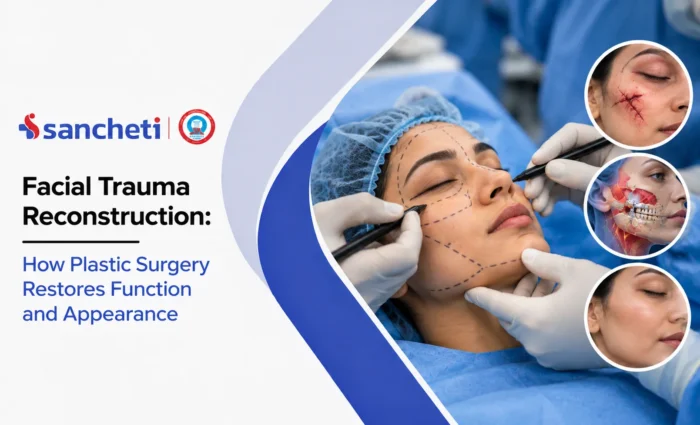

Facial Trauma Reconstruction: How Plastic Surgery Restores Function and Appearance
Facial trauma reconstruction repairs the fractures, lacerations, and soft tissue damage that follow a severe injury to the face, restoring both how a person looks and how their face actually functions.
The face is unusually dense with structures that must work together: bone that supports the eyes and jaw, nerves that carry feeling and movement, and skin that shows every expression a person makes. This guide explains how facial reconstruction surgery approaches this complexity, and what treatment actually involves.
What Is Facial Trauma Reconstruction?
In India, road traffic accidents cause 72% of maxillofacial trauma, with two-wheeler accidents accounting for 70% of cases. Facial trauma reconstruction is the surgical repair of injuries to the bones and soft tissue of the face, most commonly following road accidents, falls, assaults, or sports collisions. It covers two distinct but interconnected problems: broken facial bones, including the jaw, cheekbone, nose, and the delicate bones around the eye, and soft tissue injuries such as deep lacerations, torn tissue, and nerve damage.
The goal is never appearance alone. A misaligned jaw affects chewing and speech. A fracture around the eye socket can trap eye muscles and cause double vision if left uncorrected. A facial nerve injury can leave one side of the face unable to move. Reconstruction is planned around restoring these functions first, with facial symmetry and appearance addressed as part of the same surgical plan rather than as an afterthought treated separately once the functional repair is complete.
Common Causes and Types of Facial Injuries
Road traffic accidents and falls account for the majority of severe facial trauma, followed by sports collisions and assaults. The injury pattern varies with the mechanism: a direct blow tends to fracture the cheekbone or nose. At the same time, high-speed impacts more often produce complex, multi-bone fractures affecting several areas of the face at once and requiring a more involved surgical plan.
- Fractures: the jaw (mandible), upper jaw (maxilla), cheekbone (zygoma), nasal bone, and the thin bones around the eye socket (orbit) are the most commonly broken areas.
- Soft tissue injuries: lacerations, torn or avulsed tissue, and injuries affecting the eyelids, lips, or ears, often occurring alongside bone fractures rather than in isolation.
- Nerve injuries: damage to nerves controlling facial movement or sensation, which can affect the ability to smile, blink, or feel touch on the skin.
- Panfacial trauma: severe, high-energy injuries fracturing multiple facial regions simultaneously, requiring the most complex and carefully sequenced reconstruction.
How Facial Trauma Surgery Is Planned
Planning begins with imaging. CT scanning with three-dimensional reconstruction has replaced plain X-rays as the standard for facial trauma, giving the surgical team a precise map of every fracture before any incision is made. This detail matters enormously in a region where bones are thin, closely packed, and sit next to structures like the eye and major nerves.
The surgical team then works through the face systematically, usually starting with a soft tissue assessment and using it to guide whether underlying fractures need surgical fixation or will heal on their own. For fractures requiring surgery, the approach is chosen to minimise visible scarring wherever possible; for example, a jaw fracture is often repaired through an incision inside the mouth rather than through the skin. Complex, multi-region injuries are addressed in a deliberate sequence, since correcting one area first often re-establishes the landmarks needed to align the rest of the face accurately.
Facial Reconstruction Surgery: Bone and Soft Tissue Techniques
- Closed reduction: for simpler, non-displaced fractures, the bone is manually repositioned without an incision, most common for straightforward nasal fractures.
- Open reduction and internal fixation (ORIF): for displaced or complex fractures, the bone is surgically exposed, realigned, and secured with titanium plates and screws small enough to leave permanently in place.
- Bone grafting: when bone is lost, particularly in severe jaw injuries, a graft from elsewhere in the body restores the missing structure; free flap tissue transfer is used for the most extensive bone loss.
- Soft tissue repair: layered closure of lacerations, careful realignment of torn tissue, and microsurgical nerve repair where sensation or facial movement has been affected.
Custom 3D-printed surgical guides and pre-bent plates, planned from the patient’s own CT scan, are increasingly used for complex cases, allowing more accurate bone repositioning than freehand techniques alone.
Why Timing Matters in Facial Injury Surgery
Timing in facial injury surgery is not a minor logistical detail; it materially affects the outcome. Most facial fractures are ideally treated within the first one to two weeks of injury, while the bone fragments are still mobile and before soft tissue has begun to scar and heal around them in the wrong position.
- True emergencies (within 24 hours): an orbital floor fracture that has trapped eye muscle requires urgent surgery to prevent permanent double vision; open mandible fractures also benefit from early fixation to reduce infection risk.
- Early but not emergency (within 1-2 weeks): most displaced facial fractures fall into this category and need repair before healing begins in a misaligned position.
- Occasionally delayed by design: a short delay for some cheekbone fractures allows swelling to settle, giving the surgeon a clearer view of the true bony position.
Waiting significantly beyond these windows, once bone has begun healing in a displaced position, turns a relatively straightforward repair into a far more complex secondary reconstruction.
Types of Facial Fractures and Their Treatment
Each fracture site behaves differently and calls for a specific surgical approach.
| Fracture Site | Common Symptom | Typical Treatment |
|---|---|---|
| Nasal bone | Deformity, nasal obstruction, bleeding | Closed reduction for simple fractures; septoplasty if breathing is affected |
| Zygoma (cheekbone) | Facial flattening, numbness below the eye | ORIF via small incisions, often near the eyebrow or inside the mouth |
| Orbital floor | Double vision, sunken eye appearance | Urgent surgery if muscle is trapped; otherwise repaired with a supporting implant |
| Mandible (jaw) | Misaligned bite, difficulty opening the mouth | ORIF with titanium plates, usually via an inside-the-mouth approach |
| Maxilla (upper jaw) | Facial instability, altered bite | ORIF, often combined with mandibular fixation to restore correct bite alignment |
Recovery After Facial Trauma Reconstruction
Recovery depends on the severity and number of areas involved, ranging from a simple nasal fracture to complex panfacial repair.
| Stage | Timeframe | Focus |
|---|---|---|
| Immediate post-operative | 1-2 weeks | Swelling reduction; wound care; soft diet if jaw fractures were repaired |
| Early healing | 2-6 weeks | Bone consolidation begins; follow-up imaging to confirm alignment |
| Functional recovery | 6-12 weeks | Return to normal diet and activity; monitoring for nerve or sensation recovery |
| Long-term review | 3-12 months | Assessment of facial symmetry, scar maturation, and any residual nerve deficit |
Facial swelling and bruising typically peak around 48 to 72 hours after surgery before gradually improving over the following one to two weeks. Numbness in the treated area is common initially and often improves over several months as injured nerves recover, though some sensory change can persist depending on the severity of the original nerve injury.
Why Multidisciplinary Care Matters
Facial trauma rarely stays within the boundaries of a single specialty. A fracture around the eye involves the plastic surgery and ophthalmology teams together. A jaw fracture affecting the teeth and bite needs input from oral and maxillofacial surgery alongside dentistry. Severe soft tissue loss may need the microsurgical expertise typically associated with limb reconstruction, applied instead to the face.
At Sancheti Hospital in Pune, facial trauma is managed through the Faciomaxillary Surgery department working alongside plastic and reconstructive surgery and the hospital’s broader trauma services. For patients across Pune presenting with complex facial injuries, this coordinated approach allows bone fixation, soft tissue repair, and dental alignment to be planned as one integrated treatment rather than a series of separate referrals.
Key Takeaways
- Facial trauma reconstruction repairs both the bone and soft tissue damage from a severe facial injury, restoring function, such as chewing, vision, and facial movement, alongside appearance.
- The jaw, cheekbone, nose, and the bones around the eye are the most commonly fractured facial structures, each requiring a distinct surgical approach based on its location and function.
- CT imaging with 3D reconstruction is now standard for planning facial trauma surgery, replacing older plain X-ray techniques and allowing far more precise surgical planning.
- Timing genuinely matters. Most facial fractures are best treated within one to two weeks, and certain injuries, particularly a trapped eye muscle after an orbital fracture, are true 24-hour surgical emergencies.
- Facial injury surgery is rarely a single-specialty procedure. Plastic surgery, maxillofacial surgery, and ophthalmology frequently work together on complex cases involving multiple facial structures.
- For an urgent assessment of a facial injury, Sancheti Hospital, Pune provides integrated trauma and reconstructive care.
Frequently Asked Questions (FAQs)
Q1. How urgent is facial trauma surgery? Can it wait a few days?
It depends entirely on which structure is injured. A small number of facial injuries are true emergencies requiring treatment within 24 hours, most notably an orbital fracture that has trapped the muscle controlling eye movement, since delay risks permanent double vision or restricted eye movement. Open fractures of the jaw also benefit from prompt fixation to reduce infection risk. Beyond these specific emergencies, most facial fractures are best treated within the first one to two weeks after injury, while bone fragments remain mobile and before surrounding soft tissue has scarred into a fixed position. This is not the same urgency as a same-day emergency, but it is a genuine treatment window rather than an open-ended one. Any significant facial injury should be assessed promptly so the surgical team can determine which category it falls into.
Q2. Will facial reconstruction surgery leave visible scars?
Surgeons deliberately choose incision locations to minimise visible scarring wherever the fracture allows it. Many jaw fractures are repaired entirely through incisions inside the mouth, leaving no visible external scar at all. Fractures around the eye or cheekbone are often approached through incisions hidden within the eyebrow, the lower eyelid crease, or inside the mouth. Where an external incision on visible skin is unavoidable, typically for significant lacerations from the original injury rather than the surgery itself, careful layered closure and scar management techniques are used to minimise the eventual appearance. It is worth understanding that scarring from the original traumatic injury, a laceration from glass or impact, is usually more visible than scarring from the planned surgical incisions used to repair the underlying fracture.
Q3. Will my face look and feel completely normal after facial trauma reconstruction?
Most patients regain very good facial symmetry and function after appropriately timed and executed reconstruction, but perfect restoration to pre-injury appearance is not always achievable, particularly after severe, high-energy trauma. Numbness in the treated area is common in the weeks after surgery and typically improves over several months as nerves recover, though some residual sensory change can persist, especially after significant nerve injury. Subtle asymmetry can remain in complex, multi-fracture cases even with excellent surgical technique, since the face has very little tolerance for even millimetre-level displacement before it becomes noticeable. Setting realistic expectations before surgery, based on the specific injuries involved, is part of a thorough consultation, and most patients are satisfied with the functional and aesthetic outcome achieved.
Q4. Do I need general anaesthesia for facial trauma reconstruction, and how long does surgery take?
Most facial fracture repairs are performed under general anaesthesia, given the precision required and the proximity of facial structures to the airway. A single, straightforward fracture such as an isolated nasal or zygomatic fracture may take one to two hours in surgery. Complex or multi-region injuries, particularly panfacial trauma involving several fractures simultaneously, can take considerably longer, sometimes several hours, since each area needs to be repaired in a specific sequence to re-establish accurate facial alignment. The anaesthetic team works closely with the surgical team throughout, and for patients with associated injuries from the same accident, such as a head injury, the timing and sequencing of facial surgery is coordinated with the wider trauma team’s overall treatment plan.
Q5. What happens if a facial fracture is left untreated or treatment is delayed too long?
Facial bones, like any other bone, begin healing from the moment of injury, and if a fracture is not repaired within the appropriate window, it can heal in a displaced, misaligned position. Once this occurs, correcting it requires a considerably more complex secondary procedure: the healed bone often needs to be surgically re-broken (osteotomy) before it can be repositioned correctly, a more demanding operation than treating the original fresh fracture would have been. Functional consequences also compound over time; an untreated jaw malalignment affects chewing and can lead to long-term dental problems, and an unaddressed orbital fracture with trapped muscle can cause permanent double vision rather than a temporary one. Prompt assessment after any significant facial injury, even if symptoms seem manageable initially, is the best way to avoid this more difficult secondary reconstruction.