Home
Home PG College
 Patient Login
 Sancheti Clinic
 Contact Us
 Download Reports
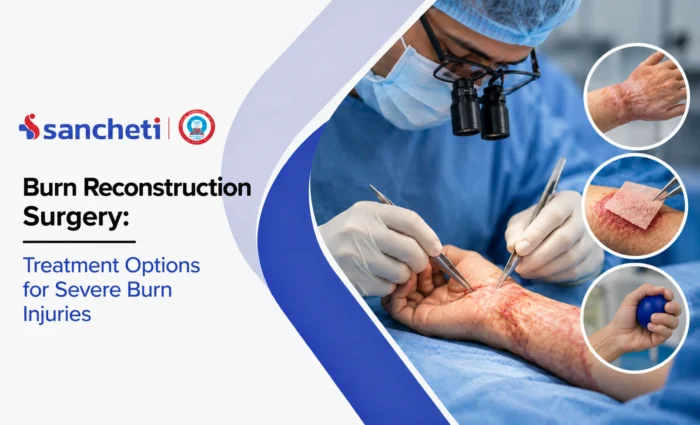

Burn Reconstruction Surgery: Treatment Options for Severe Burn Injuries
Burn reconstruction surgery restores movement and function to areas left stiff, scarred, or deformed by a severe burn injury. Close to one in three burn survivors develops a contracture, scar tissue that tightens and restricts joint movement, sometimes years after the original wound has closed.
Burn reconstruction addresses this second, longer battle. This guide explains how burns cause lasting deformity, when surgery becomes necessary, and what treatment actually involves.
What is Burn Reconstruction Surgery?
India sees 6-7 million burn injuries annually, with contracture management accounting for 50% of plastic surgeons’ workload. Burn reconstruction surgery is a branch of plastic surgery focused on correcting the functional and structural problems that remain after a burn wound has healed. Initial burn care closes the wound and saves the patient’s life. Reconstruction addresses what comes after: scar tissue that has tightened across a joint, skin that has fused fingers together, or tissue that has pulled the eyelid, lip, or neck out of its normal position.
The distinction matters because burn wounds heal by scarring, and scar tissue naturally contracts as it matures over the following months. A wound that closed with good initial coverage can still develop a disabling contracture later, particularly over a joint, where the tightening scar physically prevents the joint from moving through its normal range. Reconstruction is not a failure of the original burn care; it is a planned, often necessary second stage of treatment.
How Burns Cause Long-Term Deformity
A burn injury damages skin and, in deeper burns, the tissue beneath it. As the wound heals, the body lays down collagen to close the gap, and this new tissue is denser and less elastic than normal skin. Over the following months, this scar tissue continues to remodel and, in the process, contracts.
When a burn crosses a joint, such as the elbow, knee, neck, or the webbing between fingers, this natural contraction pulls the joint into a fixed position, often preventing full extension or flexion. Contractures can also affect the eyelids, mouth, and neck, restricting eating, speech, or the ability to look up or turn the head. The size of the original burn does not always predict the severity of the resulting deformity; even a moderate burn crossing a joint can produce a significant functional contracture if it is not managed proactively during healing.
When Burn Reconstruction Surgery is Needed
Not every burn scar requires surgery. Reconstruction becomes necessary when scarring is restricting movement, function, or appearance in a way that non-surgical treatment cannot adequately resolve.
- Joint contracture limiting movement: a scar band across the elbow, knee, neck, or fingers that prevents the joint from reaching its normal range, despite structured physiotherapy and splinting.
- Fused fingers or toes (syndactyly): webbing caused by adjacent burned surfaces healing together, restricting individual finger movement and grip.
- Facial and eyelid contractures: scarring that pulls the eyelid away from the eye (ectropion) or restricts mouth opening, affecting eye protection, eating, or speech.
- Hypertrophic or unstable scars: thickened, painful, or repeatedly breaking-down scar tissue that has not responded to conservative scar management.
- Significant aesthetic deformity: scarring in visible areas causing substantial psychological distress, where reconstruction can meaningfully improve quality of life.
Types of Reconstructive Surgery for Burns
The approach depends on which body area is affected and how the contracture is structured.
| Area Affected | Common Deformity | Typical Reconstructive Approach |
|---|---|---|
| Hand and fingers | Flexion contracture, syndactyly (webbed fingers) | Contracture release, syndactyly separation, skin grafting or flap coverage |
| Neck | Contracture limiting head movement | Scar release with flap reconstruction; grafts recontract more often here |
| Elbow and knee | Flexion contracture limiting joint extension | Z-plasty for narrow bands; release with grafting for broader scars |
| Face and eyelids | Ectropion, restricted mouth opening | Local flap reconstruction; grafting where local tissue is unavailable |
| Axilla (armpit) | Restricted shoulder abduction | Contracture release with flap coverage to resist recontraction |
Burn Surgery Techniques: Release, Grafts, and Flaps
Most burn surgery for established contractures follows the same basic sequence: releasing the tight scar tissue, then covering the resulting defect so the scar cannot simply reform in the same position.
- Z-plasty: a technique that redistributes a narrow, linear scar band along a different angle, lengthening it and reducing tension across the joint; well-suited to narrow contracture bands rather than broad areas of scarring.
- Skin grafting: after releasing a broader contracture, a split-thickness graft covers the defect; simpler to perform but carries a meaningfully higher chance of the contracture recurring over time.
- Flap reconstruction: tissue with its own blood supply and underlying fat is used to cover the release site; because flap tissue is more pliable and resists the contraction that grafts are prone to, recontracture rates are significantly lower with flaps than with grafts.
- Minimally invasive release: newer techniques allow certain narrow contracture bands to be released through a small incision without an open surgical approach, shortening recovery for suitable cases.
Staged Reconstruction: Why Burn Surgery Often Takes Multiple Procedures
Complex burn reconstruction is rarely completed in a single operation. Extensive burns, particularly those affecting multiple joints, the face, or a large body surface area, are typically managed through a series of planned procedures spread over months or, in the most complex cases, years.
This staged approach exists for practical reasons. Tissue needs time to heal and settle between procedures before the next stage can proceed safely. Growing children with burn scars often need repeat releases as they grow, since scar tissue does not lengthen at the same rate as growing bone. And in areas like the hand, where multiple structures including skin, tendons, and joints may all be affected, addressing everything in one operation increases surgical risk without necessarily improving the outcome. A staged plan, agreed at the outset with the patient, allows each procedure to build on the results of the one before it.
Recovery After Burn Reconstruction
Recovery involves both the surgical site healing and a structured rehabilitation programme to preserve the movement the surgery has restored.
| Stage | Timeframe | Focus |
|---|---|---|
| Immediate post-operative | 1-2 weeks | Wound protection; splinting to maintain the corrected joint position |
| Early rehabilitation | 2-6 weeks | Physiotherapy begins; scar massage; gradual, guided joint movement |
| Scar maturation | 3-12 months | Pressure garments, silicone therapy, continued splinting to limit recontraction |
| Long-term review | Ongoing | Monitoring for recurrence, especially in growing children or high-tension areas |
Physiotherapy is not optional after burn reconstruction. Scar tissue continues to remodel for up to a year after surgery, and without consistent stretching and splinting during this window, the contracture can begin to return even after a technically successful release. A physiotherapist experienced in burn rehabilitation guides this process alongside the surgical team.
Why Early Intervention Matters
The best outcomes in burn reconstruction come from addressing contractures before they become severe, rather than waiting until movement is completely lost. Splinting, positioning, and physiotherapy started during the initial burn healing phase can prevent many contractures from developing at all, or limit their severity enough that surgery, if needed later, is more straightforward.
At Sancheti Hospital in Pune, plastic and reconstructive surgery for burns is integrated with the hospital’s broader trauma and rehabilitation services, allowing scar management and physiotherapy to begin early rather than being added on after a contracture has already become established. For patients across Pune and the surrounding region, this coordinated approach, combining plastic and reconstructive surgery with structured rehabilitation, is what determines whether a burn heals into a stiff, restricted joint or a functional one.
Key Takeaways
- Burn reconstruction surgery addresses the contractures, scarring, and structural deformity that can develop after a burn wound has already healed. It is a planned, often necessary continuation of burn care, not a sign that the original treatment failed.
- Nearly one in three burn patients develops a contracture. Joints, the neck, and the hands are affected most often because scar tissue naturally tightens as it matures over the following months.
- Reconstructive surgery for burns follows a consistent principle: release the tight scar tissue, then cover the defect with a graft or flap. Flaps carry a significantly lower risk of the contracture recurring than grafts.
- Complex burn surgery is often staged across multiple procedures over months or years, particularly for extensive burns, growing children, or areas involving several structures such as the hand.
- Physiotherapy and splinting are essential both before and after surgery. Scar tissue remodels for up to a year post-surgery, and consistent rehabilitation prevents contracture from returning.
- For an assessment of a burn scar or contracture, Sancheti Hospital offers integrated reconstructive surgery and rehabilitation. Book a consultation in Pune.
Frequently Asked Questions (FAQs)
Q1. How long after a burn heals can a contracture still develop?
Contractures can develop for up to a year or more after the original burn wound has closed, which surprises many patients who assume the risk has passed once the skin has healed. Scar tissue continues to remodel and mature for several months after wound closure, and it is during this remodelling phase that the tightening responsible for contractures actually occurs. This is why splinting, stretching, and pressure therapy are recommended for months after a burn has healed, not just during the acute wound care period. A joint that moves normally at six weeks can still develop a significant contracture by six months if the scar is not actively managed during this window. Anyone with a burn that crossed a joint should continue scar management and monitor joint movement well beyond the point the wound itself looks healed.
Q2. Can burn contractures be prevented, or is surgery eventually inevitable?
Many contractures can be prevented or significantly reduced with proactive management started early, and surgery is not an inevitable outcome for every significant burn. Positioning the affected area to counteract the direction scar tissue tends to pull, splinting joints in an extended or neutral position during healing, and starting gentle range-of-motion exercises as soon as the wound allows are the core preventive measures. Pressure garments and silicone sheeting, used consistently during the scar maturation phase, also reduce the thickness and tightness of the resulting scar. Not every contracture is preventable, particularly with very deep or extensive burns, but consistent early intervention meaningfully reduces both the likelihood of needing surgery and the extent of surgery required if it does become necessary. This is why burn rehabilitation should begin as soon as the wound is stable, not after a contracture has already formed.
Q3. Will burn reconstruction surgery remove the scar completely?
No, and setting this expectation clearly before surgery avoids disappointment. Burn reconstruction surgery is designed to restore movement and function, and to improve the appearance and quality of the scar, but it does not erase scarring entirely. A release procedure replaces a tight, restrictive scar with tissue, either a graft or a flap, that allows normal movement, but that new tissue and the surrounding healed skin will still show visible evidence of the original injury. What changes meaningfully is function: a joint that could not extend now can, fingers that were webbed together now move independently, an eyelid that could not close now protects the eye. For patients whose primary concern is functional restriction, this represents a major improvement even though the area will not look identical to unburned skin.
Q4. Is burn reconstruction surgery painful, and what is the recovery like?
Post-operative discomfort after burn reconstruction is generally well managed with standard pain control protocols and is comparable to other reconstructive procedures involving grafts or flaps. The recovery that patients often find more demanding than the surgery itself is the rehabilitation phase: splinting, stretching, and scar massage need to be done consistently, sometimes for uncomfortable stretches at a time, to prevent the released contracture from beginning to reform. This period requires real commitment from the patient, and results are consistently better in those who follow the prescribed physiotherapy programme closely. Pressure garments, worn for much of the day over many months, can be physically uncomfortable and are also part of standard recovery for many burn reconstruction procedures. The surgical pain resolves in weeks; the rehabilitation discipline needs to continue for considerably longer.
Q5. My child has a burn scar that is growing tighter as they grow. Is this normal?
This is a recognised pattern in paediatric burn scars and is one of the reasons children with significant burns often need more than one reconstructive procedure over childhood. Scar tissue does not lengthen at the same rate as a growing child’s bones, so a scar that was adequately positioned and non-restrictive at age four can become a functional contracture by age eight simply because the surrounding normal tissue and bone have grown while the scar has not kept pace. This is not a sign that the original treatment was inadequate; it is an expected feature of scar behaviour in a growing body. Children with burns crossing joints benefit from regular follow-up through their growth years specifically to catch this pattern early, since a smaller release procedure addressing an emerging contracture is generally more straightforward than waiting until movement is significantly restricted.