Home
Home PG College
 Patient Login
 Sancheti Clinic
 Contact Us
 Download Reports

Common Myths About Knee Replacement Surgery: Dr. Parag Sancheti Sets the Record Straight
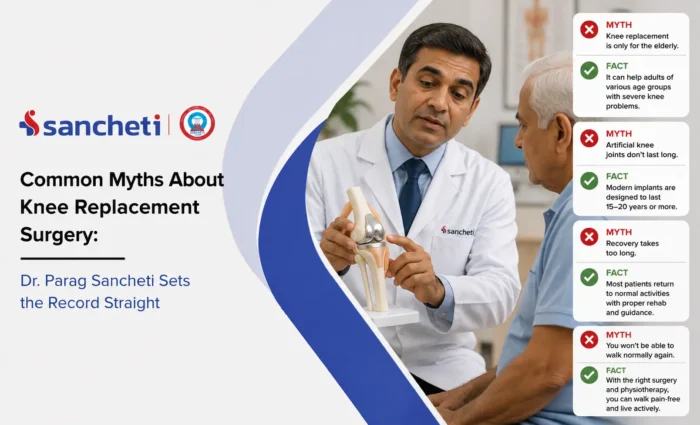
The decision to have knee replacement surgery is frequently made harder than it needs to be. Patients delay surgery that could transform their quality of life because they believe knee replacement myths that no longer reflect the reality of modern implants, modern surgical techniques, or modern recovery protocols.
Dr. Parag Sancheti, Chairman and Managing Director of Sancheti Hospital, Pune, with over 34 years of knee surgery experience, addresses the most persistent knee replacement myths directly. This article discusses each one in depth to ensure that patients make informed decisions.
What Knee Surgery Misconceptions Actually Cost Patients
Knee surgery misconceptions don’t just cause mild inconvenience; they cause harm. A patient who delays knee replacement because they believe the implant lasts only 10 years, or that recovery will take months, or that they are too old for surgery, spends additional years in pain-limited function, losing muscle mass, gaining weight, and progressively deconditioning. By the time they eventually arrive for surgery, their baseline fitness is worse, their muscles are more atrophied, and their recovery is harder than it would have been had they come earlier.
The truth about knee replacement surgery, grounded in data from modern implant registries and outcomes studies, is considerably more encouraging than the myths suggest. Implants last 20 years or more for most patients. Walking begins within hours of surgery. Most patients return to activities they had given up years earlier. Fear based on outdated information is one of the most preventable barriers to life-changing treatment.
Six Common Myths and Clinical Facts
The most commonly held misconceptions about knee replacement, and what the evidence actually shows.
| The Myth | The Clinical Reality |
|---|---|
| I’m too young for knee replacement | Age alone is not a criterion. Disease severity, functional impairment, and failure of conservative care determine candidacy. Patients in their 40s and 50s with end-stage OA are appropriate candidates. |
| I’m too old; surgery is too risky | No upper age limit exists. Functional fitness, cardiovascular health, and what the patient stands to gain matter more than birth year. Patients in their 80s achieve significant, comparable improvements. |
| The implant will wear out in 10-15 years | Modern implants have over 90% survivorship at 20 years. This figure is from current-generation materials, not the first-generation implants of decades ago. |
| Recovery takes many months and is very painful | Walking begins on Day 1. Most patients return to daily activities within 4-6 weeks. Modern pain management including nerve blocks significantly reduces post-operative pain. |
| You won’t be able to be active afterwards | Low-impact activities including swimming, cycling, golf, and walking are strongly encouraged. Most patients are significantly more active than they were in the years before surgery. |
| Knee replacement removes large sections of bone | Only 2-10 mm of damaged surface bone is removed. The procedure is a resurfacing, not a bone removal. Most ligaments and tendons are preserved. |
Setting Record Straight About Age
The belief that knee replacement is a procedure for a specific age bracket, typically framed as either too young or too old, is perhaps the most consequential myth in knee surgery. It causes younger patients to delay surgery and accept years of deteriorating function while waiting to reach the right age. It causes older patients to dismiss surgery as an option that is no longer available to them.
For younger patients: the concern about implant longevity is understandable, but outdated. Modern implants are designed for 20-25 years of survivorship, and when revision surgery is eventually needed, it is almost always to a straightforward standard revision procedure rather than a complex reconstruction. Waiting until 70 to operate on a 55-year-old who cannot walk without pain means surrendering 15 years of functional life. For older patients: study after study confirms meaningful functional improvement in adults in their 70s, 80s, and beyond (PMC, 2023). The relevant assessment is surgical fitness, not age.
Myth About Implant Lifespan
This myth is grounded in a real historical truth: the first generation of knee replacement implants, used from the 1970s through the 1990s, had considerably shorter functional lifespans than modern devices. Patient recall of older relatives who had revisions, or older information absorbed from online searches, accurately describes that era. It does not describe the current state of implant technology.
Modern implant materials, including highly cross-linked polyethylene, cobalt-chrome and titanium alloy components, and ceramic coatings, are engineered to sustain loading for decades. Registry data from national joint replacement registries consistently shows over 90% survivorship at 20 years. Sancheti Hospital’s Joint & Knee Replacement Department performs over 2,200 knee procedures annually using current-generation implants with long-term monitoring.The practical implication is significant: patients should not delay surgery assuming they will need revision within a decade. For most patients, the implant will outlast the point at which revision becomes a practical concern.
Recovery Is Long and Painful Myth
Fear of a prolonged, painful recovery is one of the most common reasons patients delay seeking surgical assessment. This fear is based on a version of knee replacement recovery that is now 20 years out of date. The defining features of modern recovery bear almost no resemblance to what patients remember hearing about from family or neighbours who had surgery in the 1990s.
Standing and walking begin within hours of surgery, on the same day or the morning after, not weeks later. Post-operative pain is managed through multimodal analgesia including spinal anaesthesia, long-acting nerve blocks, and precisely timed oral medications, producing a pain experience that most patients report as considerably less severe than they expected. Recovery does require commitment to physiotherapy.
A physiotherapist in Pune guides the progression from first steps to independent daily function. Patients who engage fully with the programme consistently reach milestones earlier than those who attend sporadically. Recovery isn’t long if done correctly; it is active and progressive from Day 1.
“You’ll Never Be Active Again” Myth
Many patients believe that choosing knee replacement surgery means accepting permanent restrictions on activity, as though the surgery trades pain for limitation. The clinical reality is the opposite. The most consistent finding across knee replacement outcome studies is that patients return to activities they had abandoned years before surgery, not that they trade one limitation for another.
Swimming, cycling, walking for extended distances, golf, gardening, climbing stairs without holding the rail, travelling, and attending family events without planning around pain levels are among the activities patients cite as restored after surgery.High-impact activities, including sustained running, contact sports, and heavy jumping, are discouraged because they accelerate implant wear, not because the knee cannot physically tolerate them. The advice is about maximising implant longevity, not about limiting function. The framing should be: you are gaining activity, with the specific guidance to preserve the implant that delivers it.
Surgery Should Be a Last Resort Myth
The instinct to exhaust every conservative option before considering surgery is reasonable in principle. The error is when this principle is applied so rigidly that it means years of inadequate function, progressive muscle loss, weight gain, and psychological impact from chronic pain before the surgical conversation is even started. By this point, the patient arrives for surgery significantly deconditioned compared with how they would have arrived if the conversation had happened earlier.
Surgery becomes appropriate when two conditions are met: imaging confirms advanced joint disease, and conservative management including physiotherapy, weight management, and injections has genuinely failed to provide adequate function. The timing is not about how long you have suffered; it is about whether the structural damage and functional impairment have reached the level where surgery offers the best available outcome. Delaying surgery beyond that point does not preserve options. A consultation at Sancheti Hospital’s Joint & Knee Replacement Department provides the assessment needed to answer this question clearly rather than continuing indefinitely with management that is no longer adequate.
Key Takeaways
- Knee replacement myths delay treatment that would significantly improve quality of life. Each year of avoidable pain carries a cost in muscle loss, weight gain, and deconditioning that makes eventual recovery harder.
- Age is not a criterion for or against knee replacement. Disease severity, functional impairment, and surgical fitness determine candidacy. Patients in their 40s and their 80s both achieve excellent outcomes when appropriately selected.
- Modern knee implants have over 90% survivorship at 20 years. The 10-15 year myth reflects first-generation devices from decades ago, not the materials and designs used today.
- Walking begins within hours of surgery. Recovery is active and progressive from Day 1. The recovery is demanding; it is not prolonged bed rest.
- Knee replacement restores activity rather than restricting it. Patients return to swimming, cycling, golf, and travel. The guidance to avoid running is specifically to protect implant longevity, not to restrict function.
- To have an honest, evidence-based conversation about whether knee replacement is right for you, book a consultation at Sancheti Hospital, Pune.
Frequently Asked Questions (FAQs)
Q1. How do I know if I’m actually ready for knee replacement surgery, rather than just being told I need it?
The right question is whether your knee pain significantly limits your daily life despite a genuine trial of conservative management. Genuine conservative management means structured physiotherapy for several months, weight management where relevant, and at least one intra-articular injection, with its effect assessed. If you have done these things and are still unable to walk comfortable distances, climb stairs without significant pain, sleep without being woken by the knee, or carry out daily activities without planning around your pain levels, the conservative management phase has run its course. An X-ray confirming Grade 3-4 OA alongside these functional limitations is the standard indication for surgical discussion. Imaging alone, the passage of time alone, or a family member’s urgency are not appropriate bases for the decision. The conversation belongs between you and a knee specialist.
Q2. Will my knee replacement set off metal detectors at airports?
It may, depending on the detector’s sensitivity and the specific implant. Modern knee implants are made from metal alloys (cobalt-chrome, titanium) that standard airport security equipment can detect. Many patients are asked to step aside for a manual check, which takes a few minutes. Some airports and security systems are less sensitive, and the implant may pass without triggering an alert. This is a minor practical consideration, not a reason to avoid surgery or a meaningful quality-of-life concern. Your surgeon will provide documentation confirming you have an orthopaedic implant, which most airports accept as an explanation for any detector response. Some patients choose to proactively show this letter before walking through the detector to streamline the process. It does not meaningfully restrict air travel.
Q3. Do both knees need to be replaced at the same time if both are arthritic?
Not necessarily. Bilateral simultaneous knee replacement, performing both knees in one surgical session, is technically feasible and is performed in selected patients. The advantage is a single recovery period, single anaesthetic exposure, and a single rehabilitation course. The disadvantages are greater physiological stress than with unilateral surgery, more demanding rehabilitation because neither leg is available as the supporting limb during early recovery, and a modestly higher surgical risk. The more common approach is staged bilateral replacement, replacing one knee and allowing it to recover fully before replacing the second. The appropriate approach depends on the relative severity in each knee, the patient’s age and fitness, and the anaesthetic risk assessment. Most patients with bilateral severe OA are staged rather than done simultaneously, but this is an individual decision made with the surgical team.
Q4. I am 78 years old, and my family says I am too old for surgery. What is the clinical view?
The clinical view is that 78 is not too old if you are functionally mobile, not suffering from uncontrolled serious medical comorbidity, and are motivated to participate in the rehabilitation that follows. Age by itself is not a surgical contraindication. The relevant assessment is of your cardiovascular fitness, anaesthetic risk, bone quality for implant fixation, and overall resilience for the recovery period. We assess these formally with a pre-operative medical review. Multiple outcome studies confirm that adults in their late 70s and 80s achieve significant improvements in pain and function following knee replacement when appropriately selected. The question to discuss with your surgeon is not your age but your fitness, your functional goals, and what the surgery can realistically offer you given your overall health picture.
Q5. I’ve heard the artificial knee won’t feel natural. Will I always be aware that it’s there?
Most patients report that the knee feels natural within six to twelve months of surgery, and many describe it as feeling better than anything they have experienced in years because chronic pain has been eliminated. The early post-operative period feels different: the knee is stiff, the surrounding tissues are healing, and the nervous system is adapting to the new joint mechanics. This phase typically lasts three to six months. Beyond that, the majority of patients stop being consciously aware of the implant during normal daily activities. A minority of patients do report a persistent mechanical quality to the knee’s feel, more common with older implant designs. The current generation of cruciate-retaining designs, which preserve the posterior cruciate ligament, are specifically engineered to maintain more natural joint kinematics, which most patients and surgeons find produces a more natural post-surgical knee sensation.