Home
Home PG College
 Patient Login
 Sancheti Clinic
 Contact Us
 Download Reports
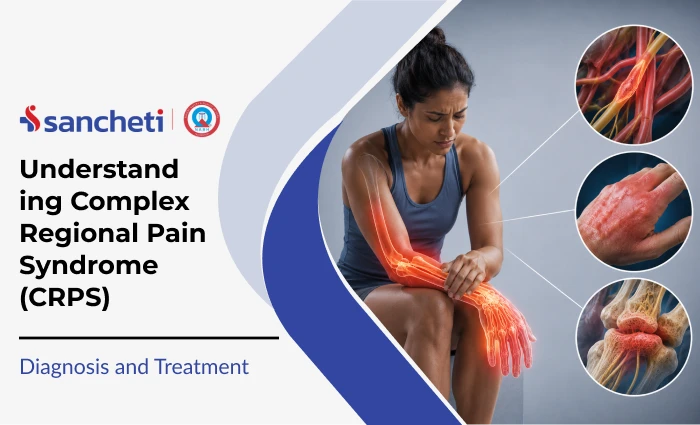

Understanding Complex Regional Pain Syndrome (CRPS): Diagnosis and Treatment
Complex regional pain syndrome (CRPS) is a chronic nerve pain disorder causing severe, persistent pain in a limb that is disproportionate to whatever injury triggered it, often accompanied by changes in skin colour, temperature, swelling, and movement.
It usually follows a fracture, surgery, or even a relatively minor injury, and despite affecting just one limb, it can become one of the most disabling chronic pain conditions a person experiences.
At Sancheti Hospital, Pune, our Neurology Department and pain management team see CRPS across its full range of severity, from early cases identified soon after a fracture to longer-standing cases needing multidisciplinary care.
What Is Complex Regional Pain Syndrome?
CRPS is a disorder of pain processing involving both the peripheral nerves at the site of injury and the central nervous system itself. After an injury, the nervous system can become persistently sensitised, amplifying pain signals and disrupting the normal regulation of blood flow, sweating, and movement in the affected limb. Critically, this happens regardless of how severe the original injury was, a minor sprain can trigger CRPS just as a major fracture can.
There are two recognised types:
- CRPS Type 1: occurs without a confirmed, identifiable nerve injury. This is the more common presentation, typically following fracture, surgery, or soft tissue injury
- CRPS Type 2: occurs following a confirmed, specific nerve injury (previously called causalgia). The clinical presentation is otherwise very similar to Type 1
A diagnosis of “CRPS-NOS” (not otherwise specified) is used when a patient has partial features that don’t fully meet diagnostic criteria, but no other explanation accounts for the presentation.
Who It Affects
A large European study found an overall incidence of CRPS of 26.2 per 100,000 person-years, challenging the common assumption that CRPS is vanishingly rare.
Key epidemiological patterns:
- Women are affected roughly 3.4 times more often than men
- The highest incidence occurs in postmenopausal women aged 61-70
- A fracture is the precipitating event in 44-75% of cases
- The hand and wrist are the most commonly affected sites (around two-thirds of cases), followed by the foot and ankle
- A small proportion of cases (under 2%) arise with no identifiable preceding trauma at all
CRPS Types and Disease Course
Beyond the Type 1/Type 2 classification, CRPS has historically been described as progressing through stages: an early “warm” inflammatory stage, followed by a “cold,” dystrophic stage, and finally a chronic atrophic stage with permanent tissue changes. Contemporary diagnostic frameworks, particularly the Budapest criteria, have largely moved away from rigid staging because individual patients do not reliably progress through these stages in a fixed order. The distinction that matters far more clinically than “stage” is simply duration and treatment responsiveness.
| Disease Course | Typical Features | Treatment Responsiveness |
|---|---|---|
| Early/Acute
(under 3 months) |
Warmth, redness, swelling, and severe pain predominate; often resembles an inflammatory process | Most responsive to treatment; this is the critical window for intervention |
| Established (3-12 months) | May show mixed features; temperature and colour changes less predictable; stiffness increasing | Still responsive, but outcomes are measurably better the earlier treatment starts |
| Chronic (over 12 months) | Coldness, skin and nail changes, muscle wasting, and contracture may develop; pain often persists | More resistant to treatment; focus often shifts toward function and multidisciplinary pain management |
Symptoms
The defining feature of CRPS is continuous pain disproportionate to the event that triggered it; this single feature is the only mandatory diagnostic criterion. Beyond pain itself, CRPS produces signs across four recognised categories, which form the basis of formal diagnosis.
| Category | Symptoms and Signs |
|---|---|
| Sensory | Allodynia (pain from normally non-painful touch, such as light brushing or clothing contact) and hyperalgesia (exaggerated pain response to mildly painful stimuli) |
| Vasomotor | Temperature asymmetry between the affected and unaffected limb, and skin colour changes (mottled, blue, red, or pale) compared to the other side |
| Sudomotor / Oedema | Swelling of the affected limb, and changes in sweating pattern (increased or decreased) compared to the unaffected side |
| Motor / Trophic | Decreased range of motion, weakness, tremor, or dystonia (abnormal muscle contraction); changes in hair growth, nail growth, or skin texture over time |
Diagnosis
There is no single confirmatory blood test or scan for CRPS. Diagnosis rests on the internationally recognised Budapest Clinical Diagnostic Criteria, combined with careful exclusion of other mimicking conditions.
The Budapest Criteria
To meet the Budapest criteria, a patient must have continuing pain disproportionate to the inciting event, plus:
- At least one self-reported symptom in three or more of the four categories
- At least one clinician-observed sign, at the time of examination, in two or more categories
- No other diagnosis better explains the signs and symptoms
The Budapest criteria correctly identify almost all genuine CRPS cases. However, some patients meeting these criteria may eventually prove to have a different underlying condition, which is exactly why excluding alternative diagnoses is considered an essential part of the criteria.
Excluding Other Conditions
Because CRPS is ultimately a diagnosis of exclusion, your specialist will actively rule out conditions that can mimic it, including peripheral nerve entrapment, deep vein thrombosis, infection (cellulitis or osteomyelitis), inflammatory arthritis, and, in rare cases, a deliberately self-induced condition. This is a standard and necessary part of a thorough CRPS work-up, not a sign that your reported symptoms are being doubted.
Supportive Investigations
- Triple-phase bone scan: may show characteristic patterns of increased uptake, particularly useful in earlier-stage disease, though a normal scan does not rule out CRPS
- Thermography or infrared imaging: objectively documents the temperature asymmetry between limbs that is part of the diagnostic criteria
- Nerve conduction studies / EMG: used specifically to identify or exclude a confirmed nerve injury, which distinguishes Type 2 from Type 1 CRPS
- X-ray: in longer-standing cases, may show patchy bone demineralisation (osteopenia) in the affected limb
None of these investigations confirms CRPS on its own; they are supportive evidence used alongside the clinical Budapest criteria, not a replacement for them.
Treatment
CRPS treatment is multidisciplinary by necessity, combining physical rehabilitation, medication, and in some cases interventional procedures.
Step 1: Physical and Occupational Therapy (First-Line)
A physiotherapist experienced in CRPS is central to treatment from the outset. The goal is to overcome the natural tendency to protect and avoid moving a painful limb (kinesophobia), which, left unaddressed, leads to stiffness, weakness, and worse long-term outcomes.
- Graded motor imagery (GMI): a structured three-stage programme designed to retrain the brain’s distorted representation of the affected limb
- Mirror therapy: watching the reflection of the unaffected limb performing movements, which can reduce pain and improve function for some patients
- Desensitisation and graded exposure: progressive, tolerable exposure to touch and movement to reduce allodynia over time
- Aerobic exercise and progressive loading: maintains general function and supports overall recovery alongside limb-specific work
Step 2: Pharmacological Treatment
- Corticosteroids: a short course can help in early, inflammatory-stage CRPS
- Gabapentinoids: target the neuropathic component of CRPS pain
- Bisphosphonates: used particularly where bone changes are prominent, with some support
- Antidepressants: tricyclic antidepressants and SNRIs are used for their independent effect
Step 3: Interventional Procedures
Sympathetic nerve blocks are routinely used in clinical practice, although their short- and long-term effectiveness is not firmly established by high-quality trials. They are typically used as part of a broader plan, often to create a window of reduced pain that allows more effective participation in physiotherapy.
Step 4: Advanced and Refractory Cases
Spinal cord and dorsal root ganglion stimulation are considered for patients with persistent, severe CRPS who do not respond to the above measures. Ketamine infusion is used in some specialist centres for refractory pain. These interventions carry promising but still variable evidence and are reserved for cases that have not responded to a comprehensive trial of first- and second-line treatment.
Recovery
The single most important predictor of a good outcome in CRPS is the speed of treatment initiation. With comprehensive, multidisciplinary care initiated early, including education, pain-modulating medication, graded physical rehabilitation, and psychological support, meaningful improvement or remission has been reported in the majority of newly diagnosed cases.
What Recovery Realistically Looks Like
- Pain reduction to a manageable level with restored function is a realistic goal for many patients, particularly those treated early
- Complete resolution of all symptoms occurs in some patients, especially with early, intensive multidisciplinary treatment
- A subset of patients, particularly those diagnosed and treated later, will have a more chronic course requiring ongoing, structured pain management, rather than expecting full resolution
- Recovery is rarely linear; periods of improvement and flare-ups are a normal part of the course, not a sign that treatment has failed
If you or someone you know develops unusual, disproportionate pain after a fracture, sprain, or surgery, particularly with swelling, colour, or temperature changes that seem excessive for the injury, seeking assessment promptly rather than waiting to see if it resolves on its own is one of the most consequential decisions in the entire course of the condition.
Prevention
CRPS cannot be entirely prevented, since it can develop after even minor injuries, and a small minority of cases occur with no identifiable trigger at all.
- Early, appropriate mobilisation: avoiding unnecessarily prolonged immobilisation after fracture or surgery, within the limits your surgeon sets, supports normal nerve and movement recovery
- Adequate pain control around the time of injury or surgery: poorly controlled acute pain is a recognised risk factor for the development of chronic pain syndromes, generally
- Awareness in high-risk patients: postmenopausal women, particularly those who have had a wrist fracture, are a recognised higher-risk group and may benefit from closer monitoring
- Prompt reporting of disproportionate pain: patients and clinicians being alert to pain that seems excessive for the injury is itself a form of prevention against severe, prolonged disease
Key Takeaways
Here are concise, article-style key takeaways written as complete sentences:
- Complex Regional Pain Syndrome (CRPS) is a chronic pain disorder in which pain becomes disproportionate to the original injury due to abnormal nervous system sensitisation.
- Persistent pain accompanied by swelling, temperature changes, skin colour changes, or reduced movement should raise suspicion for CRPS and prompt medical evaluation.
- Early diagnosis and treatment are the most important factors influencing recovery, with outcomes generally improving when intervention begins within the first few months.
- CRPS affects more than just pain, often causing sensory, vascular, sweating, motor, and tissue changes in the affected limb.
- Diagnosis is based on the internationally recognised Budapest Criteria and careful exclusion of other conditions that can mimic CRPS.
- Physical and occupational therapy form the foundation of treatment, helping restore movement, function, and confidence in using the affected limb.
- Medications, including pain-modulating therapies and anti-inflammatory treatments, may be used alongside rehabilitation to manage symptoms.
- A multidisciplinary approach combining rehabilitation, pain management, medication, and psychological support offers the best chance of improving function and quality of life.
- At Sancheti Hospital, Pune, our Neurology Department and pain management team prioritise rapid assessment of disproportionate post-injury pain, recognising that speed of diagnosis is the single most consequential factor in long-term CRPS outcomes.
Frequently Asked Questions (FAQs)
Q1. How is CRPS different from normal pain after a fracture or surgery?
The defining difference is proportionality and persistence. Normal post-injury or post-surgical pain, even when significant, is broadly proportionate to the injury and steadily improves as healing progresses. CRPS pain is disproportionate and does not follow the expected healing trajectory. It is also frequently accompanied by changes that go beyond ordinary post-injury swelling: distinct temperature differences between the affected and unaffected limb, skin colour changes, abnormal sweating, and pain triggered by touch that wouldn’t normally hurt at all (allodynia), such as light clothing contact.
Q2. Is CRPS a real physical condition, or is it psychological?
CRPS is a genuine physical disorder characterised by measurable changes in the peripheral and central nervous systems’ processing of pain, blood flow, and movement signals. It is not a psychological condition, and it is not something patients are imagining or exaggerating. That said, like any severe chronic pain condition, living with CRPS has a real psychological impact, and addressing anxiety, depression, or fear of movement that develops as a consequence of the pain is an important and legitimate part of comprehensive treatment.
Q3. Will CRPS go away on its own without treatment?
It is genuinely possible for CRPS to improve on its own, particularly in milder cases caught early, but this is not something to count on or wait for passively. The evidence is unambiguous that earlier treatment substantially improves the chances of meaningful remission. Waiting to see if it resolves naturally risks losing the window where treatment, particularly physiotherapy aimed at maintaining movement and preventing the brain’s pain processing from becoming further entrenched, is most effective.
Q4. Why does my limb sometimes feel hot and red, and other times cold and pale?
This fluctuation is a recognised and well-documented feature of CRPS, not a sign of an inconsistent or incorrect diagnosis. CRPS disrupts normal blood vessel regulation in the affected limb, and this disruption is not static; it can shift between a “warm,” inflammatory-predominant pattern and a “cold,” vasoconstricted pattern, sometimes within the same patient over the course of weeks or months. What matters clinically is documenting these changes (ideally with photographs or temperature readings) for your treating team, since they form part of the diagnostic criteria, rather than expecting a single, unchanging presentation.
Q5. What can I do if standard treatments haven’t worked for my CRPS?
If first-line physiotherapy and medication have not produced meaningful improvement, this does not mean nothing more can be done; it means the next step is escalation, not resignation. Interventional options, including sympathetic nerve blocks, spinal cord stimulation, dorsal root ganglion stimulation, and ketamine infusion, are reserved for cases that have not responded to initial treatment and carry genuine evidence of benefit in appropriately selected patients, even though that evidence is still evolving for some of these techniques. A referral to a specialist multidisciplinary pain centre in Pune is a reasonable and appropriate request at this stage, as CRPS that has not responded to first-line treatment specifically benefits from the combined medical, physiotherapy, and psychological input that a dedicated pain service can provide.