Home
Home PG College
 Patient Login
 Sancheti Clinic
 Contact Us
 Download Reports
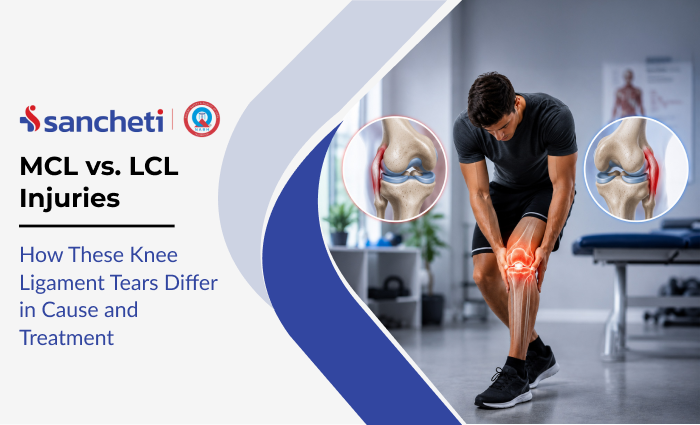

MCL vs. LCL Injuries: How These Knee Ligament Tears Differ in Cause and Treatment
Knee ligament injuries are among the most common orthopaedic problems we see at Sancheti Hospital, Pune — and two of the most frequently confused are MCL (Medial Collateral Ligament) and LCL (Lateral Collateral Ligament) injuries.
While both are collateral ligament tears on opposite sides of the knee, they differ considerably in how they happen, what symptoms they produce, and how they are treated. This blog explains both injuries clearly, side by side, so patients and their families can better understand what a diagnosis means and what recovery looks like.
Understanding the Anatomy: Where Are the MCL and LCL?
The knee is stabilised by four major ligaments. The two collateral ligaments run along the sides of the knee and prevent it from bending sideways abnormally.
- The Medial Collateral Ligament (MCL) runs along the inner (medial) side of the knee, connecting the femur (thigh bone) to the tibia (shin bone). It resists forces that push the knee inward.
- The Lateral Collateral Ligament (LCL) runs along the outer (lateral) side of the knee, connecting the femur to the fibula. It resists forces that push the knee outward.
Both ligaments are essential for knee stability, but they are subjected to very different stresses — which is why their injury patterns differ so markedly.
MCL vs. LCL: A Side-by-Side Comparison
| Feature | MCL Injury | LCL Injury |
| Location | Inner (medial) side of knee | Outer (lateral) side of knee |
| Common cause | Blow to the outer knee (valgus force) | Blow to the inner knee (varus force) |
| Sports at risk | Football, wrestling, skiing | Basketball, football, martial arts |
| Frequency | Very common | Less common |
| Associated injuries | ACL, meniscus tears | PCL, popliteus, peroneal nerve |
| Heals conservatively? | Usually yes (Grade I & II) | Often yes (Grade I & II), but Grade III may need surgery |
| Surgery needed? | Rarely | More often than MCL |
| Recovery time (mild) | 2–6 weeks | 4–8 weeks |
| Recovery time (severe) | 3–6 months | 3–6 months or longer |
How MCL Injuries Happen
The MCL is the most commonly injured knee ligament in sports. It is typically damaged by a valgus stress — a force that pushes the knee inward while the foot is planted. This happens when:
- A player takes a direct blow to the outer side of the knee (common in football and rugby tackles)
- An athlete lands awkwardly from a jump with the knee collapsing inward
- A skier catches an edge and the knee twists inward
MCL tears are graded by severity:
| Grade | Description | Ligament Status |
| Grade I | Mild sprain, fibres stretched | Intact, not torn |
| Grade II | Partial tear | Partially disrupted |
| Grade III | Complete rupture | Fully torn |
Grade I and II MCL injuries heal well without surgery in most cases. Even Grade III complete tears often respond to conservative management, which makes the MCL quite different from the ACL in terms of its natural healing ability.
How LCL Injuries Happen
The Lateral Collateral Ligament is less commonly injured because the inner (medial) side of the knee is the one most exposed to incoming contact. The LCL is stressed by a varus force — a blow that pushes the knee outward or a hyperextension combined with rotation. It tends to occur when:
- There is direct contact to the inner knee pushing it outward
- The knee hyperextends and rotates, such as in a tackle or collision
- High-impact sports like martial arts or basketball involve awkward lateral landings
The LCL is part of what orthopaedic surgeons call the posterolateral corner (PLC) — a complex of structures on the outer side of the knee. This is why lateral collateral ligament injuries are often more complicated: they frequently involve the popliteus tendon, the popliteofibular ligament, and sometimes the peroneal nerve, which runs close by.
The same Grade I–II–III classification applies to LCL tears as well:
| Grade | Description | Likely Treatment |
| Grade I | Mild sprain | Rest, physiotherapy |
| Grade II | Partial tear | Bracing, physiotherapy, possible PRP |
| Grade III | Complete tear | Often surgical reconstruction |
Symptoms: How to Tell Them Apart
While both injuries cause knee pain and swelling, the location and associated findings help distinguish them.
| Symptom | MCL Injury | LCL Injury |
| Pain location | Inner side of knee | Outer side of knee |
| Swelling | Localised to medial side | Localised to lateral side |
| Instability | Knee buckles inward | Knee buckles outward |
| Bruising | Inner knee | Outer knee, possibly down calf |
| Numbness/tingling | Rare | Possible (peroneal nerve) |
| Clicking/locking | If meniscus is also injured | If PLC structures are involved |
One important clinical sign is the valgus stress test (for MCL) and varus stress test (for LCL), both performed by a specialist with the knee in slight flexion. Increased joint space opening on the affected side indicates ligament laxity or rupture.
If you experience pain on either side of the knee after a twist or impact — especially if accompanied by a “pop,” swelling, or a feeling that the knee is giving way — joint instability of this kind should be evaluated promptly by an orthopaedic specialist.
Diagnosis: What Tests Are Needed?
A thorough clinical examination is the starting point. Your orthopaedic surgeon at Sancheti Hospital will assess:
- Point tenderness along the medial or lateral joint line
- Range of motion and joint stability
- Valgus and varus stress tests at 0° and 30° of flexion
- Neurovascular status (especially for LCL, given proximity of the peroneal nerve)
Imaging investigations typically include:
- X-ray — to rule out associated fractures (an avulsion fracture at the fibular head can accompany LCL rupture)
- MRI — the gold standard for visualising ligament tears, grading severity, and identifying concurrent injuries to the ACL, PCL, or meniscus
MRI is particularly important for LCL injuries where posterolateral corner involvement must be assessed before any treatment plan is finalised.
Treatment: Where MCL and LCL Management Diverge
MCL Injuries: Conservative First
The vast majority of MCL tears — including most Grade III injuries — are managed non-surgically. The MCL has a good blood supply and a strong natural healing capacity.
Conservative management includes:
- RICE protocol (Rest, Ice, Compression, Elevation) in the first 48–72 hours
- A hinged knee brace to protect the ligament while allowing controlled movement
- Physiotherapy to restore quadriceps and hamstring strength, proprioception, and gait
- Gradual return to sport based on clinical reassessment
Surgery for an isolated MCL tear is rarely required. It may be considered when the MCL fails to heal after adequate conservative treatment or when it is torn in combination with other major ligaments.
LCL Injuries: More Likely to Need Surgery
Grade I and II LCL injuries also heal conservatively in most cases, following a similar protocol to MCL management. However, Grade III LCL tears — especially those involving the posterolateral corner — often require surgical intervention because these structures do not heal reliably on their own.
Surgical options for LCL reconstruction include:
- Direct repair (if performed early, within 2–3 weeks of injury)
- Ligament reconstruction using a tendon graft (autograft or allograft)
- Posterolateral corner reconstruction when multiple structures are involved
Our arthroscopic and sports surgery team at Sancheti Hospital is experienced in combined ligament reconstruction when both the LCL and other structures such as the PCL or ACL are torn simultaneously — a situation that demands careful surgical planning and staged rehabilitation.
Combined Injuries: When It’s Not Just the MCL or LCL
Both collateral ligaments are frequently injured alongside other knee structures. Understanding these combinations is important because the treatment plan changes significantly.
| Combination Injury | Common Scenario | Management Implication |
| MCL + ACL | Common football/skiing injury | ACL reconstructed first; MCL often healed conservatively |
| MCL + Medial Meniscus | Twisting injury with valgus force | Meniscus addressed at time of surgery if needed |
| LCL + PCL | High-energy trauma (road traffic, contact sport) | Combined ligament reconstruction often required |
| LCL + Posterolateral Corner | Hyperextension-varus injury | Complex surgery; early referral essential |
| LCL + Peroneal Nerve Injury | High-grade LCL tear | Nerve monitoring; may recover or require further treatment |
Injuries to the medial meniscus alongside an MCL tear — sometimes part of what was historically called the “unhappy triad” — may need meniscus repair as part of the overall treatment strategy.
Rehabilitation: Road to Recovery
Regardless of which ligament is injured, structured rehabilitation is non-negotiable. At Sancheti Hospital, we follow a phased approach to knee ligament recovery:
Phase 1 — Protection and Pain Control (Week 1–2) Reduce swelling, protect the ligament, maintain quadriceps activation.
Phase 2 — Mobility Restoration (Week 2–6) Regain full range of motion, begin weight-bearing as tolerated, progressive strengthening.
Phase 3 — Strengthening and Neuromuscular Control (Week 6–12) Closed-chain exercises, proprioception training, balance work.
Phase 4 — Sport-Specific Training (Week 12 onwards) Running, cutting, jumping drills — sport-specific conditioning before return to play is cleared by the surgeon.
Recovery timelines vary based on injury grade, associated injuries, and whether surgery was performed. Attempting to return to sport before the ligament has adequately healed significantly increases the risk of re-injury and long-term knee instability.
When Should You Worry About a Knee Dislocation?
A high-energy injury that tears both collateral ligaments simultaneously may also cause a knee dislocation — a medical emergency. When the knee dislocates, the popliteal artery (which supplies blood to the lower leg) and the peroneal nerve are at risk of serious damage.
Any knee injury following a high-speed collision or fall that results in gross instability, deformity, or a cold and pale foot needs immediate emergency evaluation. Traumatic knee dislocation is one of the most time-sensitive orthopaedic emergencies.
Prevention Tips for Collateral Ligament Injuries
- Strengthen the muscles around the knee — particularly the quadriceps, hamstrings, and hip abductors — to reduce ligament stress
- Practise proper landing mechanics and change-of-direction techniques
- Wear sport-appropriate footwear with adequate lateral support
- Use a functional knee brace if returning from a previous ligament injury
- Work with a trained physiotherapist or sports medicine specialist for pre-season conditioning
Our sports medicine division at Sancheti Hospital offers dedicated knee injury prevention programmes for athletes across all levels.
Key Takeaways
- The MCL (inner knee) and LCL (outer knee) are collateral ligaments that stabilise the knee against sideways forces — they are injured by opposite types of impact.
- MCL injuries are far more common and almost always heal with conservative treatment, even at Grade III.
- LCL injuries are less frequent but more complex; Grade III tears and posterolateral corner involvement often require surgical reconstruction.
- Both are graded I–III based on severity, and both require structured physiotherapy for full recovery.
- MRI is essential for accurate grading and identifying associated injuries to the ACL, PCL, or meniscus.
- Never attempt to play through significant knee pain after an injury — early assessment protects your long-term joint health.
Frequently Asked Questions (FAQs)
Q1. Can an MCL or LCL injury heal on its own without any treatment?
A Grade I sprain may settle with rest, but leaving a Grade II or III tear without proper treatment — bracing, physiotherapy, or surgery where indicated — risks chronic knee instability, cartilage damage, and early arthritis. Even mild injuries benefit from professional guidance.
Q2. How do I know if I have torn my MCL or LCL without seeing a doctor?
You cannot reliably self-diagnose a ligament tear. Pain on the inner side of the knee after a valgus impact suggests MCL involvement; outer-side pain after a lateral blow or hyperextension suggests LCL. However, only a clinical examination and MRI can confirm the diagnosis and grade the injury accurately.
Q3. Will I need a brace after an MCL or LCL injury, and for how long?
A hinged knee brace is commonly prescribed for both injuries, typically for 4–8 weeks. The duration depends on the grade of injury, the ligament involved, and whether surgery was performed. Your surgeon will advise on the appropriate brace type and weaning schedule.
Q4. Is it safe to walk on a knee with an MCL or LCL tear?
Weight-bearing is generally permitted for Grade I and most Grade II injuries, especially with a brace. Grade III tears may require a short period of partial or non-weight-bearing. Walking incorrectly on an unstable knee risks worsening the injury or damaging the cartilage and meniscus.
Q5. What happens if an LCL injury is left untreated for a long time?
Chronic untreated LCL and posterolateral corner injuries lead to progressive lateral knee instability, accelerated cartilage wear, and eventually osteoarthritis of the lateral compartment. Delayed surgical reconstruction (beyond 3 weeks) is also technically more demanding, which is why early diagnosis matters significantly for LCL injuries.