Home
Home PG College
 Patient Login
 Sancheti Clinic
 Contact Us
 Download Reports

Total vs Partial Hip Replacement: What’s the Difference?
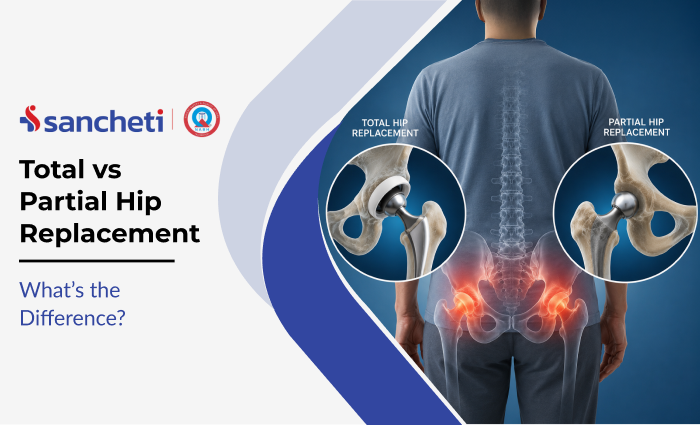
If you or a loved one has been advised hip replacement surgery, one of the first questions that comes to mind is — which type do I need? In short, a partial hip replacement replaces only the femoral head (the ball), while a total hip replacement replaces both the ball and the socket.
The right choice depends on your diagnosis, age, activity level, and overall bone health. At Sancheti Hospital, Pune, our orthopedic specialists help patients understand these options clearly before making any surgical decision.
What Is Hip Replacement Surgery?
Hip replacement surgery is a procedure in which damaged parts of the hip joint are removed and replaced with artificial implants. It is recommended when the hip joint is so severely damaged that pain and stiffness interfere with daily life — and when medications, physiotherapy, and other non-surgical treatments no longer provide relief.
The hip is a ball-and-socket joint. The “ball” is the rounded top of the thigh bone (femur), and the “socket” is the cup-shaped hollow in the pelvis. Depending on which part is damaged, your surgeon may recommend either a total or a partial procedure.
What Is a Total Hip Replacement?
A total hip replacement (THR), also called total hip arthroplasty, involves replacing both the femoral head (ball) and the acetabulum (socket) with prosthetic components. The artificial joint is typically made from metal, ceramic, or high-grade medical plastic (polyethylene).
When Is Total Hip Replacement Recommended?
- Severe osteoarthritis of the hip affecting both the ball and socket
- Rheumatoid arthritis causing widespread joint damage
- Advanced avascular necrosis involving the socket as well
- Post-traumatic arthritis following old injuries
- Failed previous hip surgeries
Total hip replacement is the most commonly performed hip surgery worldwide and has an excellent long-term success rate. At Sancheti Hospital, we use advanced implant systems and minimally invasive techniques to ensure faster recovery and better outcomes for our patients.
What Is a Partial Hip Replacement?
A partial hip replacement, medically known as hemiarthroplasty, involves replacing only the femoral head — the ball portion of the joint — while the natural socket is left intact.
When Is Partial Hip Replacement Recommended?
- Hip fractures, particularly femoral neck fractures in elderly patients
- Conditions where the socket (acetabulum) is still healthy and undamaged
- Patients who are older or less active, where a simpler procedure is preferred
- Cases where the damage is isolated to the femoral head alone
Since only one part of the joint is replaced, the surgery is generally shorter and involves less bone removal. However, it is not suitable for patients with arthritis affecting the socket.
Total vs Partial Hip Replacement: A Side-by-Side Comparison
| Feature | Total Hip Replacement | Partial Hip Replacement |
| Parts replaced | Ball + Socket | Ball only |
| Common reason | Arthritis, joint degeneration | Hip fracture |
| Surgery duration | Longer | Shorter |
| Recovery time | Moderate | Generally quicker |
| Ideal candidate | Active individuals with arthritis | Elderly with isolated fractures |
| Long-term durability | Very high | Moderate |
Key Differences to Understand
1. Extent of Joint Involvement
The most fundamental difference is how much of the joint is replaced. In total hip arthroplasty, both surfaces of the joint are resurfaced with implants. In hemiarthroplasty, only the ball is replaced, and the natural cartilage of the socket continues to bear load.
2. Reason for Surgery
Total hip replacement is predominantly performed for arthritis — a condition involving progressive joint degeneration. Partial hip replacement is most often performed as an emergency or urgent procedure following a hip fracture, especially in older adults who sustain a fall.
3. Recovery and Rehabilitation
Both procedures require dedicated post-operative physiotherapy. With total hip replacement, patients typically begin walking with support within 24–48 hours. With partial hip replacement, recovery can be similarly quick — but long-term outcomes depend significantly on how the natural socket tolerates the new implant over time.
At Sancheti Hospital, our dedicated rehabilitation team works alongside our orthopedic surgeons to create personalised recovery plans for every patient.
4. Long-Term Durability
Modern total hip replacement implants can last 20–25 years or more with proper care. Partial hip replacement implants may wear against the natural cartilage of the socket over time, sometimes requiring conversion to a total replacement later.
Who Is the Right Candidate for Each Procedure?
You may be a candidate for total hip replacement if you:
- Have been diagnosed with moderate to severe hip arthritis
- Experience constant hip pain that limits walking, climbing stairs, or sleeping
- Have not responded adequately to conservative treatment
- Are in reasonably good overall health for surgery
You may be a candidate for partial hip replacement if you:
- Have suffered a hip fracture, especially a displaced femoral neck fracture
- Are an older adult with lower activity demands
- Have a healthy acetabulum (socket) with no signs of arthritis
- Require a faster, less complex surgical intervention
What About Hip Resurfacing?
Some patients ask about hip resurfacing, which is a bone-conserving alternative to total hip replacement. In this procedure, the femoral head is reshaped and capped with a metal covering rather than removed entirely. It is typically suited for younger, active patients with good bone density. Your orthopedic surgeon at Sancheti Hospital will help determine if this is an appropriate option for your specific case.
Why Choose Sancheti Hospital for Hip Replacement in Pune?
At Sancheti Hospital, we have been at the forefront of orthopedic care in Pune for decades. Our hip replacement programme combines:
- Experienced orthopedic surgeons with sub-specialisation in joint replacement
- State-of-the-art operation theatres with advanced implant technologies
- Comprehensive pre-operative evaluation and planning
- Dedicated post-operative physiotherapy and rehabilitation
- Patient education at every step of the journey
Whether you need a total hip replacement or a partial hip replacement, our team ensures you receive the most appropriate, evidence-based treatment tailored to your individual needs.
Key Takeaways
- Partial hip replacement (hemiarthroplasty) replaces only the femoral head and is most commonly used for hip fractures in elderly patients.
- Total hip replacement (total hip arthroplasty) replaces both the ball and socket and is the gold standard for hip arthritis.
- The right procedure depends on your diagnosis, bone health, age, and activity level.
- Both surgeries are safe and effective when performed by experienced orthopedic surgeons.
- Modern implants for total hip replacement can last over 20 years with proper care and lifestyle choices.
- Post-operative physiotherapy is essential for a successful recovery from either procedure.
Frequently Asked Questions (FAQs)
Q1. How long does it take to walk normally after hip replacement surgery?
Most patients can walk with support within 1–2 days of surgery. Walking independently without aids typically takes 4–6 weeks, and a full return to normal activities can take 3–6 months depending on the type of surgery and individual healing.
Q2. Can a partial hip replacement be converted to a total hip replacement later?
Yes. If the natural socket wears down over time after a partial hip replacement, a revision surgery can be performed to convert it to a total hip replacement. This is one reason why total hip replacement may be preferred in younger, more active patients from the start.
Q3. Is hip replacement surgery painful?
Patients are under anaesthesia during the procedure and experience no pain during surgery. Post-operative pain is managed effectively with medications. Most patients find that after recovery, the relief from chronic hip pain is significant — often described as life-changing.
Q4. What activities should I avoid after hip replacement?
In the initial recovery phase, high-impact activities like running, jumping, and contact sports are restricted. Your surgeon will advise when and if you can gradually return to these. Low-impact activities like walking, swimming, and cycling are generally encouraged.
Q5. What is the success rate of hip replacement surgery?
Hip replacement is one of the most successful procedures in orthopedic surgery. Total hip replacement has a success rate exceeding 95% at 10 years, with most patients experiencing significant pain relief and improved mobility. Outcomes depend on the implant used, surgical technique, and adherence to rehabilitation.