Home
Home PG College
 Patient Login
 Sancheti Clinic
 Contact Us
 Download Reports
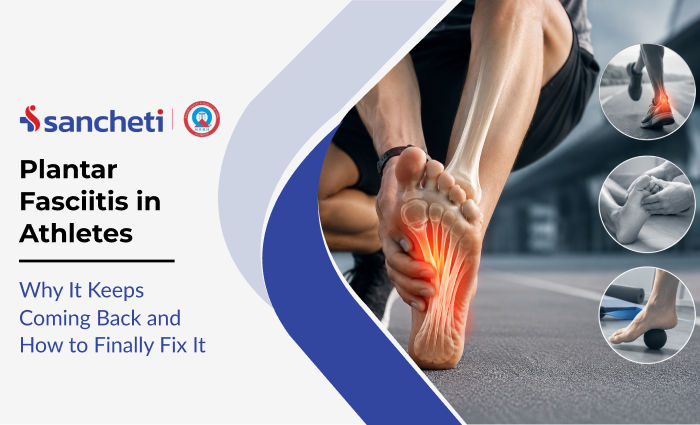

Plantar Fasciitis in Athletes: Why It Keeps Coming Back and How to Finally Fix It
Plantar fasciitis is the most common cause of heel pain in athletes — and one of the most frustrating injuries to manage because it responds to rest, then returns the moment training resumes. In short: the plantar fascia degenerates under repetitive load faster than it can repair, and the standard approach of stretching and rest treats the symptom without addressing the root cause. Understanding why it keeps recurring is what finally fixes it.
At Sancheti Hospital, Pune, our foot, ankle, and sports medicine specialists treat athletes — from marathon runners and footballers to cricketers and recreational gym-goers — stuck in the same cycle of recovery and relapse. This blog breaks it all down clearly.
What Is the Plantar Fascia and What Goes Wrong?
The plantar fascia is a thick band of connective tissue running from the heel bone (calcaneus) to the base of the toes. It acts as a shock absorber and supports the arch of the foot during every step, jump, and landing.
With repetitive loading — especially in athletes — the fascia develops microtears at its calcaneal attachment faster than it can heal. Over time, this produces a degenerative, pain-sensitised tissue: plantar fasciitis.
Like patellar tendinopathy, this is a degenerative condition, not primarily an inflammatory one. Anti-inflammatory measures alone will not restore tissue structure — and this is why so many athletes improve temporarily, then relapse.
Why Athletes Keep Getting It
Several factors make athletes disproportionately vulnerable:
- Sudden training load increases — the most consistent trigger, particularly in pre-season or when returning from a break
- Inadequate calf and intrinsic foot muscle strength — places excessive tensile demand on the fascia
- Tight calf muscles and Achilles tendon — restricted ankle dorsiflexion increases fascial tension with every stride
- Foot structure — both flat feet and high arches increase fascial load, though through different mechanisms
- Hard training surfaces — repeated impact on concrete or tracks without adequate footwear cushioning
- Worn-out running shoes — degraded midsole support is one of the most overlooked contributors
- Returning too early — the most common reason it keeps coming back; pain resolution is not the same as tissue recovery
Recognising Plantar Fasciitis: Symptoms
The symptom pattern is distinctive:
| Symptom | Detail |
| First-step morning pain | Sharp heel pain on taking the first few steps after waking — the hallmark symptom |
| Pain after rest | Returns after sitting for prolonged periods |
| Eases with warm-up | Pain typically reduces after 10–15 minutes of walking |
| Returns after exercise | Worsens again after a long run or training session |
| Tender heel on palpation | Point tenderness at the medial calcaneal tuberosity (inner heel) |
| Occasional arch pain | Some athletes feel pain along the length of the fascia, not just the heel |
This pattern — worst at first movement, easing with activity, returning after load — is what distinguishes plantar fasciitis from other causes of heel pain.
Differentiating Plantar Fasciitis from Similar Conditions
Not all heel pain is plantar fasciitis. A few important conditions to differentiate:
| Condition | Key Distinguishing Feature |
| Heel spurs | Bony growths on the calcaneus — often coexist with plantar fasciitis but are not the cause of pain |
| Achilles tendinitis | Pain at the back of the heel/tendon insertion, not the underside |
| Fat pad atrophy | Diffuse heel pain, more common in older athletes, worsens on hard surfaces |
| Tarsal tunnel syndrome | Burning, tingling heel pain — nerve-related, not load-dependent |
| Stress fracture of the calcaneus | Pain on calcaneal squeeze test, present at rest |
When the diagnosis is unclear or symptoms are not improving, MRI or ultrasound at Sancheti Hospital provides a definitive picture of fascial thickness, tears, and associated pathology.
Why the Standard “Rest and Stretch” Approach Fails
Most athletes are advised to:
- Rest from running
- Stretch the calf and plantar fascia
- Use anti-inflammatory medications
- Wear a heel cushion
This provides temporary relief — but does nothing to restore the structural integrity of the degenerating fascia. The moment training resumes, the same under-conditioned, overloaded tissue fails again under the same mechanical demands.
The key insight from modern sports medicine: the plantar fascia needs progressive loading, not just rest. This is what drives genuine collagen remodelling and long-term recovery.
What Actually Works: The Treatment Hierarchy
Stage 1 — Load Management (Week 1–2)
- Reduce running volume to below the pain threshold — do not stop entirely
- Replace high-impact training with swimming or cycling temporarily
- Ice the heel for 10–15 minutes post-activity
- Night splints to maintain gentle fascial stretch overnight — particularly effective for morning pain
Stage 2 — Targeted Loading and Strengthening (Weeks 2–8)
This is the most important stage and the one most commonly skipped.
Calf strengthening with the plantar fascia in tension:
- Single-leg heel raises — slow and controlled, on a step with the heel dropping below the level of the step
- Performed daily, 3 sets of 15 reps with progressive load
Intrinsic foot muscle strengthening:
- Toe curls, short foot exercises, towel scrunches
- Directly reduces tensile demand on the fascia during gait
High-load strength training — heavy slow single-leg calf raises with added weight (weighted vest or holding a dumbbell) — has the strongest evidence for long-term fascial remodelling and is the exercise most athletes skip because it feels counterintuitive to load a painful structure.
A well-designed physiotherapy and rehabilitation program structures this loading progression — ensuring the fascia is stimulated correctly without being overloaded before it is ready.
Stage 3 — Biomechanical Correction (Weeks 4–12)
- Footwear assessment — replace worn-out running shoes; ensure adequate arch support for the athlete’s foot type
- Orthotic prescription — custom insoles for athletes with flat feet or high arches who need ongoing load redistribution
- Running gait analysis — step rate, foot strike pattern, and cadence adjustments to reduce peak plantar fascial loading
Stage 4 — Return to Full Training (Weeks 8–16)
- Progressive mileage increases — no more than 10% per week
- Running surface progression — soft to firm
- Sport-specific loading reintroduced last
Adjunct Treatments: What Helps
| Treatment | Role | Evidence Level |
| Corticosteroid injection | Short-term pain relief; enables early rehab engagement | Moderate — inferior long-term vs loading program |
| Extracorporeal shockwave therapy (ESWT) | Stimulates fascial remodelling in chronic cases | Good — particularly for >3 months duration |
| PRP injection | Growth factor delivery for degenerative fascia | Emerging — used in refractory cases |
| Night splints | Reduces morning pain by maintaining dorsiflexion overnight | Good for morning symptom control |
| Taping (low-dye) | Offloads the fascia during activity | Useful short-term adjunct |
Our sports medicine team at Sancheti Hospital selects adjunct treatments based on symptom duration, severity, and how the athlete is responding to the loading program — not as standalone fixes.
When Is Surgery Considered?
Surgery is a last resort, reserved for athletes who have:
- Completed a genuine 6–12 month structured conservative program
- Failed shockwave therapy and PRP
- Confirmed persistent fascial thickening and degeneration on imaging
The surgical option — endoscopic plantar fascia release — involves cutting a portion of the fascia to relieve tension at the calcaneal attachment. Outcomes are good in well-selected patients, but surgery without addressing the underlying biomechanical drivers produces recurrence.
Prevention: Keeping It From Coming Back
Once resolved, plantar fasciitis has a high recurrence rate in athletes who abandon the habits that fixed it. Long-term prevention requires:
- Permanent inclusion of calf and foot strengthening in training — not just during rehabilitation
- Replacing running shoes every 500–700 km regardless of how they look
- Gradual return from any training break — never jump back to previous mileage immediately
- Addressing foot structure proactively — athletes with flat feet or tight calves are permanently at higher risk and should manage this before symptoms return
Key Takeaways
- Plantar fasciitis is a degenerative overuse condition — rest alone does not fix it because it does not restore fascial structure.
- The first-step morning pain pattern is the hallmark symptom. It eases with warm-up and returns after prolonged loading.
- The injury keeps recurring because athletes return too early, skip progressive loading, and fail to address the biomechanical factors driving the condition.
- High-load calf strengthening and intrinsic foot muscle training are the most effective rehabilitation interventions — not stretching alone.
- Adjunct treatments like shockwave therapy and PRP support recovery in chronic cases but only alongside a proper loading program.
- Surgery is effective in refractory cases but is genuinely a last resort after 6–12 months of structured conservative management.
- At Sancheti Hospital, Pune, our foot, ankle, and sports medicine specialists assess each athlete’s foot structure, training load, and biomechanics to build a treatment plan that addresses root causes — not just symptoms.
Frequently Asked Questions (FAQs)
Q1. How long does plantar fasciitis take to heal completely?
Mild cases caught early can resolve in 6–8 weeks with structured loading rehabilitation. Chronic cases — where symptoms have been present for more than 3 months — typically require 3–6 months of consistent treatment. The single biggest predictor of longer recovery is delayed presentation combined with repeated attempts at rest-and-return without proper loading rehabilitation.
Q2. Is it okay to run with plantar fasciitis?
Modified running — at reduced volume, staying below the pain threshold — is generally acceptable and preferable to complete rest. Total cessation of activity is not necessary and delays recovery by removing the mechanical stimulus the fascia needs to remodel. The goal is load management, not load elimination.
Q3. Does a heel spur mean I definitely have plantar fasciitis?
Not necessarily. Heel spurs are bony outgrowths that form at the calcaneal attachment of the fascia and are found in many people without any pain at all. They are often discovered incidentally on X-ray and are generally considered a consequence of chronic fascial tension rather than the cause of pain. Treating the spur directly — without addressing the fascia — rarely resolves symptoms.
Q4. Can the wrong running shoes cause plantar fasciitis?
Yes. Shoes with insufficient arch support, excessive heel drop, or degraded midsole cushioning alter the mechanical load on the plantar fascia significantly. This is particularly relevant for athletes transitioning to minimalist footwear too rapidly — the sudden increase in fascial demand without adequate preparation is a well-documented trigger for onset.
Q5. Is plantar fasciitis more common in certain sports?
Running-based sports carry the highest risk — distance running, football, basketball, and cricket (particularly fast bowlers with their high-impact delivery stride). Sports involving prolonged standing on hard surfaces — such as tennis on hard courts or certain court sports — also see elevated rates. The common thread is repetitive axial loading of the foot without adequate recovery or conditioning.