Home
Home PG College
 Patient Login
 Sancheti Clinic
 Contact Us
 Download Reports

Hip Replacement Surgery: Procedure, Recovery, and Risks
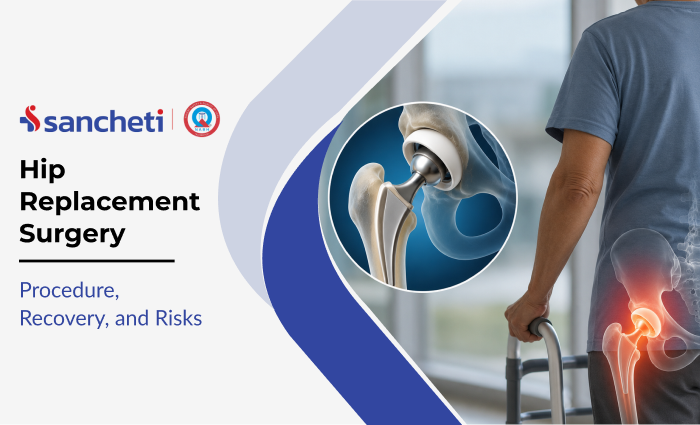
Hip replacement surgery is a well-established orthopaedic procedure that relieves chronic hip pain, restores mobility, and significantly improves quality of life.
In this blog, our specialists at Sancheti Hospital walk you through everything you need to know — from what the surgery involves, to recovery timelines, potential risks, and when it might be the right choice for you.
What Is Hip Replacement Surgery?
Hip replacement surgery, also called total hip arthroplasty, is a procedure in which a damaged or worn-out hip joint is replaced with an artificial implant. It is most commonly recommended for patients suffering from severe hip joint pain caused by conditions like osteoarthritis of the hip, rheumatoid arthritis, or hip fractures.
At Sancheti Hospital in Pune, we see a growing number of patients — both elderly and middle-aged — who have been living with debilitating hip pain for years before finally seeking surgical help. The good news is that hip replacement has one of the highest success rates among major orthopaedic surgeries.
Who Needs Hip Replacement Surgery?
Not everyone with hip pain needs surgery. However, you may be a candidate for hip replacement if:
- You have persistent hip or groin pain that doesn’t respond to medications or physiotherapy
- Everyday activities like walking, climbing stairs, or getting up from a chair have become difficult
- You experience hip stiffness that limits your range of motion
- X-rays show significant joint damage or bone-on-bone arthritis
- Your quality of life is severely affected despite non-surgical treatments
Osteoarthritis is the most common reason patients come to us for this procedure. It gradually wears down the cartilage in the hip joint, causing pain, inflammation, and loss of function.
Types of Hip Replacement Surgery
There are different approaches based on patient needs:
- Total Hip Replacement (Total Hip Arthroplasty) The most common type. Both the damaged femoral head (ball) and the acetabulum (socket) are replaced with prosthetic components.
- Partial Hip Replacement (Hemiarthroplasty) Only the femoral head is replaced. This is often recommended after a hip fracture, particularly in older adults.
- Hip Resurfacing The femoral head is reshaped and capped with a metal covering rather than removed entirely. This is generally suited for younger, more active patients.
- Minimally Invasive Hip Replacement At Sancheti Hospital, we also offer minimally invasive hip replacement options that use smaller incisions, resulting in less muscle disruption and faster recovery.
Hip Replacement Procedure: Step by Step
Understanding what happens during surgery can help ease anxiety. Here’s a simplified overview of the hip replacement procedure:
Before Surgery
- Pre-operative evaluations including blood tests, X-rays, and ECG
- Anaesthesia consultation (general or spinal anaesthesia is typically used)
- Patients are advised to stop certain medications and fast before the procedure
During Surgery
- An incision is made over the hip joint
- The damaged femoral head is carefully removed
- The acetabulum is prepared, and the prosthetic socket is fixed in place
- The femoral stem with the new ball is inserted into the thigh bone
- The new joint is tested for stability and range of motion
- The incision is closed in layers
The procedure typically takes 1.5 to 3 hours, depending on complexity.
Implants Used: Modern hip implants are made from materials such as metal, ceramic, or high-grade polyethylene. The choice of implant depends on the patient’s age, weight, activity level, and bone quality.
Hip Replacement Recovery: What to Expect
Recovery after hip replacement surgery is a gradual process, but most patients are surprised by how quickly they begin to feel better.
In the Hospital (Days 1–3)
- Most patients are encouraged to stand and take a few steps with support as early as the first day after surgery
- A physiotherapist will guide initial movements and precautions
- Pain is managed with medications
At Home (Weeks 1–6)
- Walking with a walker or crutches is normal in the early weeks
- Hip replacement physiotherapy exercises are essential to regain strength and flexibility
- You should avoid bending the hip beyond 90 degrees, crossing your legs, or sitting on low surfaces
- Most patients can resume light daily activities within 4 to 6 weeks
Long-Term Recovery (Months 2–6)
- Gradual return to activities like driving, swimming, and light exercise
- Full recovery and return to normal activity typically takes 3 to 6 months
- Regular follow-up appointments are crucial during this phase
Tips to Speed Up Recovery
- Follow your physiotherapist’s exercise plan diligently
- Maintain a healthy weight to reduce stress on the new joint
- Avoid high-impact activities until cleared by your surgeon
- Keep the wound clean and watch for signs of infection
Risks and Complications of Hip Replacement Surgery
As with any major surgery, hip replacement risks do exist. Being informed helps you and your care team take preventive measures.
Common risks include
- Blood clots (Deep Vein Thrombosis): A serious but preventable complication. Blood thinners and compression stockings are routinely used post-surgery.
- Infection: Around the implant site. Strict sterile protocols at Sancheti Hospital minimise this risk significantly.
- Hip dislocation: The new joint can dislocate, especially in the early weeks. Following movement precautions is key.
- Leg length difference: Minor differences in leg length can sometimes occur, though surgical planning aims to minimise this.
- Implant loosening: Over many years, the implant may loosen and require revision surgery.
- Nerve or blood vessel injury: Rare, but possible with any surgical procedure near major structures.
It’s important to note that serious complications are uncommon, especially in high-volume orthopaedic centres. At Sancheti Hospital, our surgical team follows rigorous protocols to ensure patient safety at every step.
Life After Hip Replacement: What Patients Can Expect
The majority of patients experience a dramatic improvement in quality of life after surgery. At Sancheti Hospital, most of our hip replacement patients report:
- Significant reduction or complete elimination of hip pain
- Better mobility and ability to walk longer distances
- Improved sleep and daily functioning
- A return to activities like travel, light hiking, and recreational sports
How long do hip implants last? Modern hip implants are designed to last 15 to 25 years, and with proper care and activity modification, many patients never need a revision.
Why Choose Sancheti Hospital for Hip Replacement in Pune?
Sancheti Hospital has been a trusted name in orthopaedic care in Pune for decades. Our dedicated joint replacement unit is equipped with advanced technology, and our surgeons are trained in both conventional and minimally invasive techniques.
- Experienced team of orthopaedic surgeons and physiotherapists
- Comprehensive pre-operative and post-operative care
- State-of-the-art operation theatres with infection control standards
- Personalised rehabilitation programmes tailored to each patient
If you or a loved one is dealing with persistent hip pain, we encourage you to consult our specialists and explore whether hip replacement surgery in Pune is the right path forward.
Key Takeaways
- Hip replacement surgery replaces a damaged hip joint with an artificial implant, primarily to relieve pain and restore mobility.
- It is most commonly recommended for osteoarthritis, hip fractures, and rheumatoid arthritis.
- The procedure takes 1.5–3 hours; recovery spans 3 to 6 months with guided physiotherapy.
- Common risks include blood clots, infection, and dislocation — all manageable with proper care.
- Modern implants last 15–25 years, and most patients experience a significant improvement in quality of life.
- Sancheti Hospital offers experienced orthopaedic care and advanced hip replacement options in Pune.
Frequently Asked Questions (FAQs)
Q1. At what age is hip replacement surgery recommended?
There is no fixed age limit. While it is more common in people above 60, younger patients with severe joint damage may also benefit. The decision is based on pain levels, functional limitation, and overall health — not age alone.
Q2. Is hip replacement surgery painful? What is the pain management approach?
Some discomfort is expected post-surgery, but it is well-managed with a combination of anaesthesia, oral pain medication, and ice therapy. Most patients find that post-surgical pain is significantly less than the chronic hip pain they were experiencing before the procedure.
Q3. Can I sleep normally after hip replacement surgery?
In the initial weeks, sleeping positions need to be modified. Sleeping on your back with a pillow between your legs is generally recommended. Side sleeping on the operated side should be avoided until your surgeon gives clearance — usually after 6–8 weeks.
Q4. Will I need to use a walker or wheelchair permanently?
No. A walker or crutches are used temporarily during early recovery, usually for 2–4 weeks. Most patients transition to walking independently and eventually return to a fully active lifestyle.
Q5. Can hip replacement be done for both hips at the same time?
In some cases, bilateral (both hips) replacement can be performed in a single surgery. However, this depends on the patient’s overall health, fitness, and the surgeon’s assessment. A staged approach — one hip at a time — is more commonly recommended for safety.