Home
Home PG College
 Patient Login
 Sancheti Clinic
 Contact Us
 Download Reports
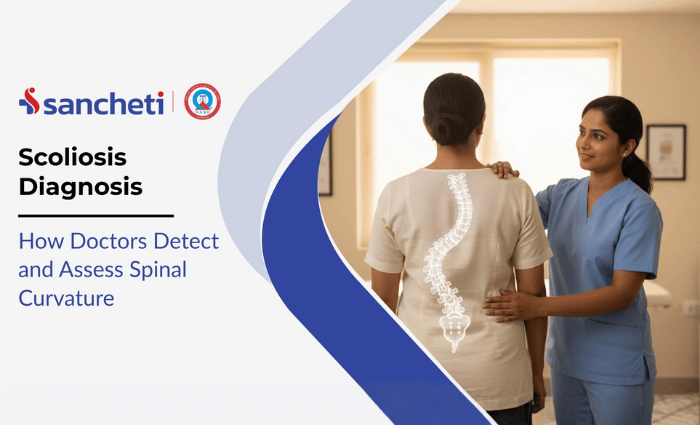

Scoliosis Diagnosis: How Doctors Detect and Assess Spinal Curvature
Getting an accurate scoliosis diagnosis is the first crucial step toward proper treatment. Many parents and patients feel overwhelmed when they first suspect scoliosis, but understanding the diagnostic process can help ease anxiety and ensure the best care.
At Sancheti Hospital, we use state-of-the-art diagnostic techniques to accurately detect and assess spinal curvature, providing our patients with clear answers and treatment plans.
How Scoliosis Diagnosis Begins: The Clinical Assessment
Taking Your Medical History
The scoliosis diagnosis process starts with a detailed conversation about:
- Family history: Scoliosis often runs in families, so doctors ask if parents or siblings have the condition
- Growth patterns: When did growth spurts happen, and for girls, when did menstruation begin
- Symptoms: Any back pain, breathing problems, or changes in how clothes fit
- Activity levels: Whether sports or daily activities have been affected
Physical Examination: What Doctors Look For
During the physical exam, doctors check for telltale signs:
Visual inspection includes:
- Shoulder height differences: One shoulder sitting higher than the other
- Hip alignment: Uneven hip levels when standing
- Trunk shift: Whether the body appears to lean to one side
- Waistline asymmetry: Uneven spacing between arms and body
The Adam’s Forward Bend Test
This is the most important part of the initial exam. The Adam’s forward bend test involves:
- The patient bending forward at the waist with arms hanging down
- The doctor looking for a “rib hump” or back prominence on one side
- This reveals spine rotation, which is a key feature of true scoliosis
Using a Scoliometer for Measurement
A scoliometer is a simple tool that measures the angle of trunk rotation (ATR). Most doctors refer patients for X-rays when the scoliometer reads 5-7 degrees, as this suggests a significant curve may be present.
Confirming the Diagnosis with X-rays
What Defines Scoliosis?
Scoliosis diagnosis requires X-ray confirmation. A spine curve of at least 10 degrees on a standing X-ray officially defines scoliosis. This measurement is called the Cobb angle.
Understanding Severity Levels
Once diagnosed, curves are classified by severity:
- Mild scoliosis: 10-25 degrees
- Moderate scoliosis: 25-40 degrees
- Severe scoliosis: 40+ degrees
Standard X-ray Studies
The complete radiographic workup includes:
Standing full-spine X-rays:
- Front view (PA): Shows the sideways curve and measures the Cobb angle
- Side view (lateral): Checks the normal front-to-back curves
- Both images help assess overall spine balance
Side-bending X-rays:
- These special X-rays show how flexible curves are
- Help surgeons plan treatment if needed
- Distinguish between structural (fixed) and flexible curves
Measuring the Cobb Angle: The Gold Standard
How Doctors Measure Curves
The Cobb angle is measured by:
- Finding the most tilted vertebrae at the top and bottom of the curve
- Drawing lines along these vertebrae
- Measuring the angle where these lines would meet
- This angle determines treatment decisions
Why Accurate Measurement Matters
Different doctors sometimes get slightly different measurements from the same X-ray. Modern technology, including AI assistance, is helping make measurements more consistent and reliable.
Assessing Growth and Progression Risk
Why Growth Matters in Diagnosis
For children and teens, knowing how much growing time is left helps predict:
- Whether curves might get worse
- How often follow-up visits are needed
- When bracing might be helpful
Risser Sign: Checking Bone Maturity
The Risser sign looks at how mature the hip bones are, scored from 0 (lots of growth left) to 5 (growth complete). This helps doctors understand progression risk.
Sanders Hand Staging
This newer method uses hand X-rays to more accurately assess remaining growth, especially useful during the critical growth spurt years.
When Additional Testing is Needed
MRI: Not Always Required
MRI scans are not routine for typical adolescent scoliosis. However, doctors order MRI when they see “red flags”:
Red flags requiring MRI:
- Left-sided thoracic curves (unusual pattern)
- Severe back pain in teenagers
- Neurological symptoms (weakness, numbness)
- Rapid curve progression
- Very young children with scoliosis
- Curves that developed before age 10
What MRI Can Reveal
When needed, MRI helps rule out:
- Spinal cord abnormalities
- Tethered spinal cord
- Syrinx (fluid-filled cavity in the spinal cord)
- Tumors or other serious conditions
Special Considerations for Different Types
Neuromuscular Scoliosis Diagnosis
When scoliosis occurs with conditions like cerebral palsy or muscular dystrophy, the diagnostic approach differs:
- More frequent monitoring: These curves often progress faster
- Earlier intervention: Treatment may start at smaller curve sizes
- Comprehensive assessment: Includes evaluation of muscle function and overall health
- Multidisciplinary approach: Involves neurologists, physical therapists, and other specialists
Scoliosis Diagnosis in Adults
Scoliosis diagnosis in adults often involves different considerations:
- Pain assessment: Adult scoliosis commonly causes back pain
- Functional evaluation: How curves affect daily activities and quality of life
- Degenerative changes: Age-related spine changes that may worsen curves
- Different treatment goals: Focus on pain relief and maintaining function rather than curve correction
Scoliosis Differential Diagnosis
Scoliosis differential diagnosis helps distinguish between different types and causes:
Idiopathic vs. Secondary:
- Most cases have no known cause (idiopathic)
- Some result from other conditions or spine abnormalities
Structural vs. Functional:
- Structural curves involve actual spine bone changes
- Functional curves may be caused by leg length differences or muscle imbalances
Modern Advances in Diagnosis
Low-Radiation Imaging: EOS imaging systems provide 3D spine views with significantly less radiation than traditional X-rays. This is especially important for children who need regular monitoring over many years.
AI-Assisted Measurement: Recent studies show that artificial intelligence can measure Cobb angles as accurately as experienced doctors, potentially reducing measurement variability and speeding up diagnosis.
Radiation-Free Alternatives:
New technologies being developed include:
- 3D ultrasound: Can measure spine curves without any radiation
- Surface topography: Uses cameras to assess posture and spine alignment
- Smartphone apps: Some show promise for screening, though X-rays remain the gold standard
Pulmonary Function Testing
For patients with significant chest deformity, doctors may order breathing tests to check if the curved spine affects lung function. This is particularly important for severe thoracic curves that might compress the lungs.
What to Expect During Your Diagnostic Visit
First Specialist Appointment
When you visit a spine specialist for scoliosis diagnosis, expect:
- Detailed history review: Discussion of symptoms, family history, and concerns
- Comprehensive physical exam: Including the Adam’s forward bend test
- X-ray studies: Usually done the same day if screening suggests scoliosis
- Results discussion: Explanation of findings and next steps
- Treatment planning: Initial recommendations based on curve severity and patient age
Follow-up Monitoring
If scoliosis is confirmed, regular follow-up visits typically include:
- Physical examinations to check for changes
- Repeat X-rays at appropriate intervals (every 4-6 months during growth)
- Treatment adjustments as needed
Expert Diagnosis at Sancheti Hospital
At Sancheti Hospital in Pune, we understand that accurate scoliosis diagnosis is the foundation of effective treatment. Our comprehensive diagnostic approach includes:
Advanced Technology
- Low-dose EOS imaging for safer radiation exposure
- AI-assisted measurement tools for more accurate and consistent results
- 3D spine reconstruction for detailed assessment
- Digital scoliometer systems for precise screening
Specialized Expertise
- Pediatric spine specialists experienced in all forms of childhood scoliosis
- Adult deformity experts for complex degenerative cases
- Multidisciplinary team including neurologists for neuromuscular scoliosis diagnosis
- Genetic counselors for syndromic cases
Comprehensive Care
- Same-day diagnosis with immediate results discussion
- Personalized monitoring plans based on individual risk factors
- Family education to ensure understanding of the condition
- Coordination with referring physicians for seamless care
Research and Innovation
Our team stays at the forefront of diagnostic advances, participating in research on:
- AI-assisted curve measurement techniques
- Radiation-free monitoring methods
- Improved screening protocols
- Better prediction of curve progression
Frequently Asked Questions
1. My child’s school screening came back positive – should I panic?
No need to panic. School screenings are designed to catch possible issues early, but most positive screenings turn out to be minor or normal variations. The next step is a proper doctor’s exam with X-rays to confirm if there’s actually a curve. Only about 1-3% of kids actually have scoliosis.
2. How many X-rays will my child need for scoliosis?
For mild curves (under 25 degrees), doctors typically take X-rays every 6-12 months while your child is still growing. Newer machines like EOS use much less radiation – about the same as natural background radiation you get in 3 months. Doctors always try to use the lowest radiation possible while still getting the information they need.
3. Is scoliosis something that runs in families?
Yes, there’s often a family connection, but it’s not simple like inheriting eye color. If a parent or sibling has scoliosis, your child has a higher chance of developing it, but many kids with family history never develop scoliosis. There’s no genetic test for it, and doctors don’t use genetic testing to diagnose or treat scoliosis.
4. Will my child’s scoliosis get worse as they grow?
It depends on how much growth they have left and how big the curve is. Curves are most likely to get worse during growth spurts. Girls with curves over 25 degrees before puberty have higher risk of progression. Doctors use tests like the Risser score to predict this risk.
5. Why am I only getting back pain now when I’ve had scoliosis for years?
Adults with scoliosis often develop back pain because the spine has been under stress for years. Unlike children where the curve might not cause pain, adults usually experience pain as the main symptom. This is because the curve has caused wear and tear on the spine over time.
6. Does adult scoliosis get worse over time?
Yes, but usually slowly. Curves over 30 degrees tend to progress about 10 degrees every 10-20 years. Curves over 50 degrees may progress more quickly. Most adults with scoliosis don’t need treatment unless the curve is causing significant pain or affecting their ability to do daily activities.